In its first year, a trial in Brandenburg, Germany looked like a failure. Poppies and other weeds overran the young wheatgrass, leaving the crop patchy. “Experts said it would never work,” recalls soil ecologist Dr Hans-Holger Liste. However, by the trial’s second year, the wheatgrass had suddenly formed a dense stand and largely displaced the competition. “Once a perennial plant has become established, it is much more resistant to environmental conditions,” notes Hans-Holger.
Experiences like these raise hopes. Perennial grains like wheatgrass, rye, or wheat are seen as a potential solution to some of the most pressing problems facing modern arable farming: Soil erosion, humus loss, drought stress, and high use of agricultural inputs.

Perennial crops have significant ecological benefits.
Andreas Muskulos
Expectations for these crops are high. Deep-reaching roots are intended to stabilise the soil, improve water access, store carbon, and promote soil life – with less tillage, fewer passes, and reduced labour. But how well does that work in practice? And is cultivation also economically viable?
Sow once, harvest for several years
Perennial grains are usually sown in summer or early autumn. In the first year, the main product is biomass, which can be used, for example, as animal feed or as a substrate for biogas production. From the second year onwards, the grain harvest follows, after which the crop sprouts again. Depending on the crop and location, this can be repeated over several years.
Perennial rye
Perennial rye (Secale cereale) is an ancient form of rye that has been used for centuries on poor soils and in low mountain ranges. In practice, stand longevity is usually limited to two years, although theoretically longer durations would be possible.
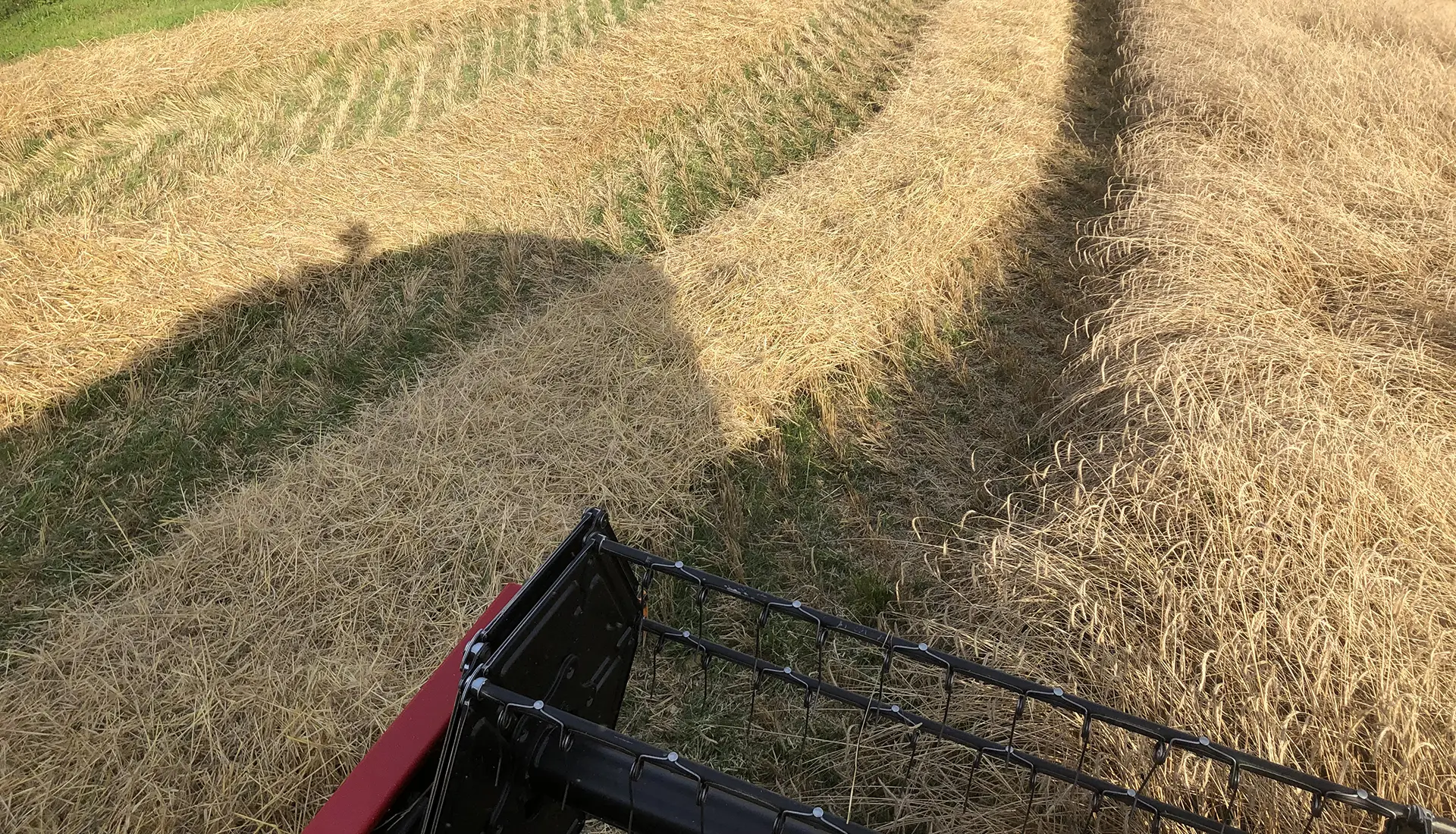
The crop is considered robust, frost-hardy, and undemanding. It is characterised by plants over two metres tall with long ears, small grains, and deep roots. However, perennial rye is prone to lodging. Grains are mainly used for sourdough and wholemeal breads. The green biomass and straw can also be used.
Wheatgrass
The development of wheatgrass is much more recent. In the US, the Land Institute has been trying for decades to domesticate perennial intermediate wheatgrass (Thinopyrum intermedium) as a grain crop. The first food-grade variety, MN-Clearwater, was launched in the 2010s. The products derived from this are marketed under the Kernza® brand.
Wheatgrass develops roots up to three metres deep. As a result, the crop is regarded as particularly drought-resistant and efficient at absorbing nutrients. It was precisely these characteristics that made the crop interesting to researchers in Brandenburg. A field trial has been under way there since 2019, conducted under organic conditions without the use of herbicides, run by Hans-Holger and Andreas Muskolus, Professor of Arable Farming and Crop Production in Organic Agriculture at the Eberswalde University for Sustainable Development.
In the very dry year of 2019, other grain crops on the trial plots ripened prematurely. “Wheatgrass, on the other hand, was thriving,” recalls Hans-Holger. Despite everything, grain yields have so far remained significantly lower than those of modern wheat varieties.

Kernza® crop in May 2021
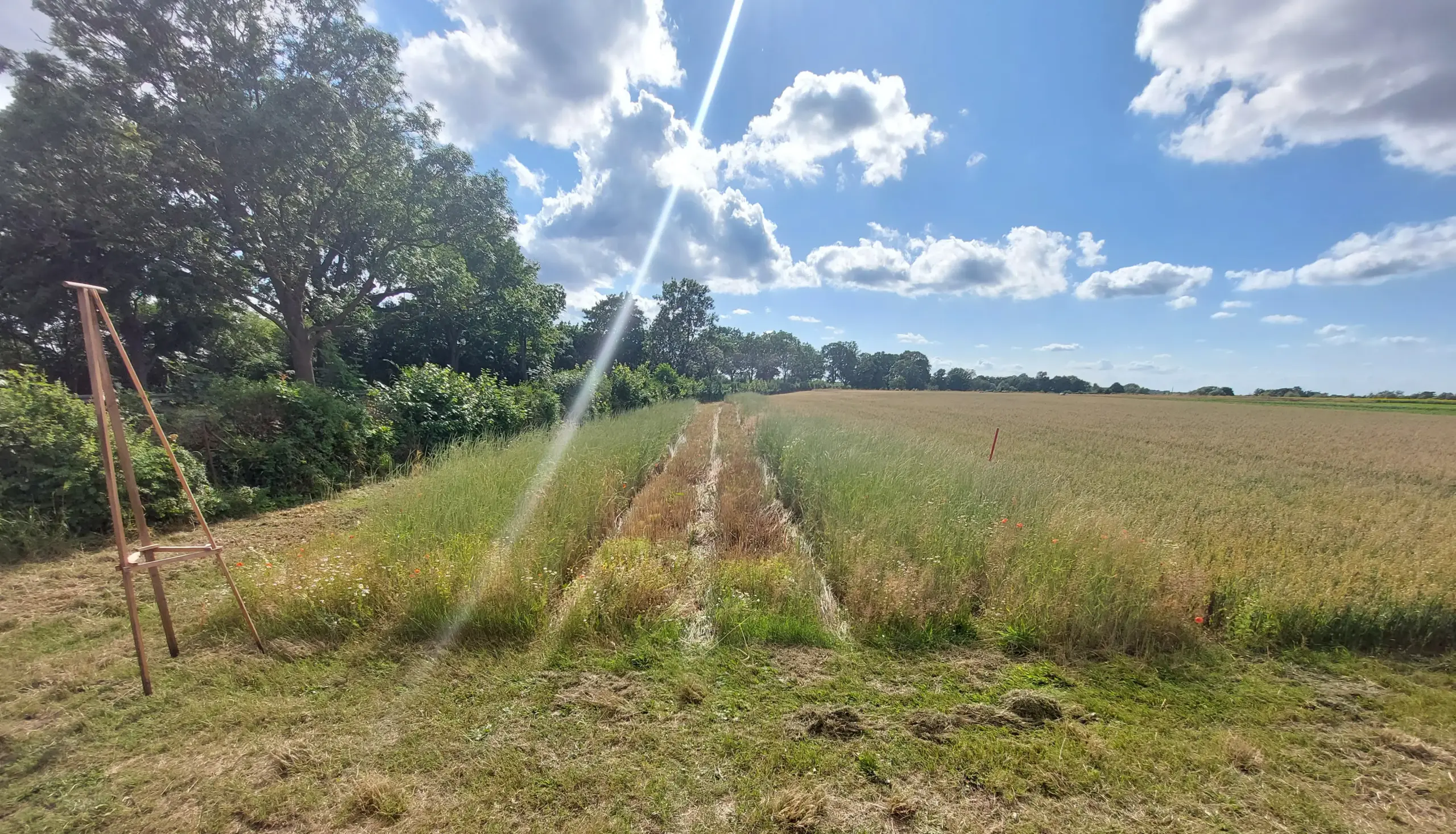
Kernza® crop in July 2021

Kernza® crop at the end of August 2022, shortly before harvest
The crop also presents technical challenges. The grains are extremely small and shatter easily if harvest is delayed. Special timing is therefore required for threshing, similar to that used in grass seed propagation. The experiment provided no evidence of invasive behaviour on the part of the grass.
The grains are high in protein but contain less gluten than wheat. That is why flour from wheatgrass is particularly suitable for mixed-grain breads or speciality products. In the US, Kernza® is already used in bread, beer, and other food products. Within the EU, its widespread marketing as a foodstuff has so far been restricted, as wheatgrass is still undergoing the novel food approval process.
Perennial wheat
In the case of perennial wheat, annual wheat varieties are crossed with perennial couch grass species (Triticum aestivum × Thinopyrum spp.) to combine the baking quality and high yield potential of wheat with the persistence of perennial plants. Although there are numerous experimental lines worldwide, very few varieties are currently ready for the market. The main problem is that yields fall sharply from the third year onwards.
Comparison of perennial grains
Wheatgrass
Perenniality:
3–5 years
Yield:
Low (at best 25% of the yield of annual wheat)
Use:
Flour, speciality products, feed
Strengths:
Strong environmental performance, drought-resistant
Weaknesses:
Low yields, difficult marketing
Current status:
An already well-established niche in the US
Perennial rye
Perenniality:
usually 2 years
Yield:
Moderate (<50% of the yield of modern rye varieties)
Use:
Feed, bread, straw
Strengths:
Hardy, frost-resistant, undemanding, very fast canopy closure
Weaknesses:
Moderate grain yields, susceptibility to lodging
Current status:
Regional niche
Perennial wheat
Perenniality:
usually 2 years
Yield:
Low to date (depending on location and year, between 9 and 96% of the yield of annual wheat)
Use:
Bread wheat
Strengths:
Potential for erosion control, humus formation, soil life
Weaknesses:
Sharp falls in yield from the second year onwards
Current status:
Mainly still at the research stage
Well-documented environmental benefits
The greatest strengths of perennial grains currently lie in their environmental benefits. “Perennial crops have significant advantages over annual crops, and this is primarily down to carbon sequestration in the soil,” says Andreas.
Studies show ecological benefits
- improved soil structure
- water infiltration
- humus formation
- soil life – can create a diverse soil microbiome
- carbon sequestration
- erosion control
- nutrient retention; wheatgrass reduces nitrate leaching significantly more than annual crops
Due to its robust root system, perennial rye is also credited with having a positive effect on soil structure. It ensures fast and intensive root penetration of the soil. In trials involving perennial wheat, organic matter in the soil increased, while the number of earthworms doubled compared with annual wheat.
The price of healthy soil
However, the ecological benefits come at a cost. Perennial grains produce significantly lower grain yields than modern annual varieties. For example, yields from perennial rye are usually only 1–2t/ha, which is less than half the yield of modern rye varieties.
In the Brandenburg trial , wheatgrass yields in the second year of cultivation were 1.25t/ha; roughly a quarter of an annual wheat crop in this location. Thereafter, the yield fell to around 0.7t/ha and, in the fifth year, to 0.25t/ha. It is not yet clear for how long wheatgrass can provide economically viable yields. “Based on our experience, however, it is entirely conceivable that it could be cultivated for seven years or more,” suggests Andreas.


In a project carried out under BÖLN (the federal scheme for organic farming and other forms of sustainable agriculture) on marginal lands in Bavaria, Germany, perennial wheat lines yielded up to 1.7t/ha in the first year. The annual wheat variety Capo did not perform significantly better under very dry conditions, yielding 2t/ha. After that, however, the yields of the perennial lines quickly halved.
At the same time, cultivation requires adapted management. Establishment in the first year in particular is considered a critical phase, as the young plants are initially weak competitors. In return, annual tillage and reseeding are eliminated.
It remains unclear how perennial crops can be meaningfully integrated into crop rotations in the long term and to what extent the positive soil effects are retained after subsequent ploughing. Nevertheless, researchers see potential, particularly on marginal land. “This is interesting because the long roots access water from deeper soil layers,” explains Hans-Holger.
Is cultivation worthwhile?
In the short term, growing perennial grains has so far rarely proved worthwhile. To date, the positive environmental impacts have done little to offset the significantly lower yields, marketing difficulties, and, in some cases, the complex process of establishing the crops.

Nevertheless, these crops can become economically viable if they serve multiple purposes, such as providing grain, feed, and CO₂ sequestration. On poor, dry, or erosion-prone sites, perennial grains still produce yields even with low inputs.
Within the still emerging field of research into perennial grain crops, wheatgrass is currently seen as the most promising crop. Nevertheless, it is still a long way from the productivity of modern wheat varieties. “I can envisage wheatgrass being grown on marginal land, where farmers are considering whether they should continue farming at all,” says Andreas. This could well be of interest to farmers, because there would also be potential buyers.
Verdict
So far, perennial grains have largely lived up to ecological expectations. There is particularly strong evidence of the benefits to soil structure, humus formation, and soil life resulting from permanent ground cover and deep-reaching roots. Economically, however, these crops are still a long way from competing with modern annual grains. Low yields and limited markets are currently preventing a broad breakthrough.
Nevertheless, perennial grains could become interesting in the future where traditional arable farming is increasingly reaching its limits – on dry sites, on land at risk of erosion, or in extensive production systems. Moreover, further breeding, political support, and a growing demand for sustainable products have the potential to increase the future importance of perennial grain crops. These crops are still in the early stages of their breeding development. Some breeders believe it is possible that wheatgrass will reach the yield levels of annual wheat in the coming decades.