‘Only battles that are not fought are lost before they start’. This saying fits well when defending peri-urban agriculture. Judging by media reports, living alongside city dwellers supposedly means disputes, street racing or fly-tipping. The reality is more nuanced and in many cases full of opportunity, provided farmers engage with public life.
Denis and Nathalie Fumery from Sagy, near Cergy-Pontoise, and their son Philémon, who took over the arable farm last year, demonstrate how their family has fought this battle for 75 years.
Insecurity
The Fumery family originally came from the Pas-de-Calais region. “In the 1950s, our father was attracted to Ile-de-France region because there were affordable farms to take over,” recalls Denis.
But the deal did not come without risks, as the rural municipalities of Cergy and Pontoise were earmarked for a major new town project, designed to relieve pressure on the rapidly expanding Paris conurbation. The area’s sweeping bend in the Oise River, before it flows into the Seine a few miles further on, made it the ideal site for a ‘landscape town’.
“My parents had a large part of our original farm expropriated because it was located in the new town,” continues Denis. During construction, the state granted them temporary occupancy status. ”This meant that they could continue to cultivate the land, but the bulldozers could come in the day before the harvest and a building site could be put on top of the crops,” he adds.
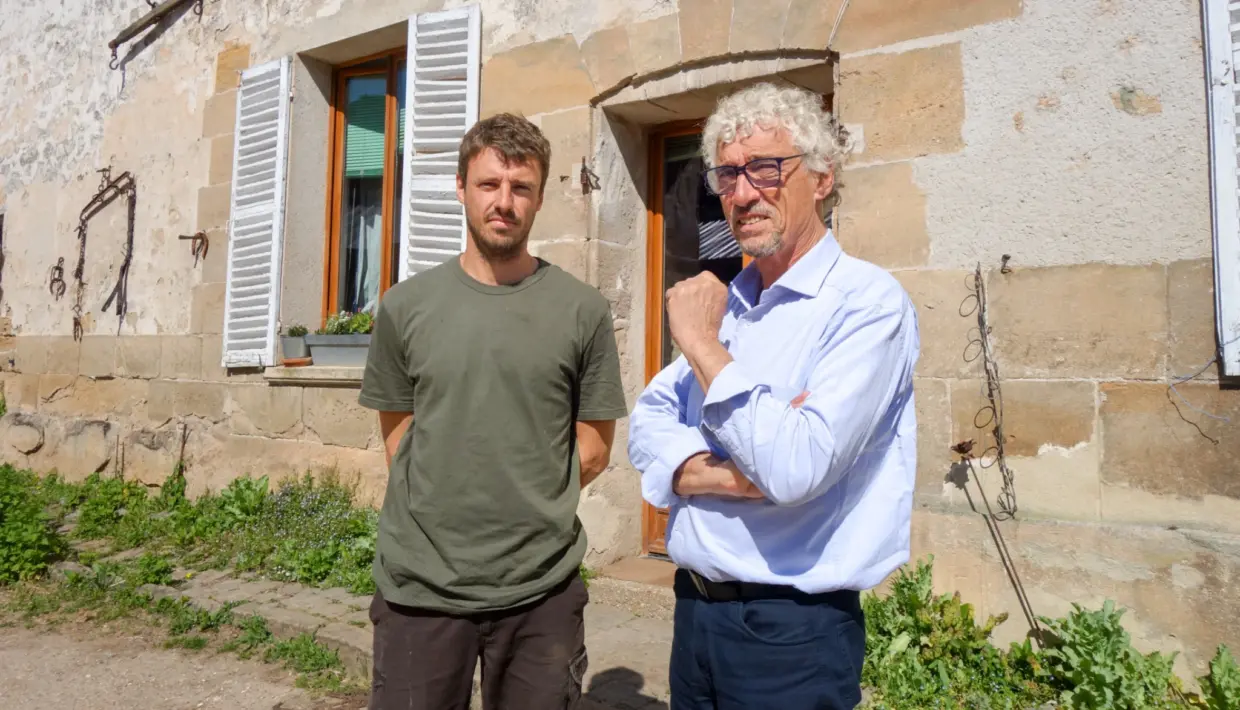
Denis himself had to leave his childhood farm in nearby Courdimanche. ‘I knew I wouldn’t be able to farm my land until retirement and that I’d have to move,” he admits.
Yet none of this deterred him. He had learned the need for flexibility and adaptability that the situation required.
“My father moved easily. So did I, and I did a number of different jobs before settling down at the age of 32”. Farming runs deep in the family, with all six brothers being or still being farmers. Denis and Nathalie have four children, including Philémon, 34, who took over the farm after studying management, gaining experience abroad, and completing an advanced vocational qualification in agriculture at the School of Agriculture in Angers.
Dates about the Fumery family
1950: the Fumery family arrived in Val-d’Oise
1988: establishment of EARL Fumery in Sagy
1995: establishment of the Vexin Regional Nature Park (stopping rampant urban development)
2005: Denis’ farm in Courdimanche relocates to the neighbouring hamlet of Saillancourt
2024: Philémon, son of Denis and Nathalie Fumery, takes over the farm
A peri-urban cereal farm
Fearing an ‘American-style’ urban expansion as the year 2000 approached, local councillors signed a charter creating the French Vexin Regional Nature Park, which covers 98 municipalities across Val-d’Oise and Yvelines. The charter tightly restricts development and recognises arable land as part of the region’s heritage, a win for farmers. Several neighbouring farmers stopped farming and transferred some of their land to Denis. EARL Fumery now spans 220 hectares of well-grouped but highly fragmented land, with 85 parcels averaging 3 hectares each.
Soils range from deep silt to abrasive sand and fairly good clay-limestone soils. After cultivating up to 40% of his land with spring field peas in the 1990s, Denis had to abandon this lucrative crop due to Aphanomyces root rot. Cereals now dominate the rotation, providing straw that is partly sold to a nearby equestrian centre. Sugar beet, spring beans, oats and rapeseed complete the crop rotation. Cultivation methods remain largely conventional, but with an inevitable shortage of future labour as Denis is unable to work as much. Philémon has expressed interest in the benefits of conservation agriculture.

Communication to de-escalate the situation
The Fumery family faces two recurring issues: antisocial behaviour and a lack of public understanding. Fly-tipping, once common, now appears to be declining. Damage to farm equipment still happens, but they have become savvy about it. “We know how to hide our machines,” says Philémon with a smile. Street racing is more persistent. “We’ve had people racing vehicles in our fields,” recalls Nathalie Fumery, “And it’s not easy to go and tell them we’re not happy about it.”
Philémon, 34, was able to talk to the people racing to explain that their ‘playground’ was farmland and the result of hours of work. As for public understanding, Denis puts it simply: ”I take the train between Cergy and Paris quite often for assignments I’m given, like during certain agricultural shows and I’m always struck by the bags of crisps and mass-produced sweets young people eat today. What do they know about farming and locally produced food?”
Who knows if some of these children could potentially be future farmers?
Denis Fumery
Association Rencontre Ville-Campagne
Not one to sit back, Denis devotes significant time to promoting agriculture in Ile-de-France. He is a co-founder of Rencontre Ville-Campagne, an association focused on communication with the general public, especially in schools from primary to university levels, including ESSEC Business School.
“We feel useful because we are listened to. We also have a partnership with the Seeds and Plants Joint Trade Organisation, which allows us to offer seeds to schoolchildren.” A memorable example came in Easter 2019, when the municipality of Neuilly-Plaisance (Seine-Saint-Denis) divided a park into small plots. Denis’ team helped to sow the spring wheat, and families then tended the crops and later baked bread from their harvest. ”Who knows, some of these children might be potential future farmers, NIMAs as we say. I’ve already trained a few.” (NIMA means not from a farming background)
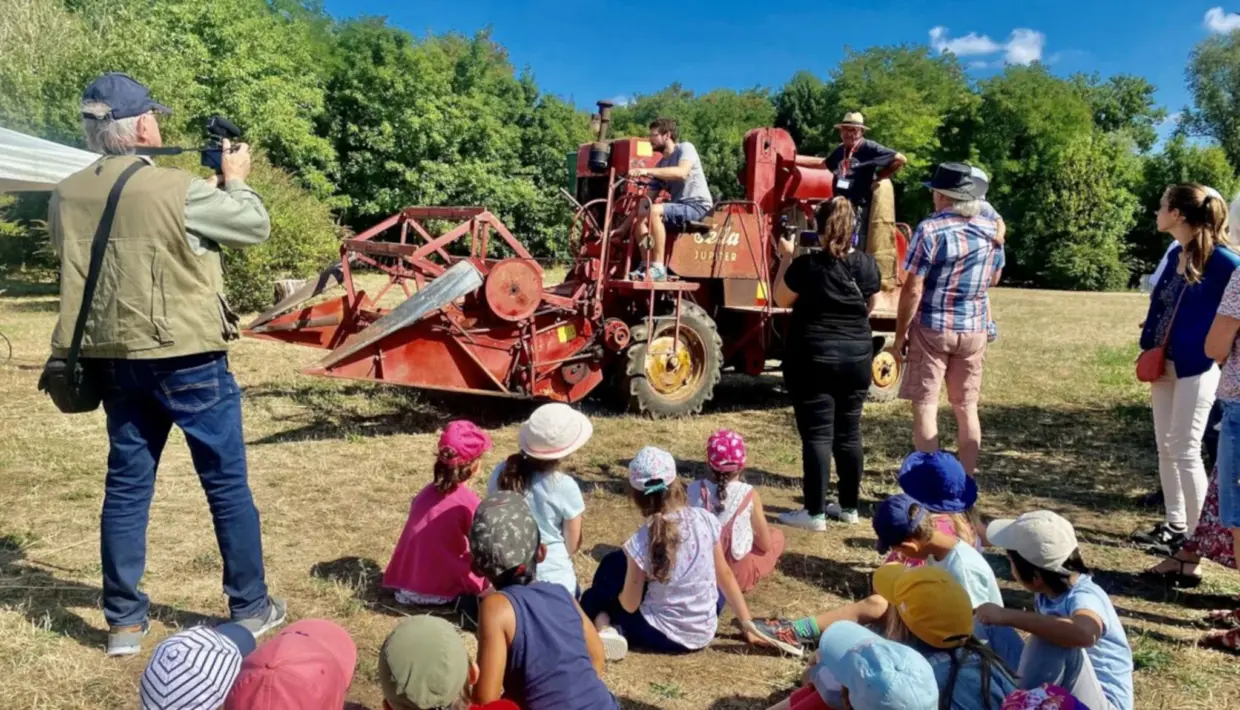
Harvesting in Neuilly-Plaisance, less than 10 miles east of Paris. Denis Fumery advised schoolchildren on sowing spring wheat, and some future farmers among them

Just 15 minutes from the farm, a large equestrian centre has bought straw from the Fumery family for 35 years, taking up to 400 tonnes of straw annually. In exchange, Philémon Fumery receives a large quantity of horse manure, which he composts and spreads across 60 hectares each year.
Straw/manure exchange with an equestrian centre
L’Epinette, an equestrian centre in Boisement, just 15 minutes from Sagy, has collaborated with the Fumery family since 1988. Denis saw the potential early, and L’Epinette has since become one of the area’s most successful riding schools.
In 2001, the two parties formalised a partnership, and EARL Fumery delivers around 2,000 round bales, or 400 tonnes of straw, every year at harvest time. “We have the baling done by a contractor, who generally gets to work 24 to 48 hours after the harvest”, explains Denis, “And we can even wait a little while when it’s baled before putting together the large pile at the riding school”. Philémon then moves the bales every few days with a telehandler.
In return, the farm receives large quantities of horse manure. ‘It’s a very straw-rich waste that needs months of composting or maturation before spreading. While the financial stakes remain limited in Philémon’s eyes, he remains positive. “We receive enough of this excellent organic fertiliser to cover no fewer than 60 hectares every year”.
You can visit the Rencontre Ville-Campagne website at www.agriculteursidf.org