Picture a humanoid robot ambling through poultry houses checking conditions and completing general tasks, maybe even with its own robotic dog at its side. From a distant field, a farmer asks his phone, “Hey McDonald, how are my chickens doing today?” The simple prompt returns a rundown of key information ranging from temperature readings to bird behavior indicating a need for intervention such as a change in feed or a vet visit.
This future isn’t as science fiction or distant as it sounds. Georgia Tech Research Institute senior research scientist and robotics branch chief, Colin Usher, says the components of this reality are coming together at a pace that is fast accelerating. Cost is falling. In 2025 a Chinese company offered a bipedal humanoid robot for sale for less than $6,000. Power needed to run onboard computers is shrinking while computation power is increasing. An internet connection can flash data from barn sensors to data centers providing near-instant results for calculations that used to take days.

Data instead of gut feeling
The use of large language models (LLMs) will likely allow producers to interact with technology using normal language and basic prompts, Usher says. Data gathering and interpretation are critical fronts to advancing functional autonomy in livestock production.
We have data. We want information. How can we tie these points together to tell a story and make a decision that will have an impact down the road.
Suzanne Leonard
“We have data. We want information. How can we tie these points together to tell a story and make a decision that will have an impact down the road,” says Suzanne Leonard, North Carolina State Univ. Extension specialist. Information also has to be economically valid. Individual bird feed conversion isn’t likely to be valuable for commercial producers. Sensors to evaluate environmental conditions in the pig barn to optimize health and decrease mortality is a much easier sell.
AI detects problems at an early stage
Guoming Li, Univ. Of Georgia poultry engineer, sees near-term potential for computer vision monitoring of gait scores and other behaviors in broiler flocks. AI and deep learning models can gather and analyze behavior metrics in week two that can predict gait scores in week seven. “We can use early prediction to make nutrition or other corrective strategies to improve gait, which will possibly improve welfare and productivity later,” Li says.
We can use early prediction to make nutrition or other corrective strategies to improve gait, which will possibly improve welfare and productivity later.
Guoming Li
Computer vision levels the board for experience. A veteran producer may notice subtle behavioral signs a fresh hire may not. “Sensors and computation provide more objective, accurate, and consistent evaluation,” Li says. Tech can also literally be an extra set of eyes. NCSU scientists are seeking funding to advance a camera system to monitor farrowing.
Instead of a human constantly checking 50 farrowing sows, the monitoring system keeps track. If a sow is doing her job and delivering every 10-15 minutes, let nature take its course. But if the system determines it’s been too long between piglets, it will alert for human intervention. “Technologies like these can help humans optimize how we spend our time,” Leonard says.
Robots take over routine tasks in the barn
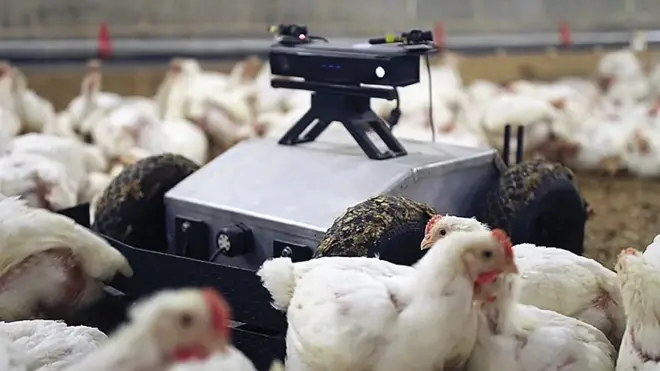
One such technology nearing commercialization is a Georgia Tech robot that collects floor eggs in broiler breeder houses. It’s an important, but simple and time-consuming task. If you don’t pick up the eggs, more eggs get laid on the floor, Usher says. It’s simple labor, but labor and time are a commodity in short supply.
A lot of work has been done on robots working with humans, not a lot has been done on robots working with animals.
Colin Usher
Usher notes the importance of secondary functions for industry-wide adoption of robotics. The egg collector, for example, could also collect mortalities, haze chickens to nests, encourage new chicks to feed and water, and monitor barn conditions. “The robot is using AI algorithms to look at the scene as it’s driving around. Why can’t the camera system also evaluate chickens, feeders, drinkers, and more?” he says. Interaction between animals and robots is a challenge. The egg collecting robot had to be trained to ‘play chicken’ to clear a path. “A lot of work has been done on robots working with humans, not a lot has been done on robots working with animals,” he says.