A change in the weather, with a longer period of rain, is forecast for the coming Sunday. For this reason, farmer Stefan Jacobs from Losheim am See decides to bring forward the silage corn harvest for his cows, even though the plants have not yet reached full maturity. But once the heavy soil becomes soaked, the fields may not be passable for a long time, and he isn’t willing to take that risk.
Here in western Germany, close to the borders with Luxembourg and France, the fields are small, hilly and irregularly shaped. After a wet growing season, the corn stands tall, and under today’s sunny skies, conditions are ideal for harvesting.
In total, 30 hectares of corn across 15 fields are to be harvested on the day’s schedule.
A SPFH operator is actually a tinkerer.
Laurin Müller
Living a childhood dream
Laurin Müller is at the steering wheel of the forage harvester. As a teenager, he helped out a lot on a friend of his father’s farm, often operating tractors during the chopping season. He had wanted to become a farmer himself, but with no family farm to take over, he chose another path.
After completing his Abitur (A-levels) at a technical high school after finishing secondary school, he went on to study electrical engineering. Eventually, he joined John Deere in Zweibrücken where he now works on the development of the SPFH cab.
Operating a John Deere forage harvester for a contractor in his spare time allows Müller to live out his childhood dream while directly complementing his main job. Consequently, he knows first-hand exactly what a forage harvester operator needs.
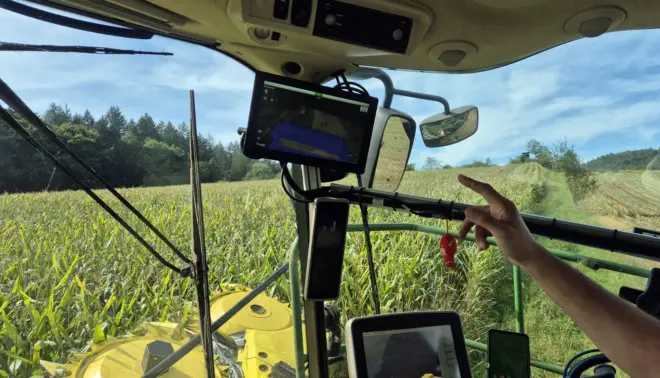
After finishing the last rows of corn on a sloping plot, he moves on to the neighbouring field, which borders a forest. Before starting, he checks his monitor and spots fruit trees on the opposite edge of the field. “Since we have integrated Google Maps into our monitor, it is much easier for operators to identify obstacles early on,” he explains.
Functional test in practical use
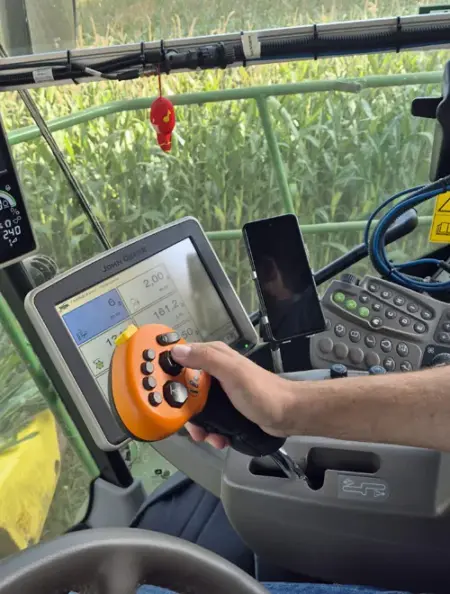
The John Deere 9900i SPFH that Laurin is operating today was built in 2019 and belongs to a local contractor. The region is characterised by small fields and limited budgets with customers rarely willing to invest in as advanced features like surveying field boundaries, yield maps, or analysis or crop ingredients. Nevertheless, Laurin has equipped the machine with all the additional technical components, including Harvest Lab and the latest-generation displays. This lets him field-test the software and the touchscreen’s programming. He has already gathered numerous valuable ideas for his work, such as user-friendly positioning of touchscreen controls.

Thanks to his work at John Deere, Laurin can equip the contractor’s forage harvester with the latest components and features.
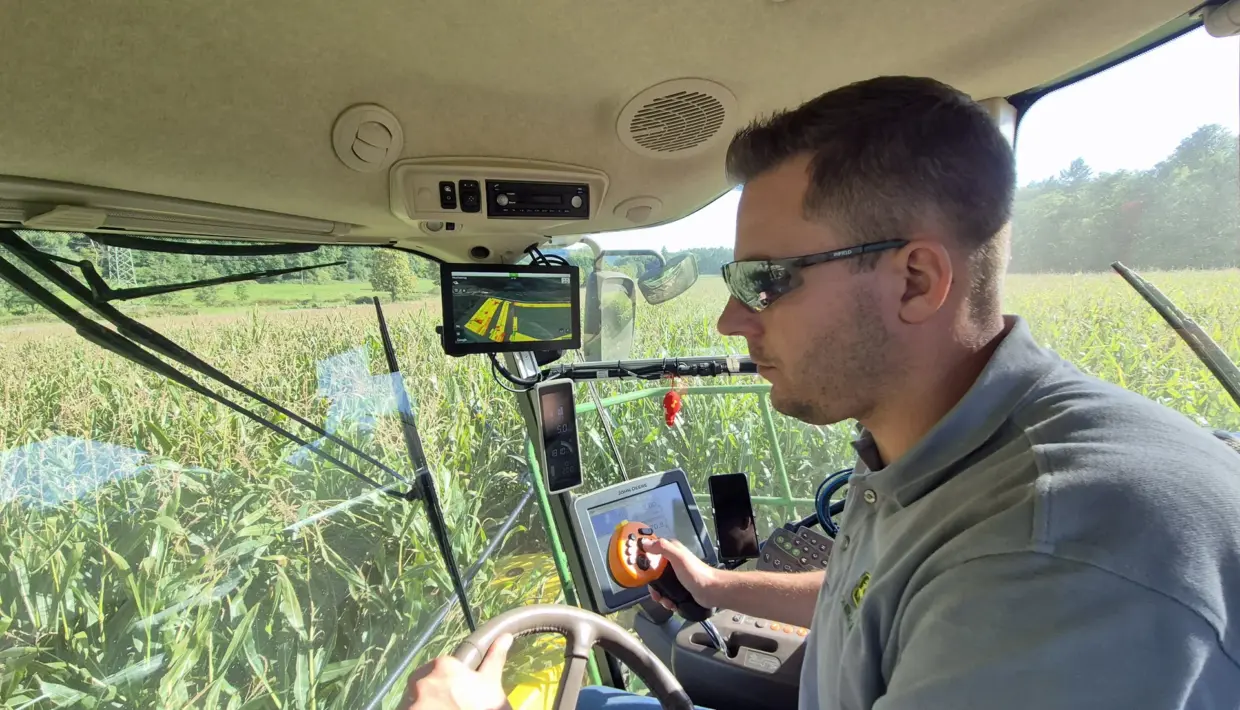
His practical, hands-on experience of chopping helps him develop ideas for even greater user-friendliness.
The SPFH is also fitted with the MachineSync system, which allows it to control the tractor driving alongside, making crop transfer far easier. Today, however, the collection trailers are not pulled by John Deere tractors, so Laurin must rely on the discharge spout camera to load the wagons optimally. As is quite common in this region, one trailer is driven by the farmer, while the contractor’s employee operates the other. The three-man team works together seamlessly, and the loading runs smoothly.
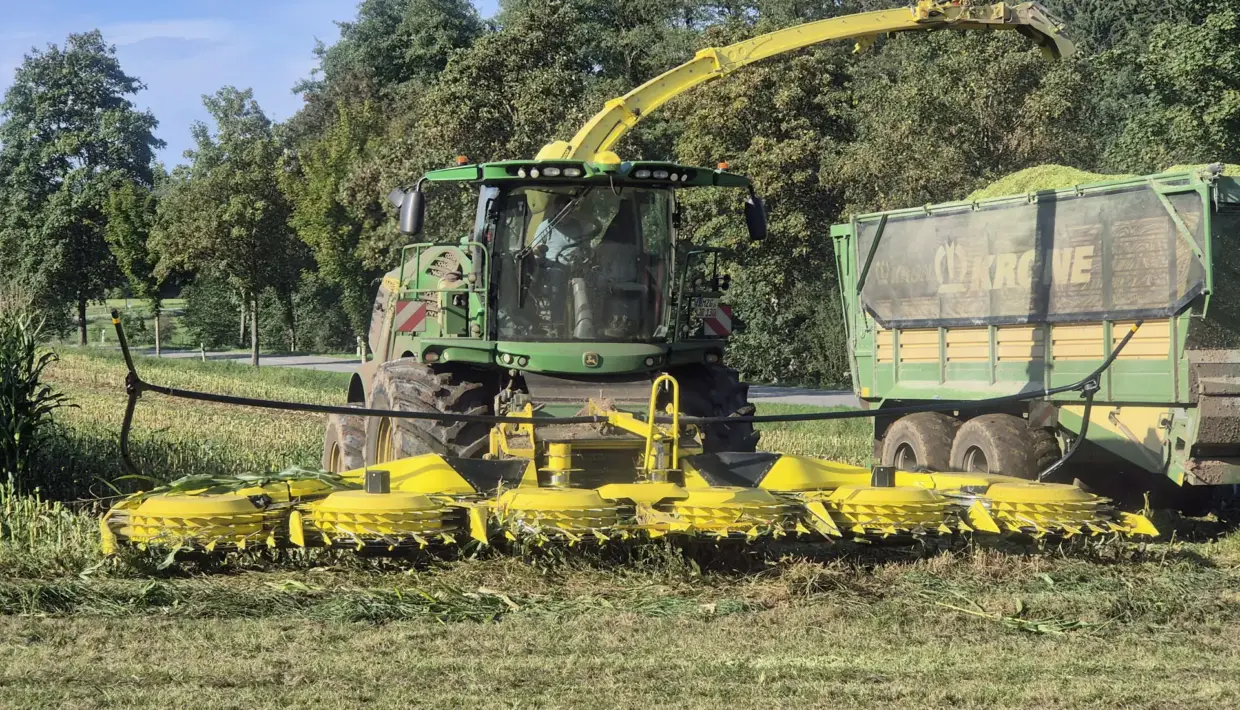
The operators form a well-coordinated team, ensuring smooth filling of the collection trailers.
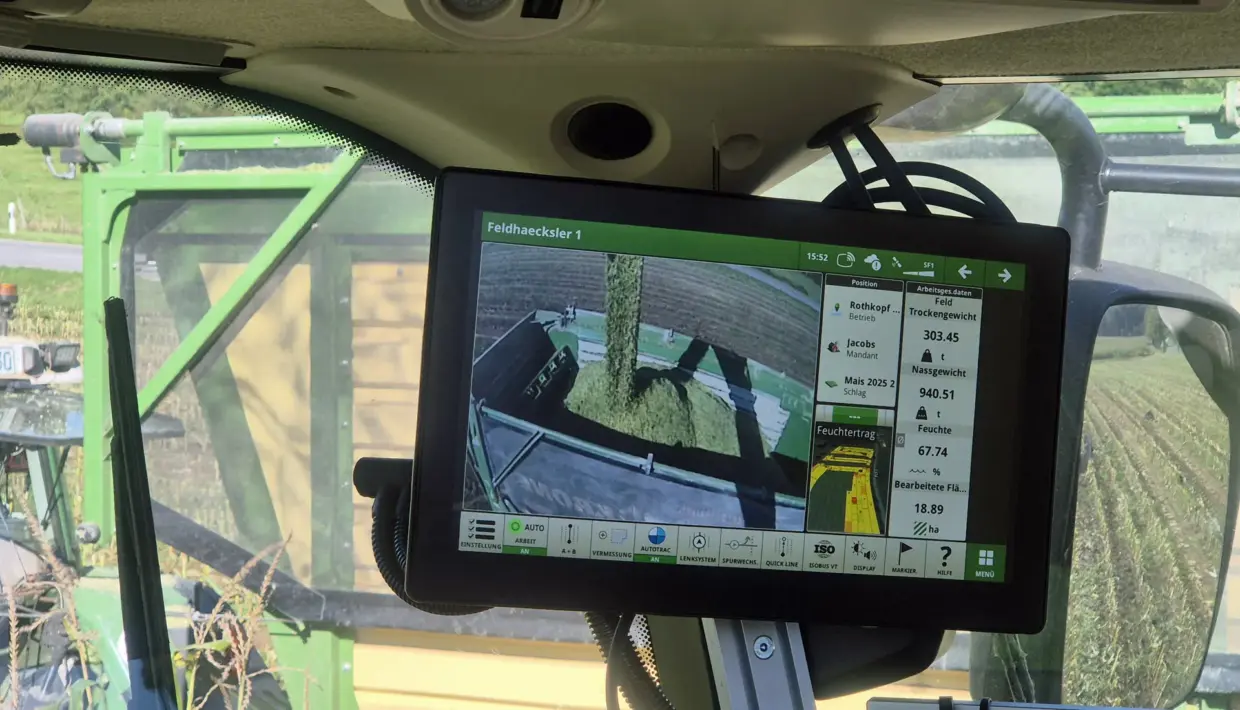
The camera on the discharge spout helps Laurin optimise loading precision.
Tinkerers in the forage harvester cab
Back at John Deere, Laurin assists his colleagues with field trials and is also responsible for the further development of the additive dosing system, in addition to the SPFH cab.
Both as an operator and during testing, he noticed that microorganisms in the additive can clog the dosing system if not cleaned immediately after use. “For this reason, the new F8/F9 field chopper generation has been equipped with a freshwater tank. Now the system can be flushed in the field,” explains Laurin.
“A field SPFH operator is actually a tinkerer”, Laurin continues. “As the machine is subjected to such heavy use, there are many wearing parts that have to be replaced repeatedly. I always keep a set of overalls in the cab.
His penchant for tinkering and problem-solving is also evident in the cab layout. He constantly evaluates details such as the positioning of the additional display in the upper-right corner along with the ergonomics. The mobile phone holder to the right of the control console is also not yet available on standard machines – whether it will ever be provided will be determined by an extensive evaluation process at John Deere. In any case, working as an operator in his spare time helps Laurin Müller better understand his customers’ requirements and provides him with valuable insights for his main job as a development engineer.