“The world is focusing on regenerative agriculture and food nutrition. I really hope it is, because that’s the way that we are pushing,” says Chris, who runs his contract farming partnership, Cloud Farming, alongside James. Based in central and southern Scotland, they manage over 600ha of land and put a strong focus on cover crops. With such a wide area under their custodianship, the duo work with a range of soil types, whilst also having significant climatic challenges to contend with.
Planning crop rotation according to soil and climate
For two decades, Chris’ experience of farming was about pushing for the biggest yields, operating min till and no till systems. But it was a move to East Lothian that prompted a change in tack. The new farm Chris started working for had an interest in environmental farming. “It was early days and we hadn’t quite got the soil to the stage it needed to be,” he says. By focusing so much on the ‘no till’ methods, he realised they were missing something more important. “It isn’t about the no till, the machine or what you apply to the crop. It is really about the cover crop and the soil and getting that right.”

The region has a reputation for harder ground, with a lot of stones to contend with, as well as red clay soils which can be very dry, particularly in spring due to prevailing winds. In addition, some of the farms they manage further north have a much cooler climate, meaning farming becomes more challenging. For example, many nitrogen fixing cover crops like clover simply won’t grow in colder climates. Likewise, machinery needs to be carefully considered and adaptable to the different conditions.
Having tested several drill systems, Chris and James eventually settled on a John Deere 750A. At 6m wide, it can cover ground quickly, which is useful when drilling windows are tight. “Timing is absolutely critical,” says Chris.
Crop rotation at Cloud Farming

Finding the right cover crop
When planning cover crops in rotations, the previous crop, soil type, soil quality and climate must all be factored in. “We’re constantly analysing,” remarks Chris. Working closely with agricultural research organisations in the UK including the Agricultural Development Advisory Service (ADAS) and Yield Enhancement Network (YEN) helped him to explore crop rotations in more detail.
Having tried several techniques when sowing cover crops, including broadcasting from the sprayer and from straw rakes, it was a learning trip to France that really opened the pair’s eyes to the options available.


In France, legislation requires ground cover until Christmas, which has led to extensive cover crop trials. Chris and James witnessed different establishment techniques firsthand, from drones and disc drills to tine drills and power harrow combination drills. The variety of crops grown and the resulting soil structure was mind blowing, says Chris.
Further learning at conferences led them to discover other useful cover crops – for example, Ornithopus (bird’s foot trefoil). A fast growing, dense rooted nitrogen fixing plant, it helps to improve soil structure and support nutrient cycling.
Cover crops are grown to:
- Protect soil
- Suppress weeds
- Fix nitrogen
- Improve soil structure
Cover crop choice isn’t just a case of ordering a bag of seed – you need to design your crop, thinking about what will work on your soil, in your conditions. Ultimately, it needs to suppress weeds, prevent pest infestations, and either protect an existing crop (when cover is sown before harvest) or benefit your soil.
Redesigning crop rotations
Armed with valuable information on cover crop options that can survive the winter, Chris has adapted his planting regime to suit conditions. Now in its third year, it includes a mix of beans, winter hairy vetch, Ethiopian mustard and Ornithopus.
The beans were previously grownas a cash crop, but inconsistent yields (ranging from 2-7t/ha) and tight margins meant it wasn’t financially viable.
“We grow food as a business” states Chris. They grow spring milling oats, spring and winter milling wheat and seed barley, as well as conventional oilseed rape (OSR), for a deeper rooting crop. OSR can also be harvested earlier, allowing time to establish a good cover crop, taking care of slugs and boosting soil biomass. This is particularly beneficial for one client who makes their own whisky; growing spring barley after OSR and a cover crop enables minimal inputs.
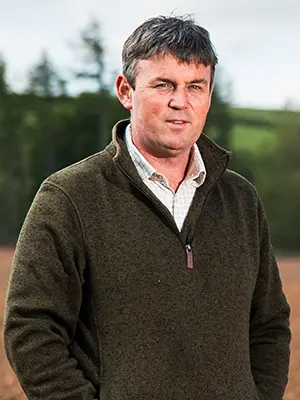
It isn’t about the no till, the machine or what you apply to the crop. It is really about the cover crop and the soil and getting that right.
Chris Leslie, farmer and co-founder of Cloud Farming
Managing a predominantly spring cropping system, rotations look different for Chris now. For the past two years they have been using a secondhand Horsch CO to establish cover crops as quickly as possible after harvest, and they’ve been ‘ruthless with rotations’. They direct drill wheat after spring oats, and / or plant a cover crop after OSR, spring barley and spring oats.
The selection of cover crop species is crucial for Chris, who is trying to move away from chemical use. Brassicas and beans are helpful with soil structure and securing nitrogen, and there’s no need to apply chemicals to kill them off, as they can be managed with cultivation. Vetch is great at out-competing weeds due to its linear growth, while broadleaved cover crops reduce grass weeds.
For Chris and James, the ultimate goal is maximising soil organic matter and nutrients, to benefit the next crop using a mulching and discing system. Using a crimper knife roller, they chop to around 50mm (the optimum length to benefit soil microbes and ensure quicker nutrient cycling). They follow this up with a disc to help incorporate nutrients into the soil before mulch drilling the next crop.
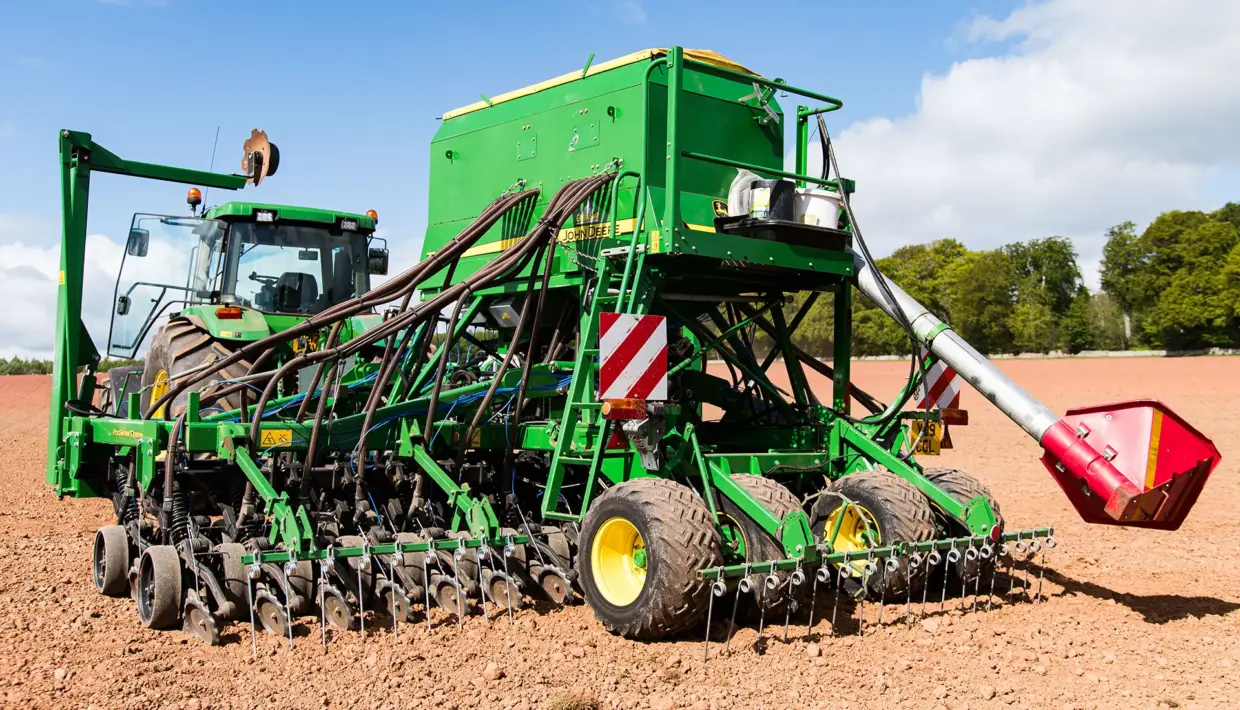
After testing several drill-sowing systems, Chris and James finally opted for a John Deere 750A.
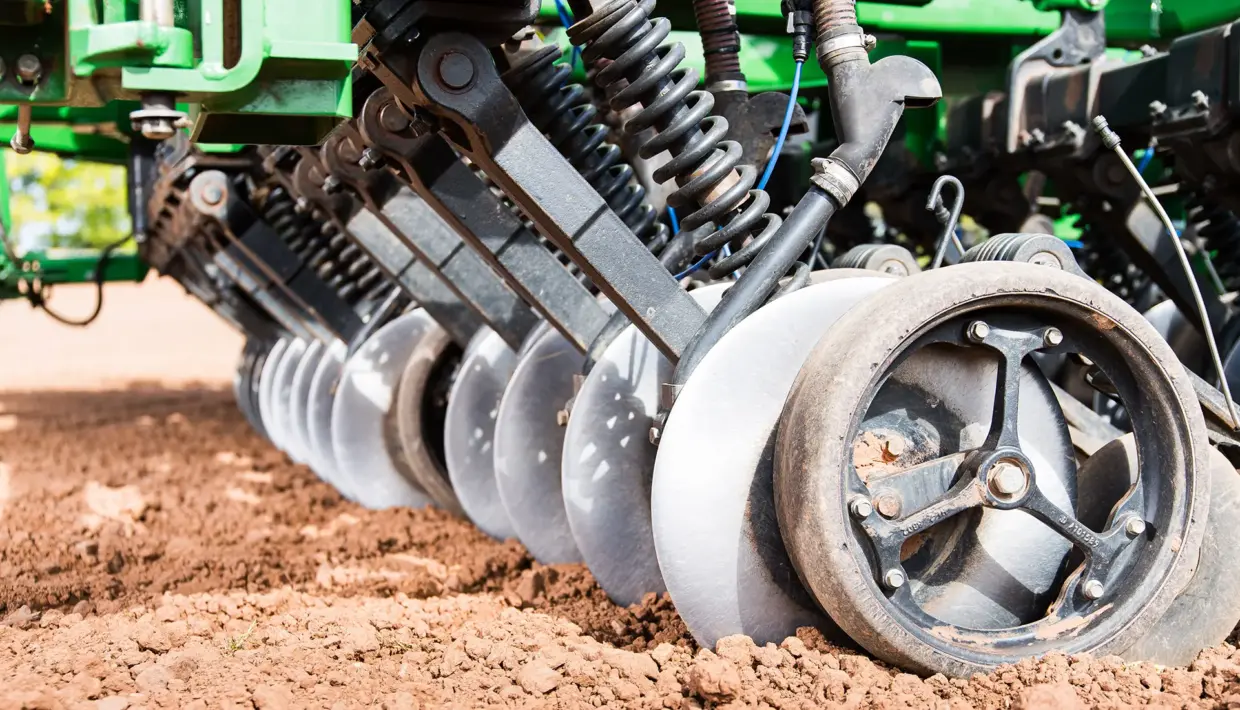
Close-up of the 750A’s single-disc openers and depth gauge wheels. The opener design allows the drill to work in both no-till and low-till conditions.

Vetch is great at out-competing weeds due to its linear growth.
For every cover crop, the carbon to nitrogen ration is crucial, and mulching is a good way to optimise this. “We are trying to feed the ground, understand the soil and microbes, and what cover crops we can grow, so that we don’t need to apply as much artificial inputs,” says Chris. “Our goal is to grow crops without additional nitrogen.”
People think we can put more on and get a better result – you can’t. The answer is not in a can. Instead, they should look at growing their own nitrogen. That is key to farming in the next decade, as far as I see.
Chris Leslie
When it comes to establishment, their biggest success was broadcasting OSR into a standing crop of wheat. This enabled the OSR to establish so it was growing away once the wheat was harvested. The duo have also had success direct drilling wheat after spring oats. This mixes high amounts of carbon from the oat stubble into a very shallow surface – which uses up nitrogen as it decomposes, reducing weed growth. However, with open structured crops like OSR, it’s better to sow cover crops like beans and vetch in one pass, as slugs don’t tend to touch them.
Evolving this set up has taken plenty of trial and error. For Chris, the biggest failure came from planting wheat after OSR, given the short window for applying pesticides to manage slugs. Here, the only options are using slug pellets (not very environmentally friendly), or cultivation – which on the stony land presents other issues.
Less fertiliser, better soil: the benefits of cover crops
Chris’ efforts and investments in cover crops could be considered a lot, but Chris believes it’s worth it. Sowing a cover crop in winter protects the soil, supresses weeds and fixes nitrogen, while also improving the soil structure and health, and providing an excellent seed bed for spring drilling. These benefits can then be seen in subsequent cash crops, with excellent establishment and cheaper crop nutrition.

Chris calculates that on a fresh weight basis their cover crops deliver about 80kg/ha of nitrogen, 100kg/ha of potash and 40kg/ha of phosphate. “We’re getting to the stage that in two to three years’ time, we might be able to grow a crop with no artificial inputs.”
But it’s important to keep an eye on soil structure with continued use of no-till, he warns. “After all, you need tilth, oxygen in the soil, and an uncompacted 10-inch layer. Compaction is a killer.” Therefore, he isn’t averse to subsoiling or applying gypsum when needed to help improve soil structure and add additional nutrients.
Another chemical Chris is keen to move away from is glyphosate – which is why he has explored other ways to destroy the cover crop. In his view, growers of the future should avoid the ‘more-on approach’. “People think we can put more on and get a better result – you can’t. Instead, they should look at growing their own nitrogen,” he says. “That is key to farming in the next decade, as far as I see.”
About Cloud Farming:
- Based in central and Southern Scotland
- Regenerative farming business
- Work in partnership with growers
- Manages over 600ha of cover crops, alongside cash crops
- Website: Cloud Farming Ltd
Further information:
Follow Chris’ journey on TikTok @farmingdaft