
 Loading...
Healthy soil and sufficient fresh water are essential for agricultural production. Both receive ample attention at Hoeve Lotmeer, Klaas Schenk’s farm in Anna Paulowna, North Holland. In 2002, Klaas changed course and significantly reduced his acreage. Of the 90 hectares he farmed, owned and rented, he kept just 30. It marked a shift from large-scale production to farming from the ground up.
”We do a lot of soil management,” he explains. ”We keep the land covered all year-round, so soil life is less affected by weather conditions. We have stopped ploughing and are using fixed travel paths.”
The supply of fresh water is coming under increasing pressure and then you are at the mercy of nature.
Klaas Schenk
1-in-4 potato rotation
These management choices benefit soil life, organic matter and ultimately boost crop growth. But on rental plots, Klaas met limitations.
”We were in a 1-in-3 rotation on these plots: two years of maize and then one year of potatoes. A much more intensive crop rotation plan than the 1-in-4 we use on our own land. I saw that reflected in the cultivation; I was leaving 15% of the yield behind.” For seed potatoes, his main crop, that loss adds up quickly.
The farm’s coastal location offers ideal conditions for growing high-quality seed potatoes.
Temperatures are moderate, and the wind reduces aphid pressure. It is a labour-intensive crop that provides year-round employment.”
His cropping plan is supplemented with seed onions, wheat, and newer crops like sweet potato. Seed potatoes and onions, in particular, pose challenges for crop protection. ”The chemical package is rapidly shrinking, and the remaining agents have an increasingly narrow scope of action. Weed and pest control becomes more difficult as a result.”
Dutch seed potatoes are exported globally and must meet the very highest standards. ”That’s why we have been working on functional agrobiodiversity for 15 years. With flowering field edges, we encourage natural enemies.”
More conscious choices
The biggest challenge, says Klaas, is trusting the natural balance. ”It means not intervening too quickly, but that is difficult with the zero-tolerance policy for seed potatoes. We cannot do without chemicals completely.” Still, he sees usage dropping sharply thanks to intensive monitoring and intervening only at certain thresholds.


”We use sticky traps and collection trays for this purpose. Technical developments are advancing rapidly. Soon, camera technology and AI will allow you to see in real time what is happening in the crop. That will help us act faster and more precisely. Modern tools provide guidance to make more conscious choices.”
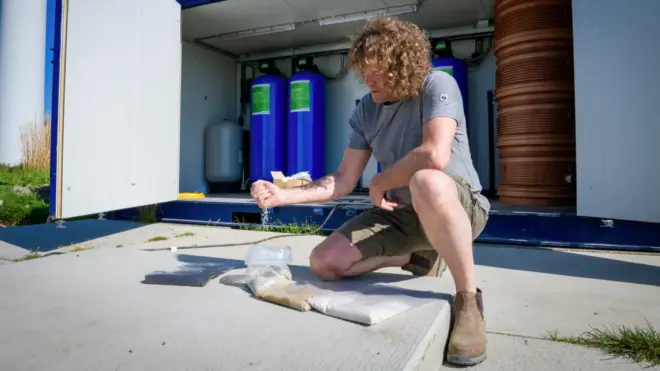
A striking example is the farm’s water and nutrient management system. Over the past five years, Klaas has built a sustainable water system through the Freshwater Farmers project, making the farm virtually self-sufficient. ”Climate change means more drought and greater risk of salinisation. Our polder is located at the end of the water board’s system and is the last to receive fresh water from the IJsselmeer. That supply is increasingly under pressure, leaving you at the mercy of nature. There is more than enough rainfall each year to grow our crops, but much of it falls during the period when we don’t need it. So you need to store the water.”
Underground storage
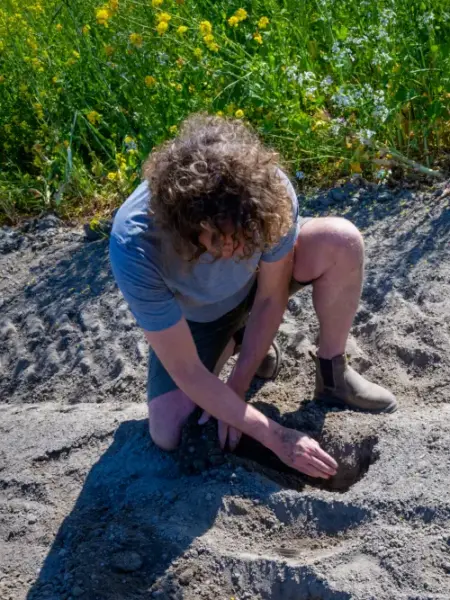
Water can be stored above or below ground. But above-ground basins take up a lot of space and pose problems during storms. That led Klass towards underground storage, an approach already tested in the region. At a depth of 25-30 metres, he found a suitable soil layer for storing water. A well was drilled, allowing up to 30,000m³ of water per year to be pumped down for storage.
”Think of it as a kind of balloon that inflates and displaces the salt water,” Klaas explains. “We do that in the autumn and winter. In spring and summer, we reverse the process and can extract about 95 per cent of the stored water again.”
To achieve this, he adapted his drainage system to store water rather than drain it. Drains were installed 1.10 metres deep and isolated from surrounding waters. They are part of a level-controlled system that allows him to regulate the freshwater lens beneath the fields.
“When it is wet, the excess water flows into the basin. The water basin is equipped with a sand filter that removes organic compounds and an activated carbon filter that removes chemical compounds, such as crop protection products. Finally, a UV filter was installed to kill bacteria and fungi. We are almost making drinking water. Such cleanliness is not necessarily required for our crops, but now we are sure we are not polluting the groundwater.”
Crop monitoring
Crops are irrigated from below through the drains and from above via drip irrigation. Nutrients are added through the drip hoses, typically, three times a week. “Crop monitoring happens on three fronts – soil moisture sensors, satellite and drone imagery, and lab analysis of crop and soil samples.” Based on this data, a model is being developed that allows to provide the right amount of water and nutrients at the right time.
With our water system, we can mitigate the effects of the weather and minimise crop stress as much as possible.
Klaas Schenk
”A potato can produce its yield in 100 days,” says Klaas. Depending on the (weather) conditions, it sometimes takes 90 days, other times 140 days. With this water system, we can mitigate the effects of the weather and prevent the crop from experiencing stress as much as possible.”
The system allows Klaas to farm in a fully circular way. In the unlikely event that he must discharge into surface water, he can filter 10 m3 of water per hour. In heavy rain, if pressure builds in the system, the excess is cleaned before reaching surface water.
Year-round moisture
Klaas can also anticipate the weather forecast and drain water in advance if high precipitation is expected.
”With a high-risk crop like potatoes, you do it sooner than with grain, but it’s possible.” It made him not only a farmer but also a water manager.
”It’s nice to have a grip on something we never had control over before. We have many more options to control things. Moreover, we can keep the soil moist year-round. This ensures that during heavy rainfall, we can drain the water more quickly, thanks to the soil’s sponge effect.”

The foundation of his system is solid, he says. ”It is now a matter of fine-tuning and learning to manage all the different parameters. Then yields may increase.”
The investments mean his cost price is roughly 35% higher, but he pushes ahead.
“We have to do things differently than my father and grandfather did. Growing with minimal impact on the environment. To achieve that as a sector, we also need our surroundings. Customers, governments, financiers, society. It is a collective effort. As an industry, we are part of society. In many ways, we can be part of the solution, but we cannot do it alone.’