
 Loading...
When you think of Canadian agriculture, you imagine the vast expanses of the prairie provinces, like Saskatchewan, where the average farm size is 720ha. However, most farms are located in the province of Ontario, where agriculture is small-scale by Canadian standards, with farms averaging 98ha according to the last agricultural census (2021). Large or small, 97.3% of all Canadian farms are family farms, says Kelly Daynard, executive director of Farm and Food Care Ontario. “And we’re very proud of that.”
Theiler Farms is located 25 minutes by car south-east of the capital Ottawa in Eastern Ontario, a rather flat region strongly shaped by agriculture with many dairy and arable farms. Straight roads cut through the landscape as if designed on a drawing board. The farms are spaced far apart along this road and can be reached via an access road, next to which a Canadian flag always flies. The farms are surrounded by meadows and fields, and many of them have the tall silos typical of North America. The four silos on Theiler Farms rise up to 30m into the sky. “They store lucerne, grain with a residual moisture content of 27%, and 900t of chopped corn (maize),” explains farmer Josef Theiler during a tour of the farm.
Farms fly the flag
Most of this is animal feed for the 70 Holstein dairy cows in tethered housing, which is permitted in Ontario, as long as the cattle are outside for two months of the year, says the 37-year-old farmer. There are also 550 Swiss Saanen dairy goats and 380 young animals that are expected to produce milk in a year’s time. The farm includes 200ha of agricultural land, of which 80ha are leased. “In a typical year, there are 60ha each of soyabeans and grain maize, around 20ha of winter wheat, and grassland for hay and silage.” The straw from the winter wheat is baled and used as bedding for cattle and goats. In good years, Josef can sell around 100t of soyabeans and 200t of surplus grain maize on the market.
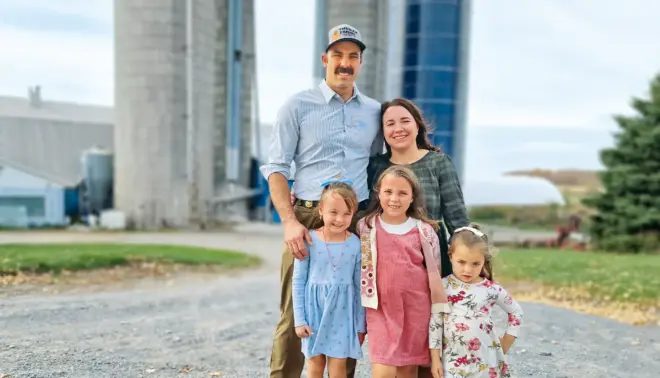
Milk quota and a thousand goats
Josef does not breed his own dairy replacements. “It doesn’t make economic sense; if I need a new cow, I’ll buy a two-year-old one.” The cows produce around 36 litres of milk per day, at 3.2% protein and 4.2% fat. “We feed for a high fat content, which is very popular in Canada.” Canada operates a quota system (per kg of milk fat), and the milk price is set in advance depending on the season and market situation. Theiler Farms can supply 90kg of butterfat per day at a current purchase price of $0.95 CAD (£0.51) per litre of milk (as of October 2025).
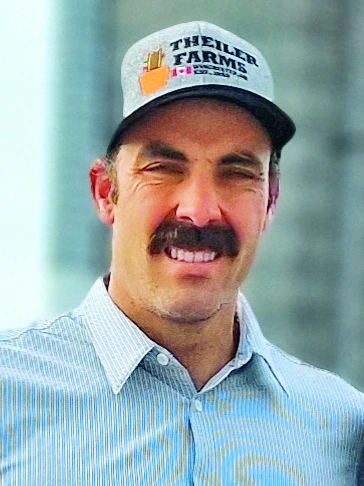
As a smaller farm, you have to be able to improvise.
Josef Theiler
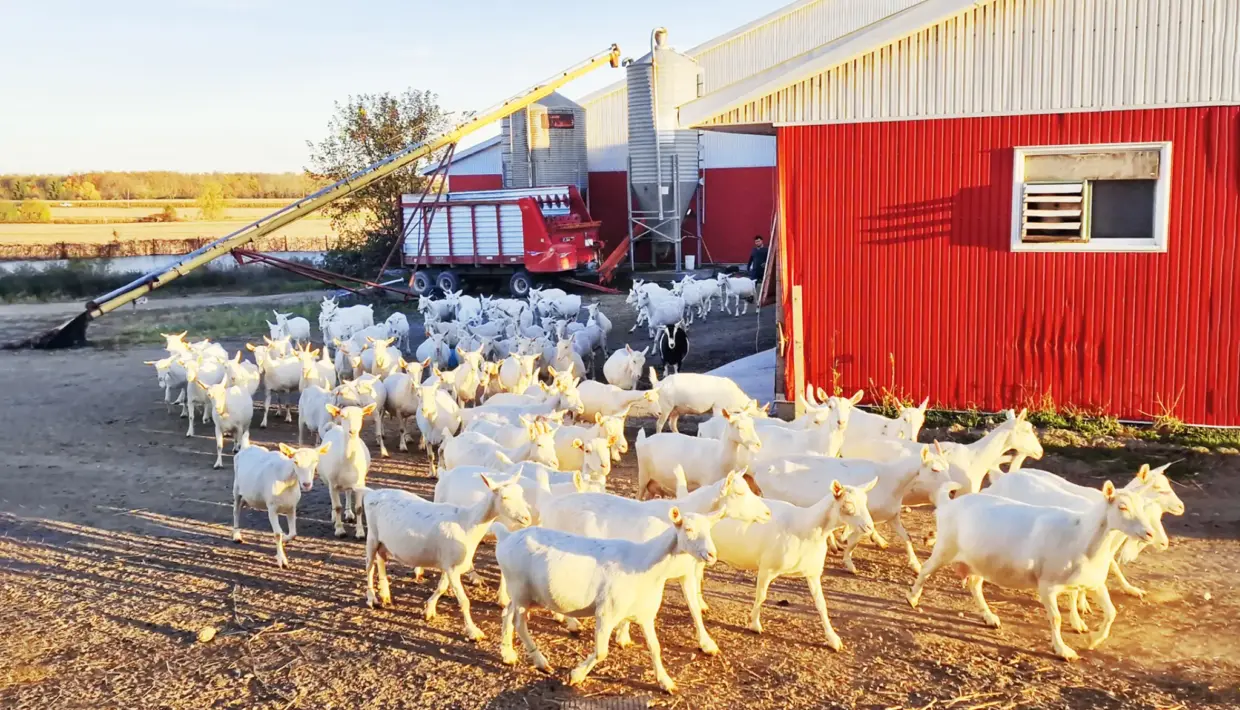
“The fixed purchase price creates income security,” he says – and room for experimentation. Josef leased a dairy farm five kilometres away, which was abandoned due to the lack of a successor. He converted the 8 × 8 milking parlour designed for 150 dairy cows into a 20 × 20 milking parlour for goats. He also bought another abandoned dairy farm just one kilometre away. The buildings, like the barn with a hipped roof, date back to the early 20th century. He plans to renovate the buildings eventually, when the goat farm requires more space – the goal is to milk 1,000 dairy goats one day. “The potential is there; the demand for goat’s milk is high and exceeds supply – and unlike cow’s milk, there is no quota.”
Josef enjoys going to auctions to purchase used machinery and equipment. “There is a lot of old equipment; more and more of the smaller farms are closing down, and the larger ones are expanding and require different technology.” In order to survive as a smaller farm, you have to be able to improvise, he says. He enjoys tinkering and inventing technology that makes his work easier, or delegating tasks where possible.
He is particularly fond of his “backpackers”, as he calls the young people who have been coming to his farm from all over the world for many years to work with him in return for food, accommodation, and a family connection. Some bring valuable expertise with them, in which case they also receive pocket money. For some years now, he has also employed two people from Guatemala, along with his colleague Walter Vandekemp, who combines his crops, and his neighbour Tim Moher.
Maple leaf, a Canadian symbol
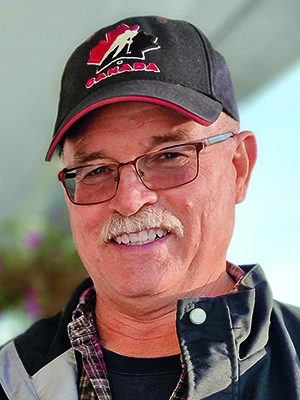
The latter runs an arable farm (soyabeans, maize, winter wheat) across 180ha of land. He also has 10ha of “bush”, as Tim calls his maple forest, which he cultivates for the production of maple syrup. No agricultural product is more “Canadian”, he enthuses, “and the maple leaf is the quintessential Canadian symbol”. When travelling in Canada, you come across the maple leaf everywhere. It adorns the national flag, and foodstuffs are labelled with it in shops to facilitate regional purchasing decisions. The right maple trees and climate converge in north-east America, allowing the sugar sap to be extracted from the trunks in spring. Canada is the world’s leading producer of maple syrup, far ahead of the United States and responsible for over 70% of global production. Germany is the most important market outside America.
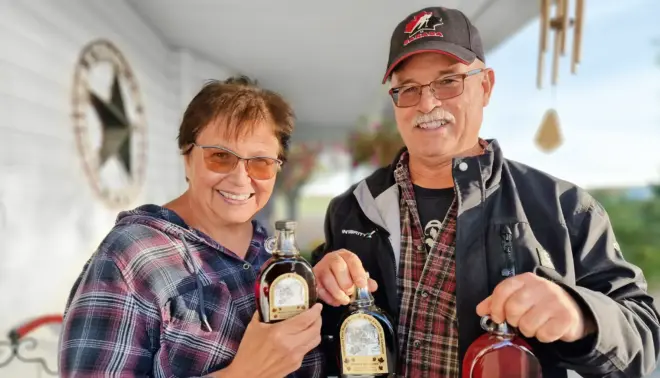
Tim invites us on a forest walk. To extract the sap from the maple trees, small holes are drilled into the trunks and fitted with a tap with a bucket hanging underneath. “Good trees can produce up to 15 litres of sugar sap a day,” he says. In commercial production, the sap is transported from the tap to the sugar shack via plastic hoses. In Tim’s case, this is a wooden barn that stands back on the farm. There, he shows where the sap is boiled down into syrup – around 40 litres of tree sap make one litre of maple syrup.
No agricultural product is more Canadian than maple syrup.
Tim Moher
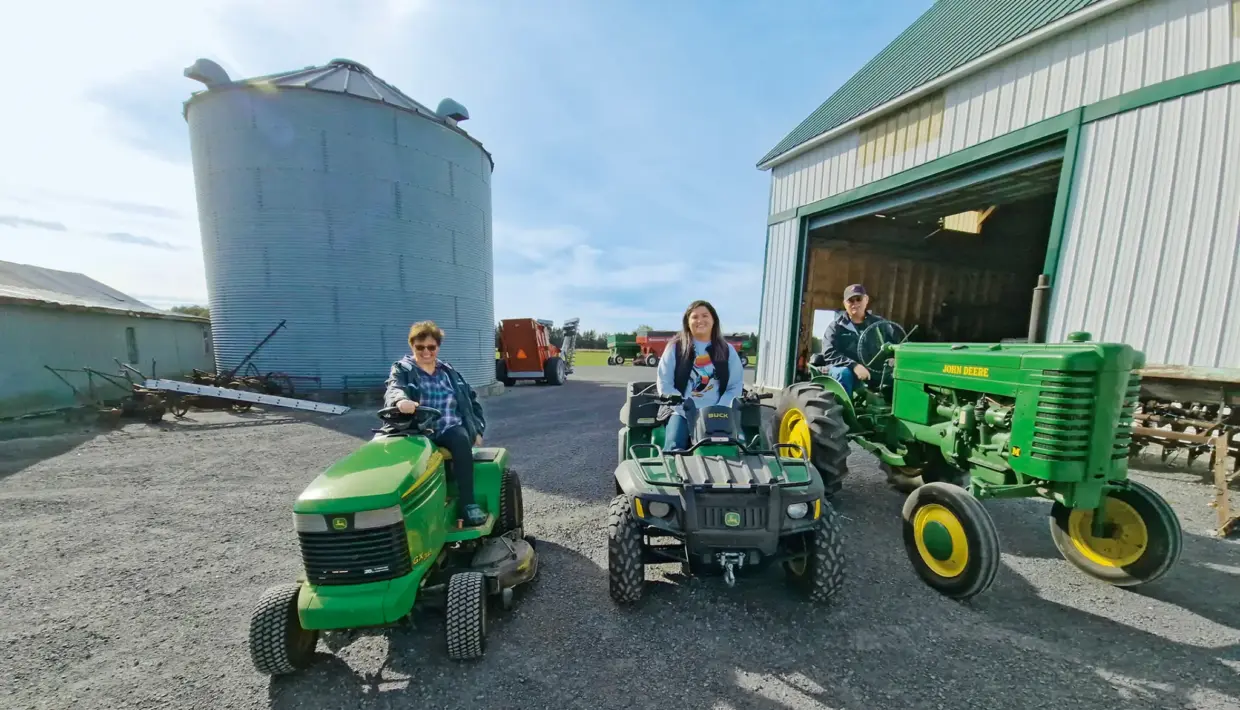
The warm-hearted farmer then takes the opportunity to showcase a small part of his John Deere fleet: wife Arlene drives the lawn tractor, daughter Hayley a utility vehicle with a tipper body, and Tim a lovingly maintained John Deere two-cylinder tractor. He proudly presents his model M, from the first production run in 1947. Daughter Hayley laughs: “It’s showtime”.
A visit to the Deere Pen
“That’s nothing”, dismisses Tim. We really must visit his neighbour Henry Doornwaard: “He’s crazy about John Deere tractors”. The first one is already at the entrance to his farm. Tim knows his stuff: “This is the 4320, built in 1972”. The tractor is connected to an auger conveyor. A little later, Henry will use it to unload a new truckload of grain maize that he has brought from the field to the drying plant. Just behind this are seven silos, each with a capacity of up to 650t.
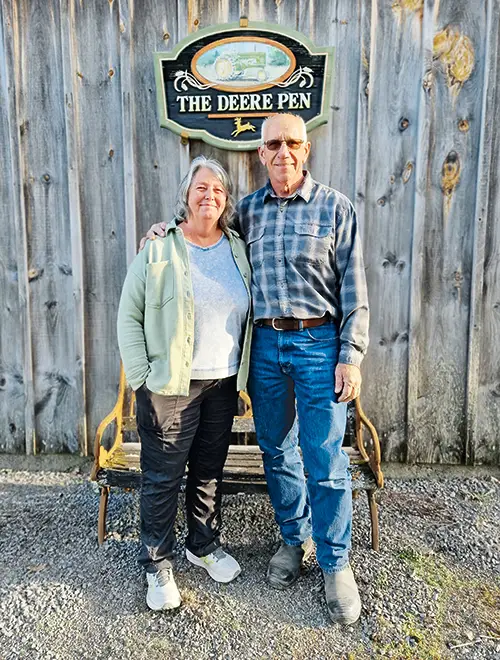
It’s mid-October and the grain maize harvest is in full swing. The 69-year-old manages the 320-ha arable farm (here too: maize, soyabeans, winter wheat) with his sons Garrett and Trevor and daughter Jenna. A sign saying “The Deere Pen” is displayed on one of the machine barns. This is where he stores some of his John Deere tractors. “Yes, I’ve become a collector,” admits the likeable farmer somewhat sheepishly. He now owns 15 tractors. The oldest is a D model from 1939, and a rarity is the 2510 petrol model from 1965 with PowerShift transmission, which was produced in limited numbers.

Back to the Theiler Farm. Josef helps his daughters Claire, Erika, and Heidi (aged between seven and three) into the car – they wear dungarees like little farmers. Josef wants to visit his colleague Jean-Luc Jaquemet: “A passionate farmer who is always ready to help with tips”.
He also works on a farm that is particularly large for the region, with 1,618ha of land, mainly growing soyabeans, maize, and winter wheat. An area of this size requires power – and he has plenty.
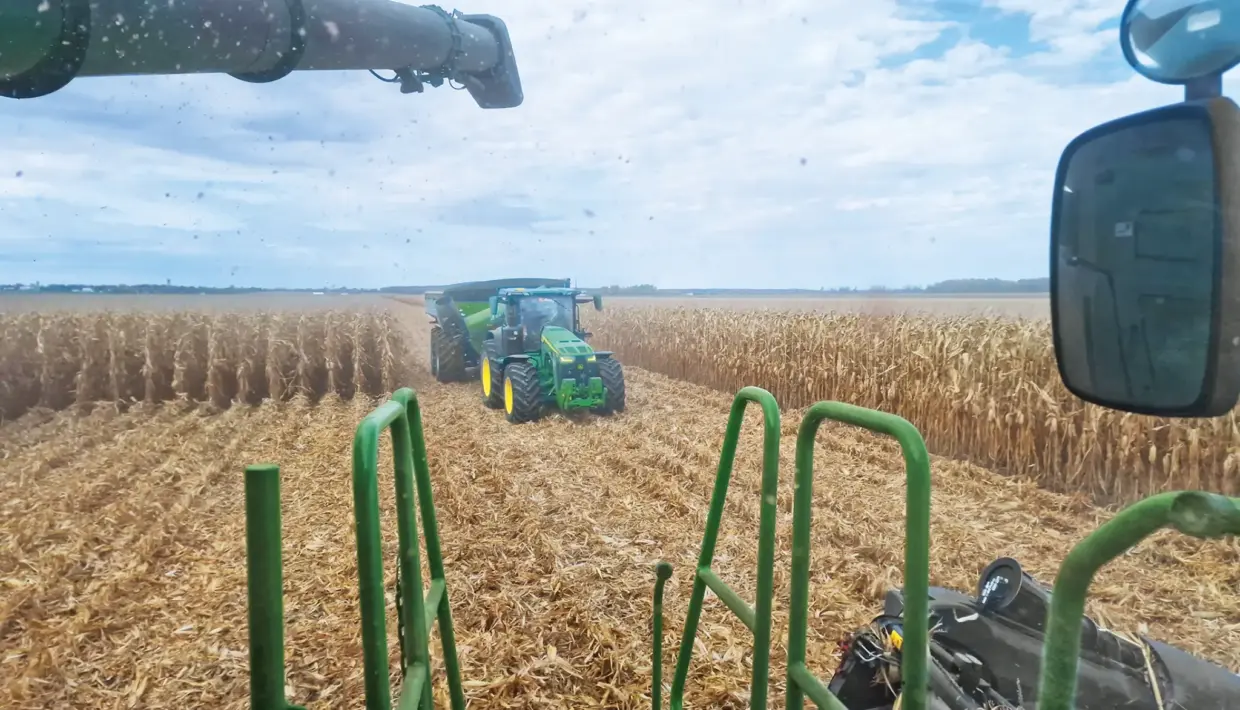
Jean-Luc Jaquemet’s large fields require power: A view from the X9 1000 combine harvester during the maize harvest.
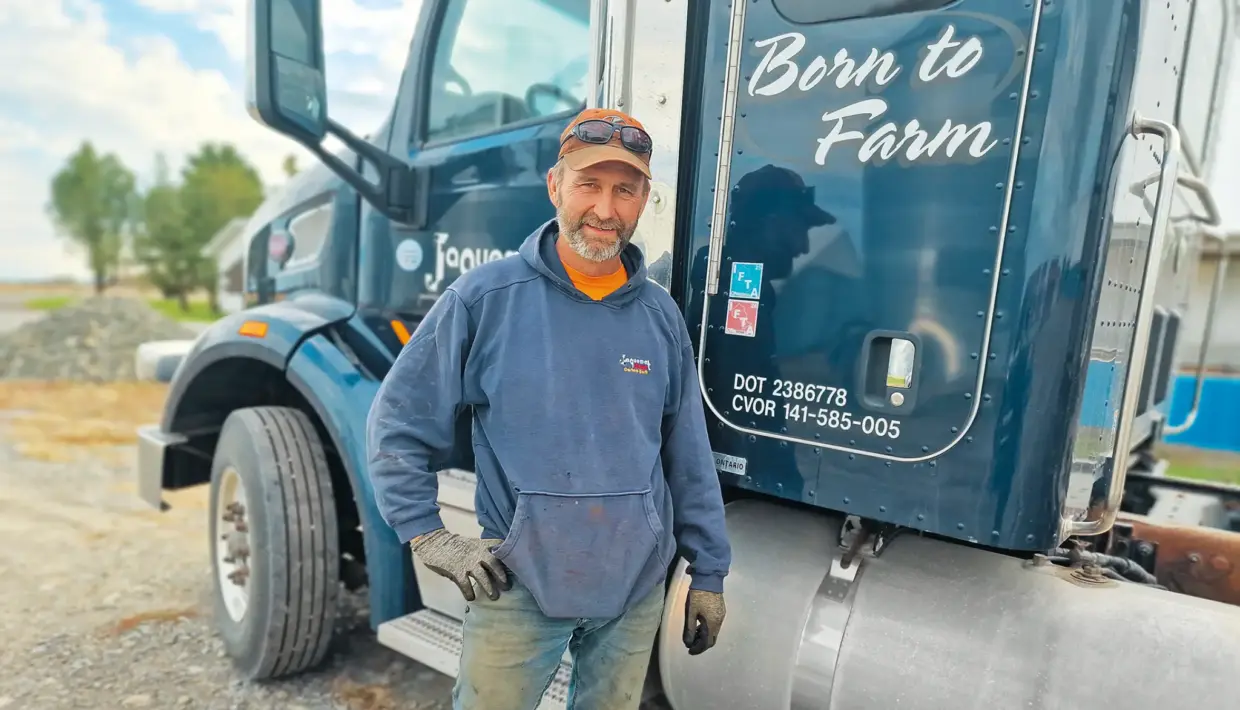
Jean-Luc Jaquemet is a farmer with passion. “Born to farm” is written on his truck, which he uses to transport maize to his drying facility.
During our visit in mid-October, the grain maize harvest is in full swing. He harvests with the John Deere X9 1000 combine – and is “thrilled”, he reveals. The header is almost 14m wide, and the combine can harvest up to 183t/hr! “Born to farm” is written on Jean-Luc’s truck, which he uses to transport the freshly threshed grain maize to his drying plant, where there are imposing storage silos with space for up to 30,000t of crop.
He tells us that his parents emigrated from Switzerland to Canada with 10 children. His father wanted to give each of his five sons the opportunity to run a farm, which was not possible in Switzerland: a small country with limited land. They were able to do this in Canada. Fifteen farms now belong to the family business – an operation of a somewhat different magnitude. Jean-Luc is in his mid-fifties and has seven children, including four sons; his siblings also have children. The amiable farmer laughs mischievously: “There must be around 100 of us now”.