Mathias Preussner is not only a farmer; he is also involved in the disposal of leftover food and used cooking fats, as well as the utilisation of organic waste, which he uses to generate energy. Last autumn, he decided to purchase a new John Deere S7 800 combine harvester, but because his own acreage is too small to fulfil the combine’s capacity, two of his farmer friends contributed to the purchase via a private loan and now share the combine. Together, they harvested 470ha during the 2025 season.
The key factors in his decision to buy the combine – alongside the machine’s robustness and durability – were the new technical features of the latest series, like the automatic, predictive ground speed system. “The combine doesn’t just react to actual conditions; it adjusts in advance to expected conditions – an obvious advantage over systems that only work reactively,” says Mathias.
He also uses data-driven intelligence, which allows for a connected fleet of machines, and thanks to AI, they can learn from each other. Given the large number of machines in operation worldwide, Mathias considers John Deere to be a leader in this field. And ultimately, these features appealed to him so strongly that he decided to buy the combine sight unseen. After the first harvest it even impressed his combine operator, Johannes Jäckel who originally preferred a different brand.

Harvest weather
In 2025, the cold and damp period during summer meant the grain harvest made little progress. Web forums and magazines were full of stories on grain quality losses and farmers could hardly wait to get back into the fields with their combines. Jan Peter Loth is one of the partners of Mathias Preussner. On the way to his farm near Friedberg in Hesse, wheat still stood in many of his fields. The stalks and ears shimmered in a greyish tone, but thankfully any sprouting or germination was barely visible.
The day before, a grain sample showed a Hagberg falling number well above 300, so there was no reason to worry about having to market the grain as feed wheat. “Most likely, the low temperatures of the past few weeks and the fact that the wheat remained standing in most fields helped preserve the grain quality. There’s not too much damage, at least not on our farm,” says Peter.
Unloading and grain transport
By midday, Jan-Peter’s winter wheat is dry enough for harvesting, and the brand-new S7 800 combine begins making its rounds, operated by Johannes Jäckel. Grain is unloaded on the move into one of the trailers positioned at the edge of the field, each holding around 20t of grain. “It takes us about four minutes to unloaded,” explains Johannes. “With 20 loads a day, that adds up to more than an hour of extra harvesting time per day.” Unfortunately, because the tractors aren’t from John Deere, MachineSync, the automation system that allows the combine driver to control the tractor during unloading, can’t be used. So, Johannes and the tractor drivers must be extra attentive during the unloading process.
Field trial: Automation of the S7 800
Patrick Hofstetter is also on site today; he is responsible for overseeing the field trials at John Deere and evaluating how the machines perform in real-world conditions. He aims to test how the automated combine settings and predictive speed control affect the machine’s productivity and grain losses, compared to an experienced operator like Johannes. To do this, a tray is mounted beneath the feeder-house to catch kernels that fail to enter the combine.
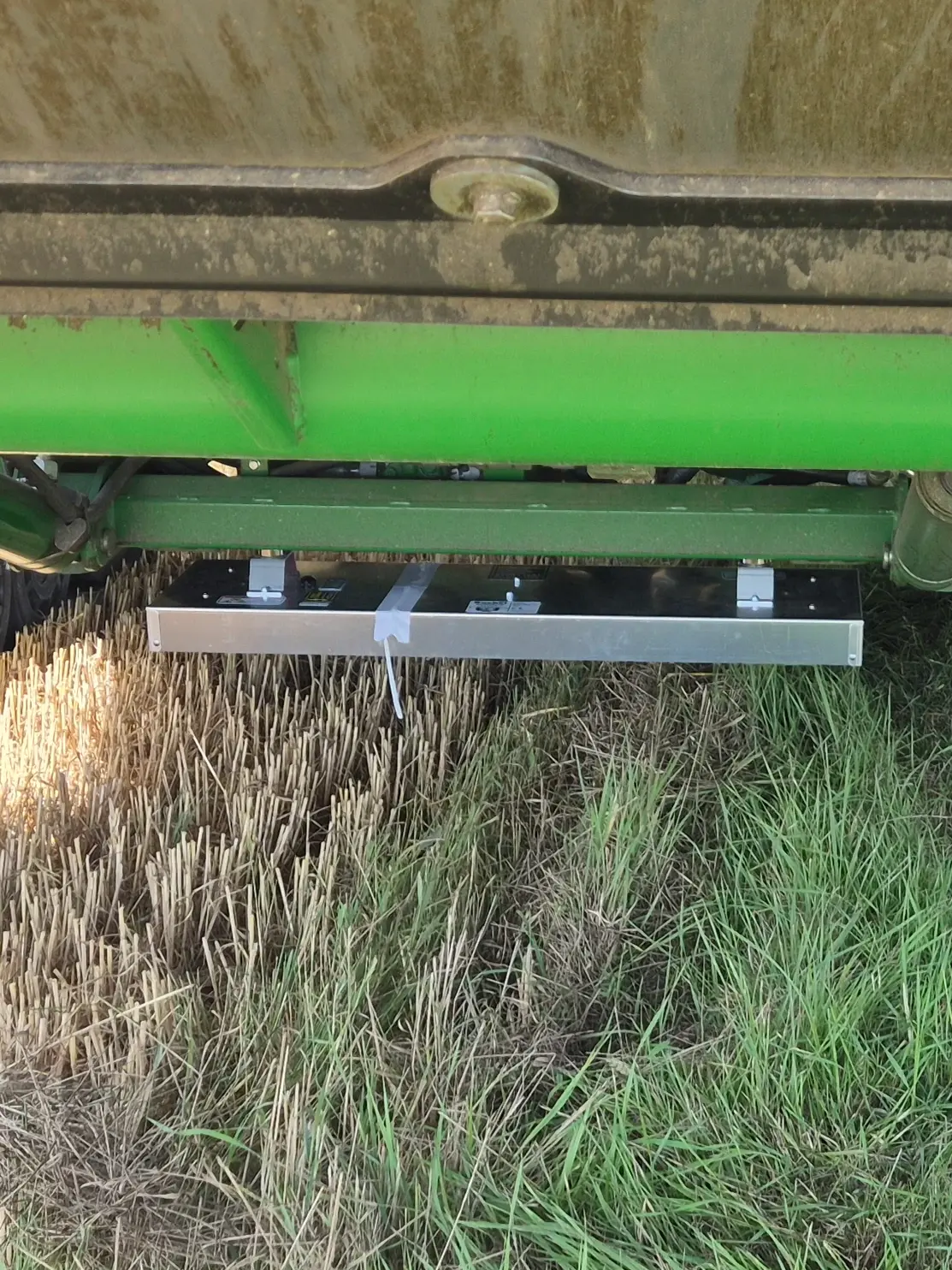
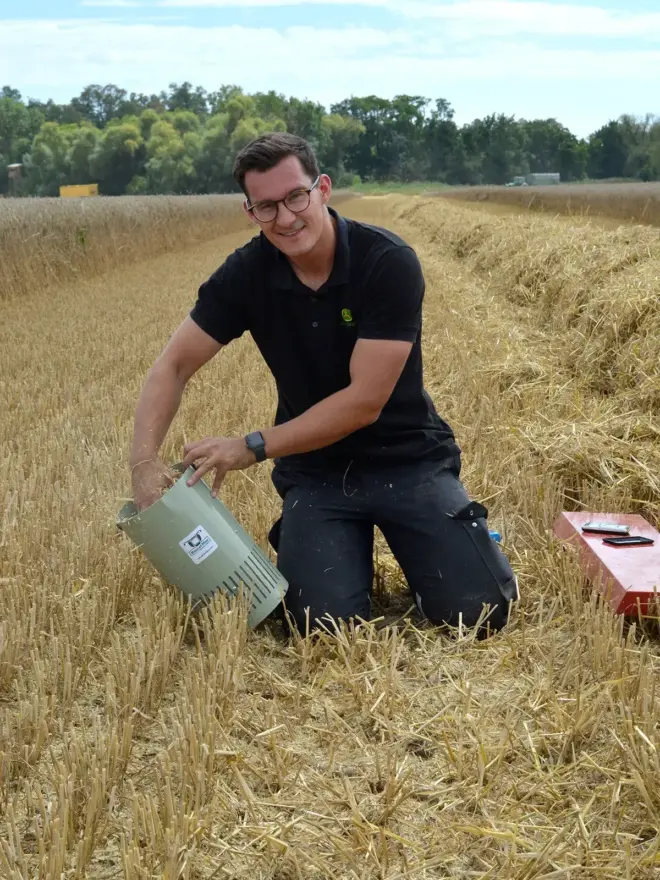

While the machine is running, Patrick monitors the grain losses on the G5 CommandCenter display and triggers the release of the tray via a remote control, he then needs to find the tray under the thick straw swath. Using a blower, he separates the wheat from the chaff until only the kernels remain and then measures the exact weight of the lost grain. To ensure a true comparison between the automated system and manual operation, the trial must be repeated several times throughout the afternoon.
The new combine has a fan
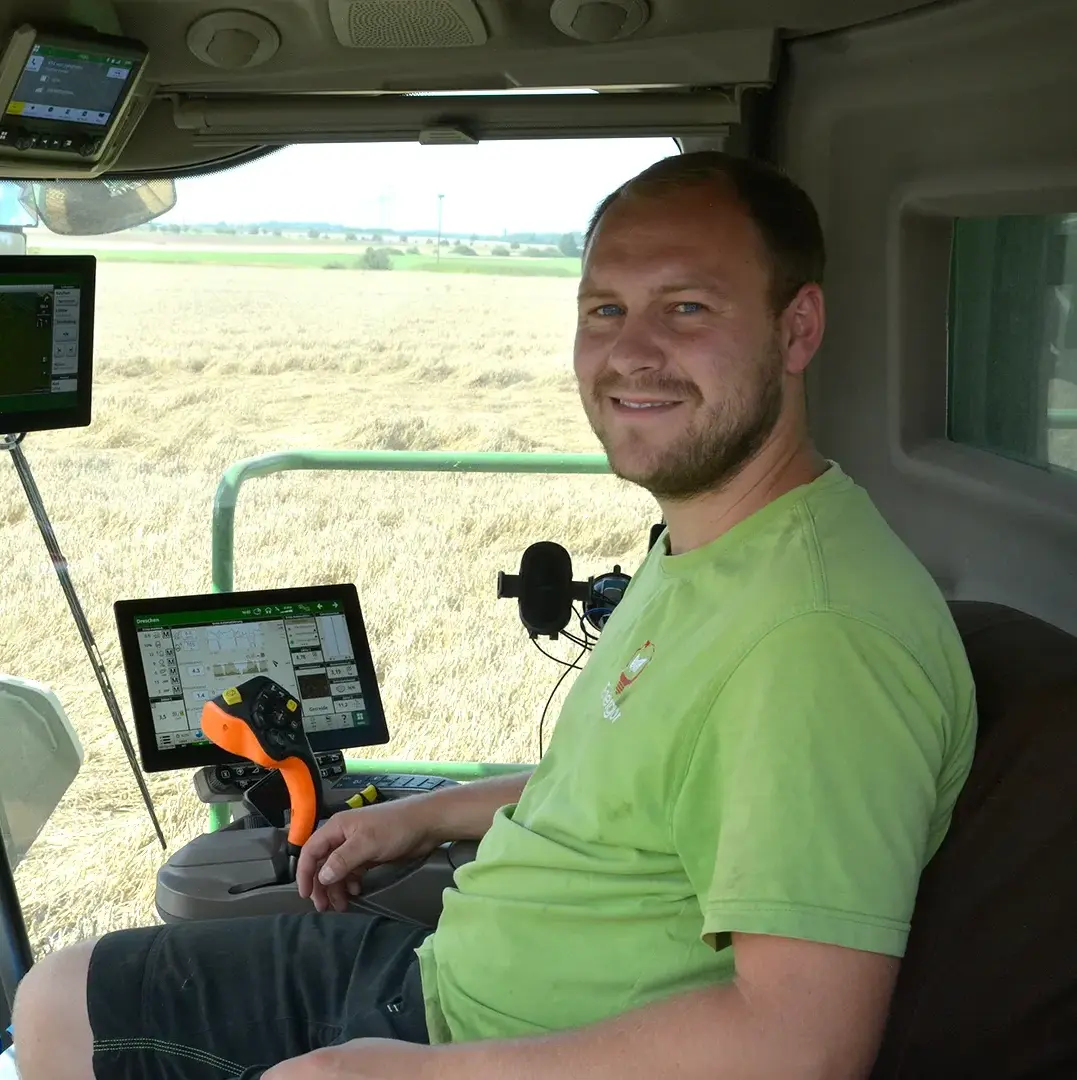
Meanwhile, Johannes is sitting in his air-conditioned, dust-free cab, enthusiastically discussing the new machine. “Originally, I wanted a combine from a different manufacturer, but when my boss told me we were getting this model with harvest automation, I immediately started watching YouTube videos to familiarise myself with the machine,” he says. And this homework paid off. “During the machine briefing by a service technician from the dealership, it felt almost like a conversation between equals.”
Since I had already watched so many YouTube videos beforehand, the machine briefing by the dealership technician felt almost like a conversation between equals.
Johannes Jäckel
Maximum cutting width
To avoid having to do a three- point turn at the end of the field, Johannes divided it into strips. Each strip is exactly 9mwide, which, given the header width of 9.15m, leaves precisely 7.5cm at each side of the header. “The boss originally told me to start with an effective cutting width of 8.50m and gradually work my way up to see what’s possible,” says Johannes. “But I went straight to 9m, and it worked.” he says This is made all the easier by the fact that the combine performs the headland turns itself, without the operator having to do anything.
Predictive speed adjustment
The new combine is equipped with Predictive Ground Speed Automation, a system which uses an algorithm to anticipate changes in flow and adjusts the speed accordingly. “On the guidance system screen, you can see a biomass map based on satellite data – it contains information about crop growth,” explains Johannes. “On the live camera screen, you can see the machine scanning the terrain directly in front of the header. An AI algorithm combines data from both sources and adjusts the combine’s speed pre-emptively”. The goal of this is to fully utilise engine power and keep the combine operating at its performance optimum. The speed changes are so smooth that the operator barely notices them inside the cab.
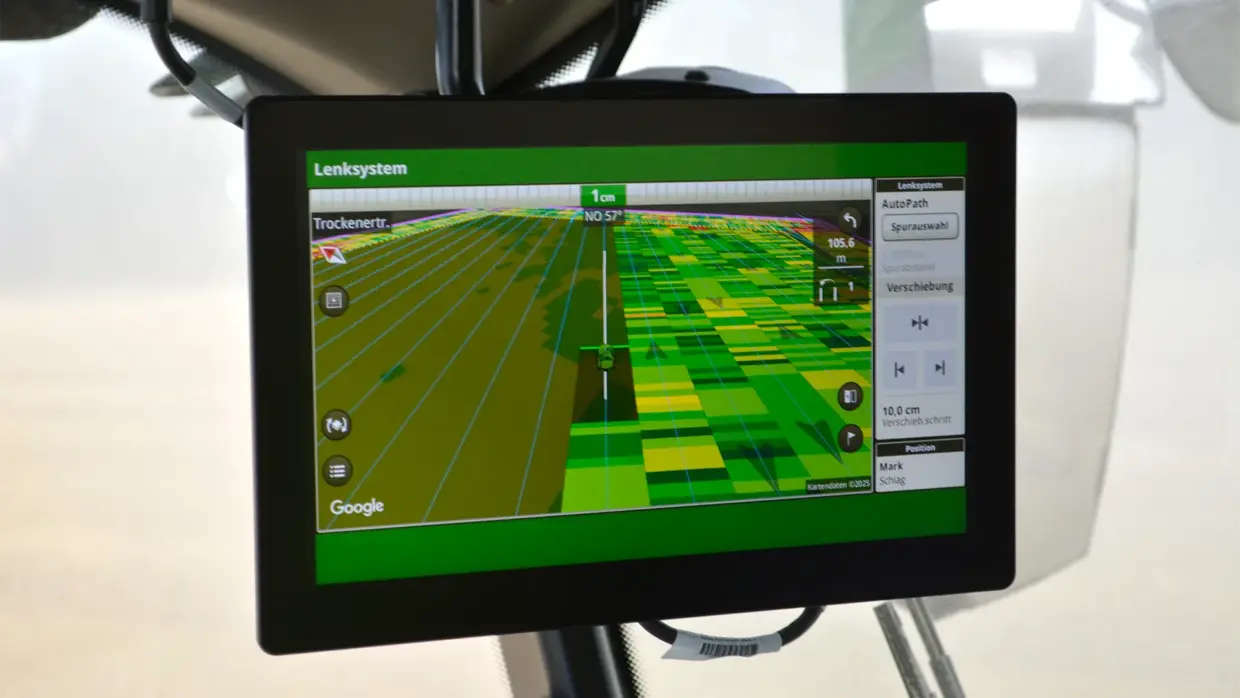
The guidance system screen displays the biomass map based on satellite data.
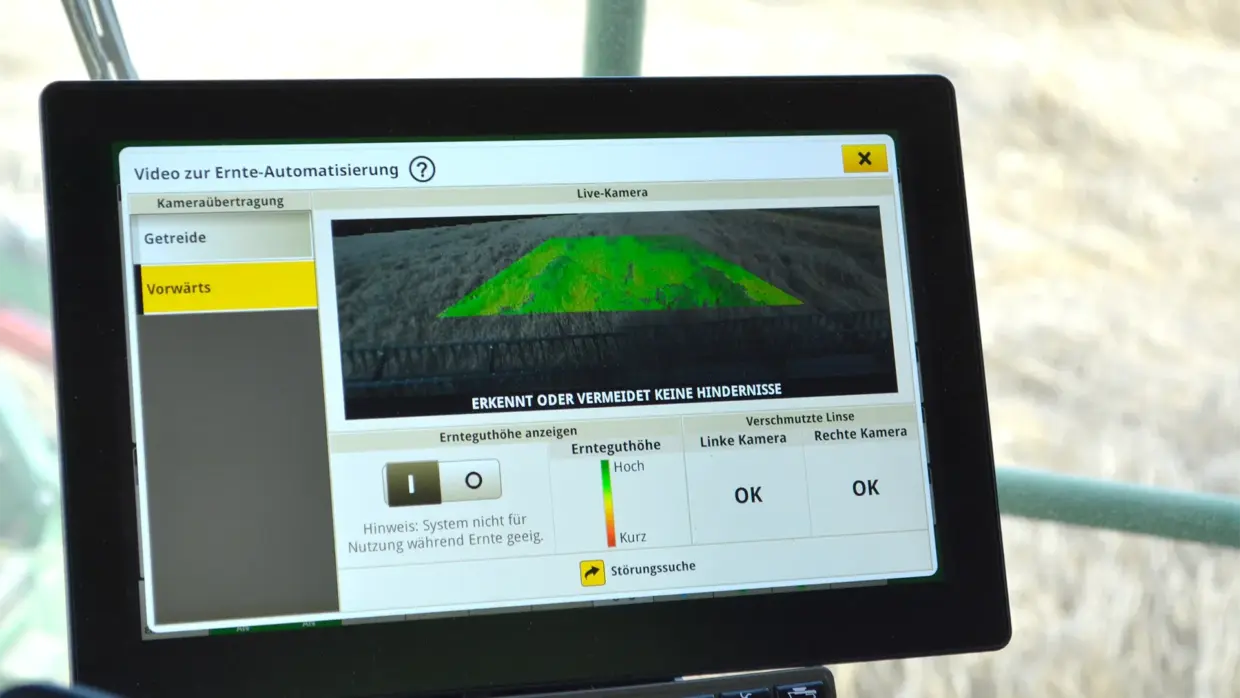
The green areas on the live camera screen indicate where the combine is scanning the field in front of the header.

The values displayed on the screen are based on a nominal scale from one to 10 and must be calibrated against physical measurements.
Automated machine settings
The key factor in reducing grain losses is the Harvest Setting Automation, which can be used to set limits for grain losses, quality and cleanliness. The system features new loss detection technology and continuously analyses performance parameters in relation to the defined limits. AI takes care of all necessary internal adjustments to keep the values within the set limits as effectively as possible.
The values displayed on the screen are based on a nominal scale from one to 10 and do not represent actual percentages. To paint a realistic picture, they must be calibrated against physical measurements – like Patrick’s grain loss tests – using the grain camera, or by looking into the grain tank.
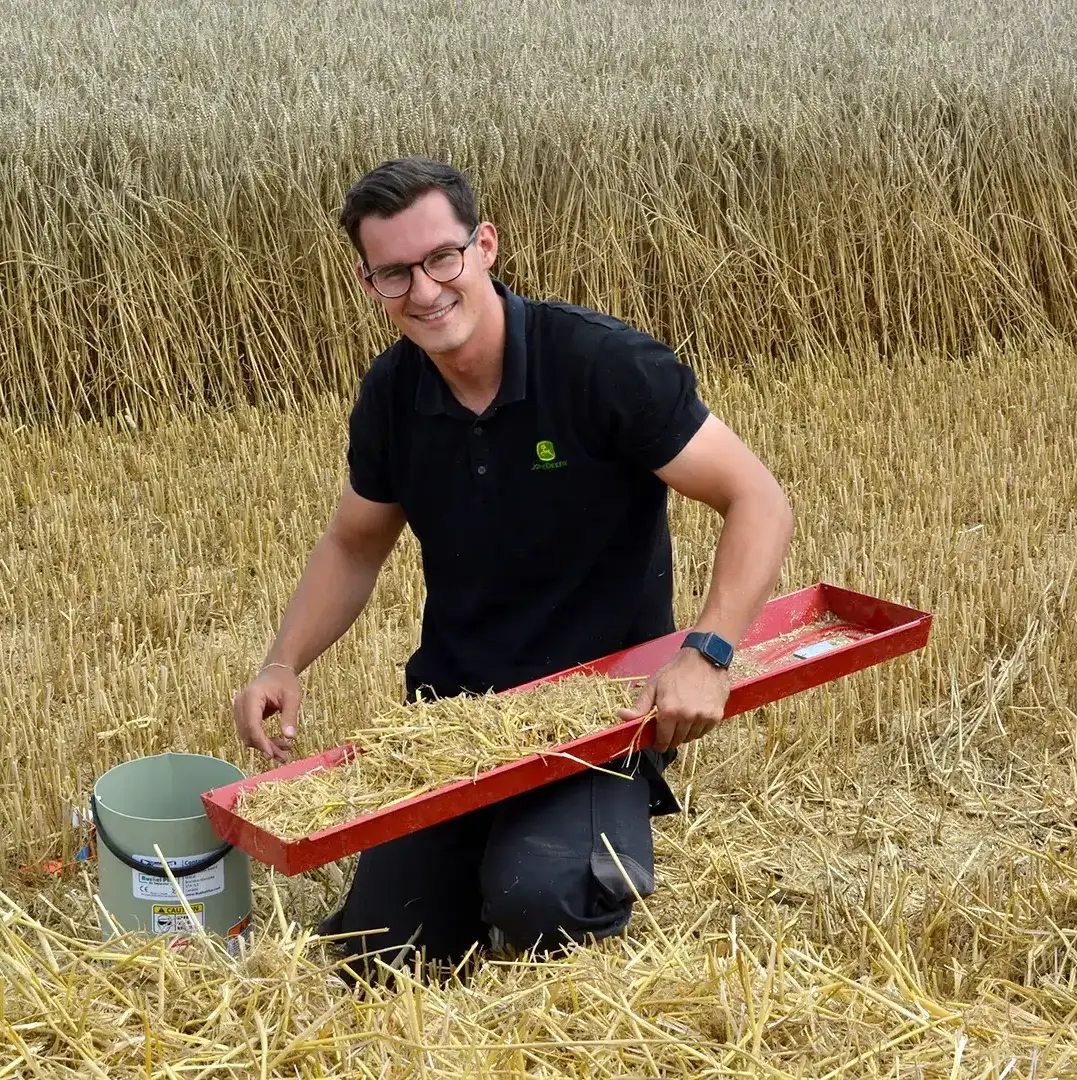
The automatic machine settings keep grain losses consistently within the target range of 1%.
Patrick Hofstetter
Automation keeps performance consistent
Patrick gives a signal to stop. “I’m done with the measurements now, and the result is clear,” he says. “The automatic machine settings keep grain losses consistently within the target range of 1%.” In contrast, the measurements fluctuate significantly when using manual control and, in some cases, show considerably higher percentages. Johannes is convinced that over the course of the day, he cannot maintain the same performance as the automation of the new S7 800 combine. Based on his gut feeling, he estimates that, given the relatively small fields he harvests, the automation delivers an additional performance of up to 15%. “You can clearly tell that the machine is constantly making adjustments,” says Johannes. “A regular driver simply can’t manage that over an entire day.”