It’s difficult to address the issue of employees in agriculture without considering dairy farming and its on-call duties. According to a recent study by Idèle (formerly the Institut de l’Elevage), the EU has nearly 6,700 large livestock farms (440 cows on average). These supply 20% of European milk production.
In France, only 6% of the 44,000 dairy farms have 200-300 cows, according to expert Philippe Perrot. Beyond 300 head, the proportion drops to 1.8%, comprising fewer than 800 farms.
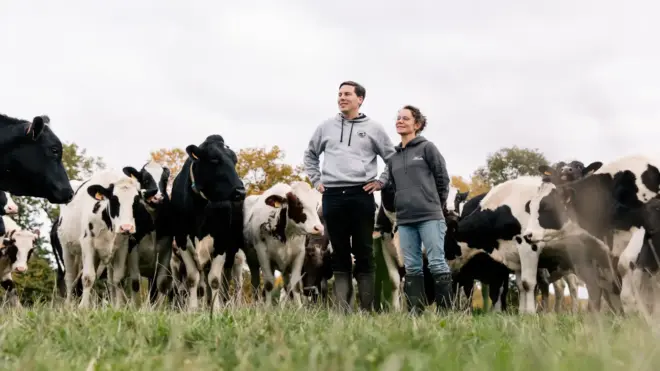
It was one of these herds that The Furrow visited in October 2025 to meet its manager, Luc Sassel. The Rives d’Or civil agricultural company is based in the Orne countryside, at La Chapelle d’Andaine, a few miles from Bagnoles-de-l’Orne.
At the age of 35, Luc employs up to 14 people, equivalent to eight full-time jobs. The farm in La Petite-Houssaye produces 3.7m litres of milk annually. It does not process its milk on-site; instead, it delivers it to the Fléchard family business, a local processor that specialises in high-end butter, and to the Gillot cheese dairy, a leading name in Protected Designation of Origin Camembert. The team’s work is therefore entirely focused on caring for the livestock.
Anything but a factory farm
“My parents, who are originally from Luxembourg, moved to the region in 2002,” recalls Luc. “Some 15 years later, they had 80 dairy cows on 80ha. Like my brothers and sisters, I went into higher education, found a job and earned a good living in Paris. In 2018, my wife and I decided to relocate to return to my passion for farming.”
Following the merger of three farms, Rives d’Or now has 350 cows and the plan is to increase this to 450 in 2026. This is no factory farm. It sits alongside a small country road and is often crossed by walkers who enjoy seeing up to 200 cows grazing in well-kept paddocks.
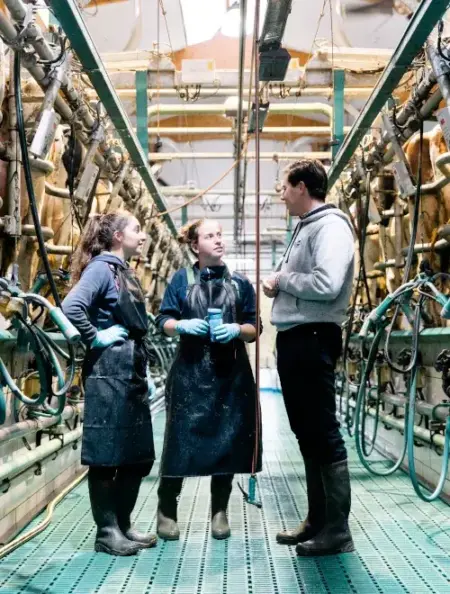
A large, well-equipped building with sand bedding, ventilation, a modern calf unit and a brand-new milking shed complete the picture. The surrounding area is immaculately mowed.
Fieldwork is undertaken by Gautier Frères, an agricultural contractor based in Mayenne, and the CUMA de l’Aiguillon, a machinery sharing co-operative. Their involvement helps to control mechanisation costs particularly during drilling or silaging the farm’s 120haof maize.
Travel broadens the mind
“From my parents, I inherited a passion for genetics and a good command of German,” says Luc. “That has enabled me, as an international Prim’Holstein judge, to meet experts from all walks of life.” He remains in regular contact with a German nutritionist.
“In France, large herds are generally managed by family partners, who employ one or two people” he notes. “Whereas in Northern Europe, the manager is alone but surrounded by a much larger number of employees, which is the case for me. It was abroad that I observed the best practices for quickly recruiting and retaining good staff.”
“I’ve made mistakes and had resignations, I readily admit that,” concedes Luc. “But now I invest the time and use the right tools, to ensure that our employees feel at home at Rives d’Or, especially the younger ones, because they are sensitive about their free time; we have to make sure they have it.”

Planning a month in advance, and other good ideas …
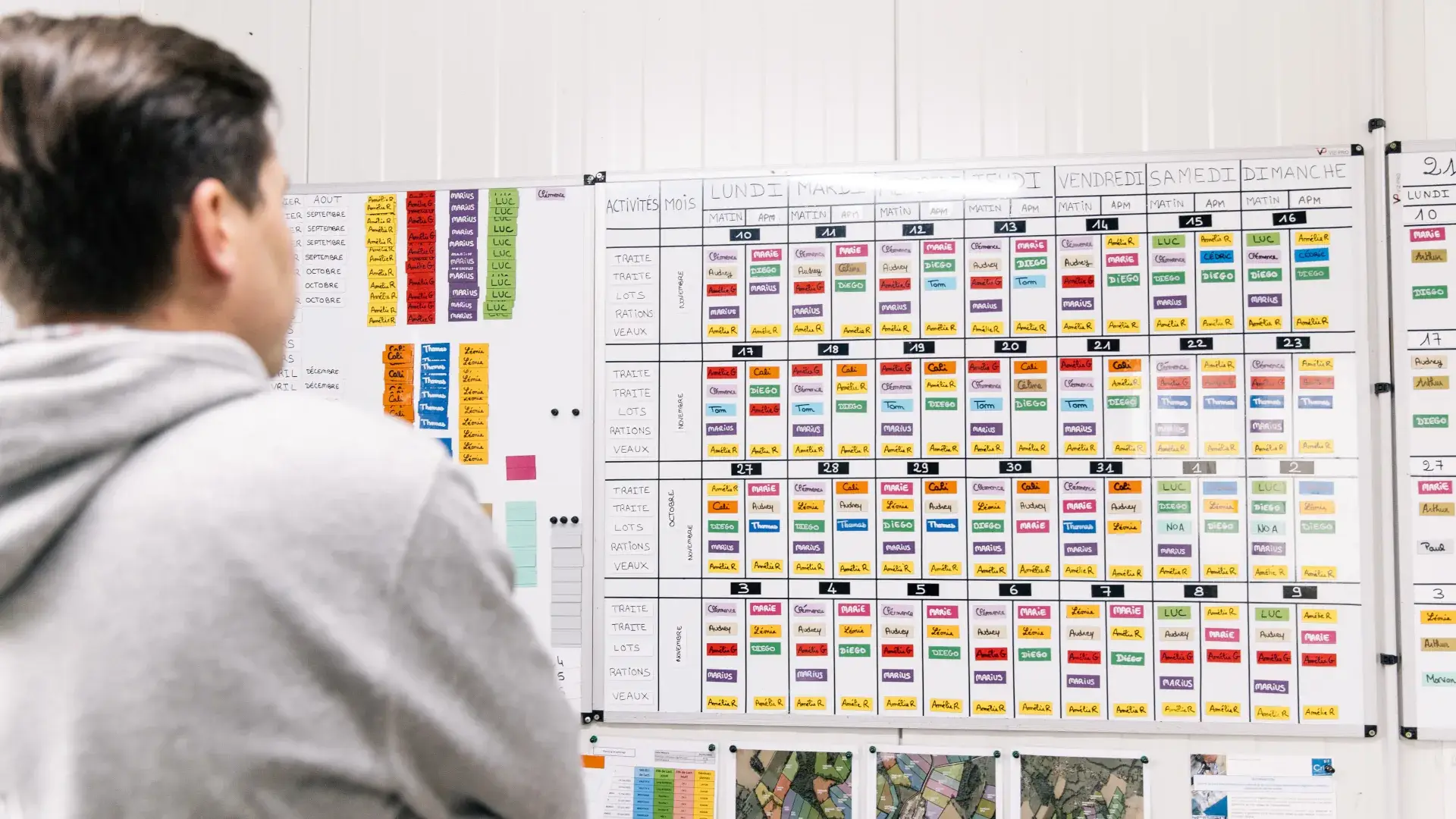
1. The monthly on-call schedule
This giant board, with its coloured magnets for each team member, requires Luc and his team to spend several hours planning at the start of the month. Each team member, whether in the morning or afternoon, can clearly see their responsibilities and who they’re going to work with. “This is quite important,” says Luc, “Of course, we are flexible as and when personal constraints arise.”
2. WhatsApp groups
The farm has two private WhatsApp groups. The first provides the whole team with information about the farm silage days, new starters, rota updates and general announcements. The second is dedicated to the milking teams, who report daily collection figures and any issues encountered in the parlour.
3. Clearer job descriptions
“I realised how important detailed job descriptions are. When someone leaves us, I know exactly what profile I am going to look for to replace them. A good milker, who is thorough and gentle, is hard to replace,” says Luc. “I also insist on punctuality. Being on time is essential for the cohesion of the group… and for the cows, of course.”
4. Faster recruitment through social media
Finding staff can take months, even when pay is competitive. “I shortened the process by adapting my advertisements; we use informal language, highlight the atmosphere and emphasise the importance of respecting the working week and showing consideration, because no one can know everything.”
5. Internal communication
After the first milking, around 9:30am, the team have breakfast together. “It’s not only about work,” notes Luc. “It’s a moment that brings the team together, because everyone can go through a difficult period in their personal life without saying so.” It is also an opportunity for the manager to raise any points for improvement or, conversely, to highlight successes. Lunch often ends up with sharing meals as well.
6. Paying for responsibility, not just hours
Luc believes pay should reflect skills and responsibility, and that motivated employees should earn more than the minimum required. In addition to the legally required hours, each contract clearly sets out the task assigned to the employee and an estimate of how long it will take. This clarification encourages and rewards diligence at work.
7. External communication
“I update our Facebook page six or seven times a year with photos and news from the farm,” says Luc. “When I’m judging at genetics competitions, lots of young people mention they’ve seen it.”
8. Ergonomics and work environment
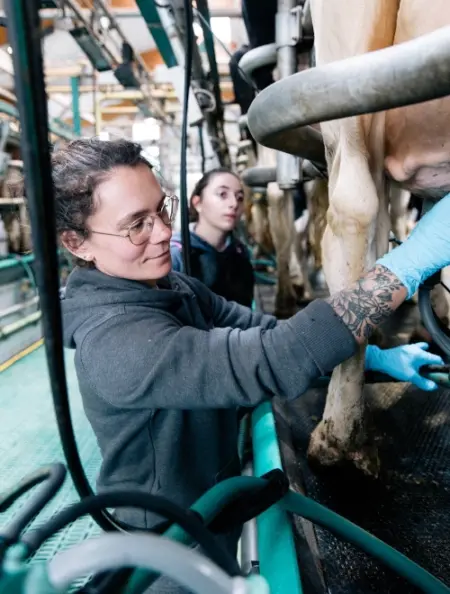
Milk taxis, lightweight milking clusters, rail-mounted feeders, covered calf hutches, sand bedded cubicles, well-maintained surroundings and staff-only car parking: The list is long. Luc pays close attention to the practical details, ensuring equipment is properly adjusted and working conditions are as comfortable as possible.
Team Focus Drives Farm Performance
At Rives d’Or, every employee is expected to give their best, because “ultimately, that’s the goal,” says Luc. That philosophy underpins the decision to invest in a large new milking parlour in 2020 rather than installing robots.
The figures support this people-oriented approach. With employees working between 35 and 42 hours per week, the farm boasts an enviable gross revenue of €220,000 (£190,000) per full-time equivalent.
“Stability for the herd, supported by committed employees, is something that appeals to me” admits Luc. The final word goes to Tom Decheppe, one of the team’s most passionate members.
“I’ve done many internships in France, and this is the first time I’ve seen a farm organised like this,” he says. “Knowing my rota and free time a month in advance is crucial for a keen cyclist like me!”