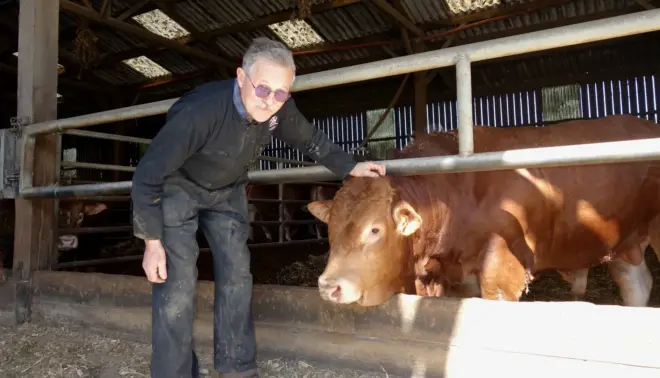
Jean-Luc Bérard farms at EARL Bérard-Beauvais in Noyen-sur-Sarthe, rearing 125 Limousin suckler cows and their offspring; a total of 300 head to be fed during the winter.
In 1996, after having been a crop manager, stockman and finally manager of various organisations in the regional livestock sector, Jean-Luc returned to his passion: Rearing beef cattle. “I was able to take over my father-in-law’s farm with my wife; it was a farm specialising in meat but had only 40 Rouge des Prés suckler cows,” he explains. This was followed by the purchase of 75 Limousin cows in the breed’s place of origin, the construction of four closely grouped buildings, and a sales contract with the Bovimaine co-operative.
Three years later, with meat prices at a low, the owners of EARL Bérard-Beauvais decided to diversify by planting 10ha of cider apple trees, which are now in full production. At the same time, the Loué Farmers’ Agricultural Cooperative enabled Jean-Luc to start rearing broiler chickens. Avian flu has led to a renewed focus on duck production in the pre-fattening stage; a rather time-consuming activity, including bedding, feeding, various care tasks and so on.
“How could we make ourselves available for this if feeding 300 cattle took two to three hours a day,” says Jean-Luc. “The question of whether to use a robot naturally arose, and in 2016, when Lely offered its Vector solution and after-sales service, we invested.”
A ROBOT FOR OPTIMAL AVERAGE DAILY GAIN
The business had employees, but it was not perfect, because humans make mistakes. “When weighing the animals, we noticed significant growth discrepancies of around 200g/day.” But the robot had a cost: Was the investment worthwhile? The farm employs two staff members, who are no longer directly involved in distributing rations, although a straw blower remains in service and care must be taken to restock the robot’s feed kitchen every two days.
There is no shortage of work in the fields either: The farm comprises 166ha of utilised agricultural area, including 50ha of grassland, 25ha of maize, 25ha of cereals and 5-6ha of fodder beet, which has recently been reintroduced into the rotation.
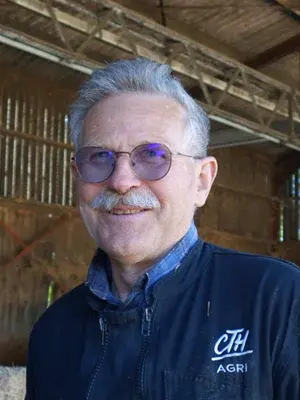
From a profitability point of view, I would say that 130 suckler cows and their offspring are really the maximum for a single feeding robot.
Jean-Luc Bérard
“From a profitability point of view, based on 10 years’ experience, I would say that 130 suckler cows and their offspring are really the maximum for a single feeding robot,” says Jean-Luc. What remains is the technical performance and the farmer’s peace of mind. “Before the robot arrived, we had a mixer wagon and a bale unroller, which required two tractors, diesel and between two and three hours’ work a day. We created one mix for the young bulls and another for the rest (weaners, pregnant cows, and heifers). So the rations were not tailored to each batch, which limited the precision of the feeding.”
To encourage feed intakes and limit refusals, staff had to push up the forage several times a day, which, in addition to the physical strain, was also time-consuming, he adds. “Now the robot pushes the forage, and it does so silently.”
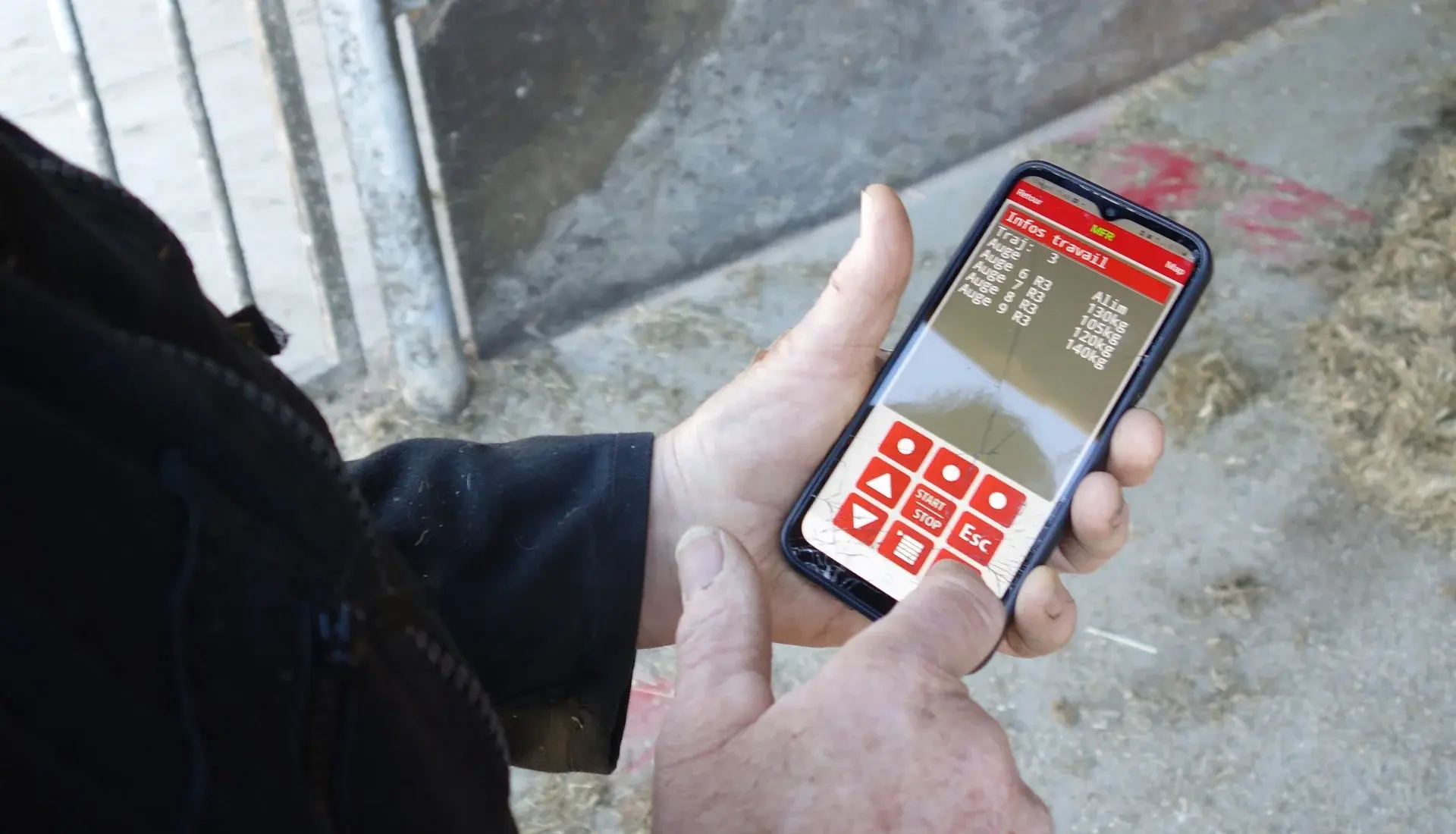
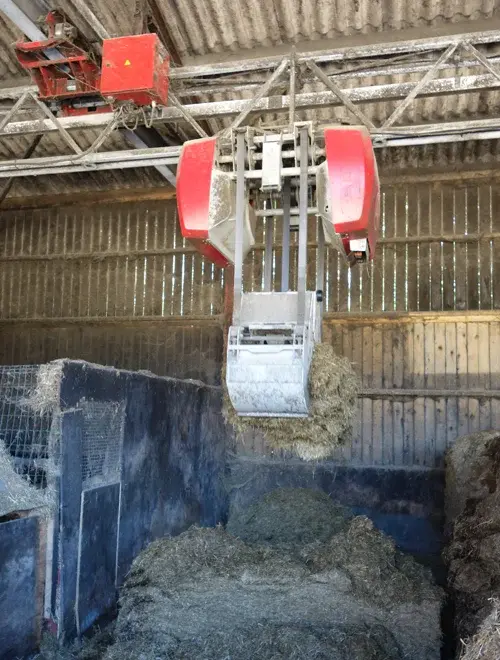
Using his mobile phone app and a computer rationing programme, Jean-Luc has created seven precise rations: Two for young bulls, two for heifers, two for first-calf heifers and one for fattening cows. “In the feed kitchen, sensors on the grab motor estimate the weight of the feed; this weight is then adjusted, if necessary, at the mixer bowl,” he explains.
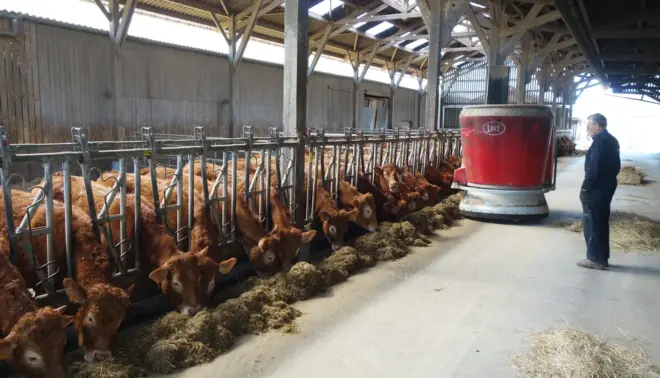
Guided along rails laid on the floor, the robot passes in front of the feed face every hour; it uses ultrasonic sensors to position itself perfectly in front of the troughs for each fattening pen. Fresh deliveries 24 hours a day improve palatability of the forage, encouraging the animals to eat more. Lely France confirms this point: “The cow is a ruminant with a complex digestive system. With its four stomachs, it has a high capacity for digesting fibre,” it says. “The availability and accessibility of the ration allow the animals to eat small meals throughout the day, thereby maintaining a stable pH in the stomach.”
+0 g
additional average daily gain (ADG) recorded for each animal in Jean-Luc Bérard’s herd thanks to the robot, compared with deficits of up to 200g/day when the mix was prepared by an operator using a conventional mixer wagon.
A ROBOT FOR ANIMAL WELFARE
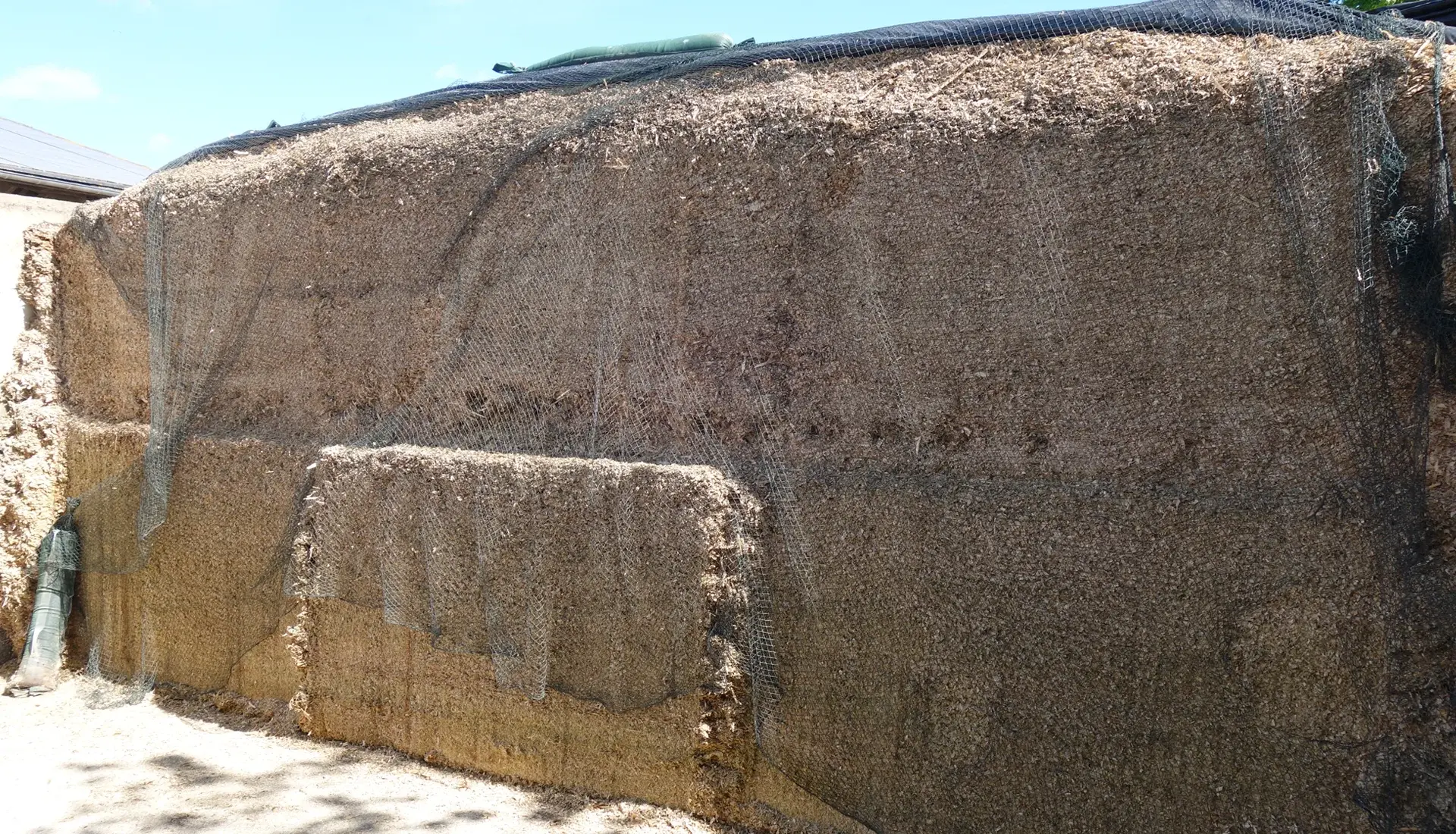
Contrary to expectations, the robot does not distance the farm staff from the animals, notes Jean-Luc. “It frees up our time to observe them; this is essential for a calm and peaceful herd.” And he admits that automation isn’t a cure-all either. “I’m a bit of a pain when it comes to keeping the maize silo clean, for example; I insist on using nets to protect the silage face from birds, and I use a blade-type silage cutter to ensure the face doesn’t oxidise before the robot’s grab picks it up.” Furthermore, he adds ensiled straw to the rations because of its benefits for rumination.
Contrary to expectations, the robot does not distance the farm staff from the animals.
Jean-Luc Bérard
There are around 200 feeding robots in use on cattle farms in France, according to RobAgri, the association set up in 2017 to represent the agricultural robotics sector to the French government. This compares with the 14,000 milking robots in use, plus the 2,800 or so slurry scrapers and vacuums, and around 1,000 forage-pushing robots, etc.
A report by industry players in the machinery sector recently stated: “Robots will play a key role in relieving farmers of the burden of strenuous or repetitive tasks. Agricultural machinery will be able to rise to the challenge. On cattle farms, feeding is one of the most time-consuming tasks, often taking between one-and-a-half and two hours a day, depending on the size of the herd and the number of groups to manage.” It’s a prediction that Jean-Luc could have written… 10 years ago!