Some 90% of European ammonia emissions come from agriculture, primarily from animal manure. While the gas does not have a direct impact on the climate, it contributes to eutrophication and forms fine particulate matter that is harmful to health. One way of reducing these emissions is to lower the pH of slurry, as the more acidic the environment, the more the chemical equilibrium shifts from gaseous ammonia to bound ammonium.
Acidification trials in livestock housing show that ammonia emissions there can be reduced by around 40%. And, according to the literature, reductions of up to 90% are possible during storage. If the pH level in the livestock housing or storage facility remains low over a prolonged period, methane emissions can also be reduced.

For arable crops, we have so far observed increased yields in 62% of cases.
Tim Wantulla
In practice, several approaches are possible for this. In Denmark, slurry is sometimes acidified in the livestock housing or storage facility. Germany finds this more difficult because acidification in such locations is technically and legally complex. One alternative is to add the sulphuric acid during application. After all, this is where around half of the ammonia losses occur. The key advantage is that the nitrogen that does not volatilise remains available to the plants. Whether this offsets the additional costs, however, depends heavily on the operating conditions.
Field trials
In Germany, the Säure+ im Feld project is conducting field trials on 39 commercial farms to assess the practical viability of the process. The SyreN system, developed by the Danish company Biocover, is used for this purpose; it meters sulphuric acid into the slurry stream during application. “For arable crops, we have so far observed increased yields in 62% of cases,” explains Tim Wantulla, project co-ordinator at the North Rhine-Westphalia Chamber of Agriculture. “On average, these positive cases showed an increase of 3.8%.”

In total, the analyses carried out to date have covered 67 yield results, predominantly for winter cereals. However, the average effect across all cases remained low, with 0.6% additional yield. This is mainly because the application dates for the demonstration facilities cannot always be chosen to coincide with ideal weather conditions. In some cases, the slurry was also acidified in cool or damp weather – situations in which ammonia losses are low anyway.
The results are more pronounced for grassland. There, a total of 61 results from permanent and temporary grassland were analysed. In 74% of cases, the yield increased; in these positive cases, it rose by an average of 13%.
Crude protein content also tended to increase. For arable crops, 59% of the results were higher, by an average of 0.4 percentage points. Ammonia concentrations were also compared directly above acidified and non-acidified slurry applied in strips. While these measurements do not allow for an exact conversion into kilograms of nitrogen saved, the ammonia concentration in the measuring hood above the acidified slurry bands was typically around 45–75% lower than above the non-acidified slurry. What this means in terms of actual nitrogen savings depends on the absolute level of emissions to begin with. “Acidification is not an automatic process,” emphasises Tim. “It is particularly useful when high emissions are expected during application.”
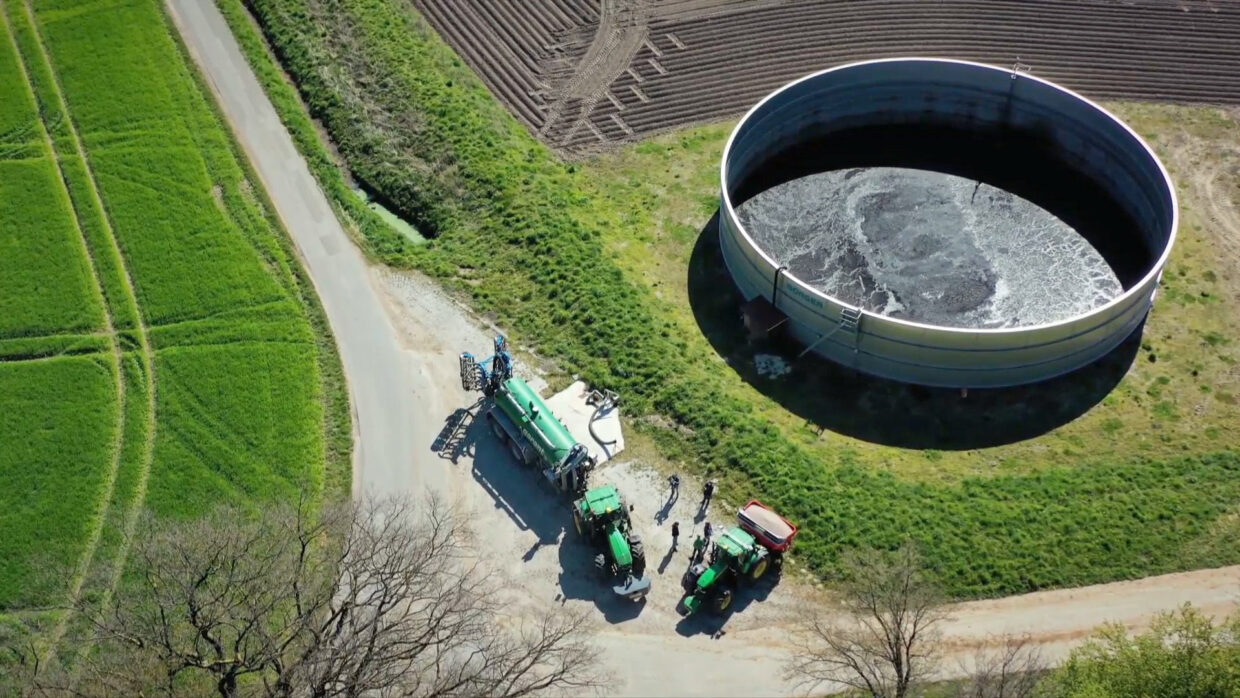
Sulphur is also a factor in the economic calculation. Around 0.6kg of elemental sulphur is applied with every litre of sulphuric acid. With 25m³ of slurry per hectare and two litres of acid per m³, this amounts to approximately 30kg/ha of sulphur. Part of the costs can therefore be offset by the savings from reduced sulphur fertilisation. However, the amount of sulphur applied must match the crop requirements. In purely theoretical terms, each litre of sulphuric acid would require around 1.87kg of CaCO₃ in additional liming to neutralise it. When soil pH was compared in the demonstration plots after harvest, however, the project has so far found no clear differences across sites between plots receiving acidified and non-acidified slurry.
Sophisticated technology
Stefan Vogelsang, operator of a mixed farm in Rheda-Wiedenbrück, has been testing the SyreN system since 2023. Over three years, he has spread pig and cow slurry, mixed slurry, and digestate, both with and without acid. “The results vary considerably,” he concludes. “In cloudy weather with light rain, we measure virtually no effect, because the losses are minimal anyway. If we apply slurry for the third cut in sunny, windy conditions with no rain forecast, we have observed a 20-25% increase in yield in grassland.”
Stefan has also observed yield effects when slurry is incorporated using strip-till for maize. As the slurry is already in the soil in this case, and hardly any ammonia escapes, he suspects that the cause is more likely to be improved phosphorus availability due to the lower pH value.
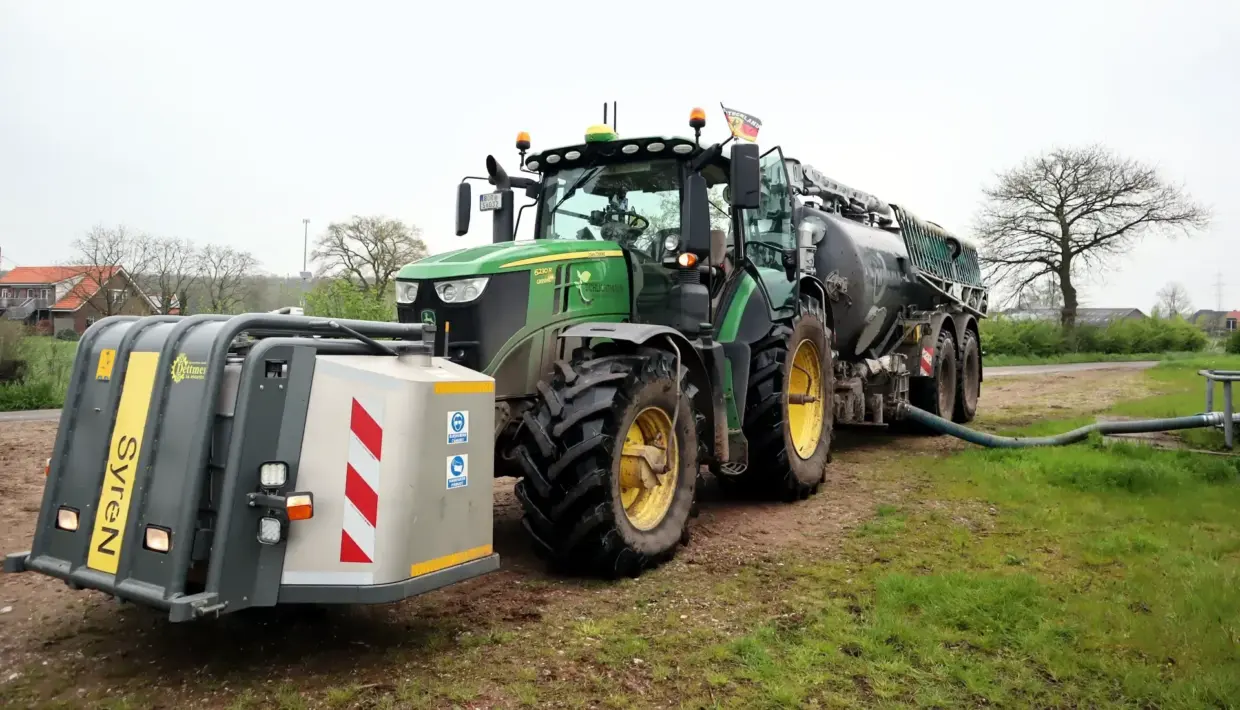
The treated slurry is adjusted to a pH value of around 6.5 and is therefore no more acidic than many soils. Theoretically, the sulphuric acid does result in an additional lime requirement; however, the project did not identify any cross-site reduction in soil pH. Furthermore, acidification could increase the availability of phosphorus.
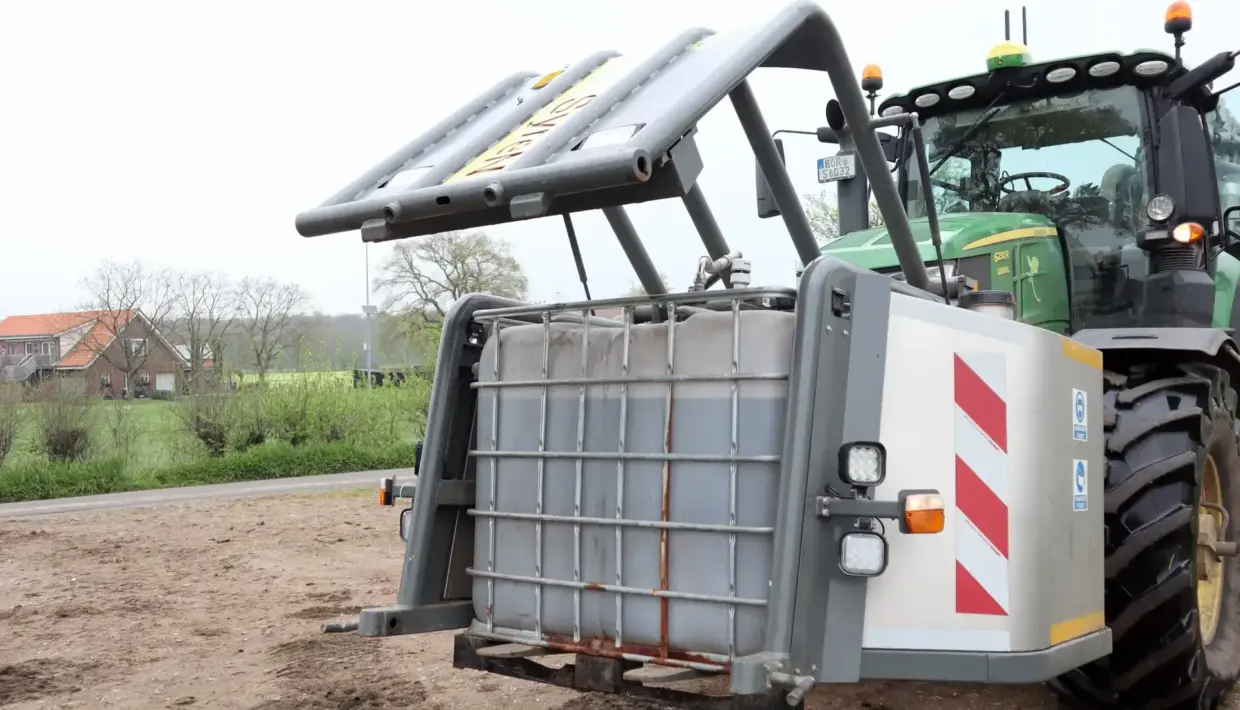
Sulphuric acid is almost twice as dense as water. Fully loaded, the front-mounted unit weighs around 3.3 t, requiring substantial front-linkage lift capacity.
The process is technically challenging: The front unit weighs around 1.5t when empty and around 3.3t when fully loaded with 1,000 litres of sulphuric acid. The demands placed on the tractor’s lifting force, axle load and hydraulic power are correspondingly high. The acid is injected downstream of the tank, and the dosage is adjusted in real time based on the continuously measured pH value. The aim is to maintain a pH value of around 6 to 6.5.
There are also additional requirements for the operator and the farm. Sulphuric acid is a dangerous good and an ADR (dangerous goods) certificate is required for transport on public roads. In addition, acid-resistant components, training and suitable storage facilities are required.
Greater flexibility, even distribution
For Stefan, the real benefit lies not so much in the increased yield as in the flexibility it provides, as acidification significantly extends the time window for application. “I no longer have to wait for rain to be forecast, but can base my decisions more on soil trafficability,” states the farmer. This could be of interest to agricultural contractors in the long term, as the slurry tanker would then not only be in demand during narrow weather windows. On Stefan’s land, which is situated in nitrate-vulnerable zones, every kilogram of nitrogen not lost to the atmosphere is valuable.
Another practical effect can be seen in the boom. The slurry foams up considerably due to a reaction with the acid. Carbon dioxide is released suddenly and the pressure in the distribution head rises significantly. “Instead of 0.4 bar, we are reaching two to four bar there,” reports Stefan. “As a result, we experience virtually no blockages anymore, and distribution across the entire working width is much more even.”
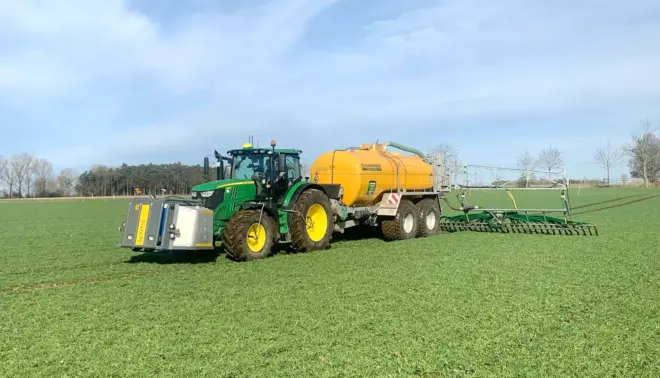
Even thick slurry can be spread more evenly in this way. The project also found that less solid ‘slurry sausages’ form, meaning that the slurry is distributed more evenly throughout the soil. However, problems can arise if a tank is almost completely emptied and the acid dosing system is not disabled in good time, so the tank is not subsequently flushed with slurry. In such a situation, the acid concentration in the distribution head can rise sharply.
Focus on costs
With investment costs of around €100,000 (£85,700), the technology is most likely to be adopted by agricultural contractors. “It is difficult to justify the purchase on economic grounds for normal operations,” says Stefan. He is using the SyreN system himself as part of a trial partnership: The equipment is provided for him, while he pays for the sulphuric acid himself. He considers a surcharge of around €15/ha (£12.85) to be realistic for such a service. In addition, there are the acid costs. Beyond that, he expects a limited willingness to pay among many farms.
Distribution across the entire working width is much more even.
Stefan Vogelsang

Tim comes to a similar conclusion: “Because not every application should be acidified and not all organic fertilisers react equally well, the system must be utilised as fully as possible.” Furthermore, digestate often has a high buffering capacity and therefore requires more acid to reach the target pH.
The level of adoption is still limited. According to information from the project, around 14 SyreN systems were in use in Germany in the spring of 2026, although there is significantly more interest than the number of machines would suggest. Besides costs and technology, public perception also plays a role. “If you have a hazardous goods sign on your tractor, people look at you critically,” says Stefan. It will therefore be crucial whether acidification receives more political support or is recognised in regulatory terms. Until then, it remains a tool for farms and agricultural contractors seeking to avoid high nutrient losses – particularly where weather conditions, organic fertiliser, site requirements and costs align.