“Most people overestimate what they can do in a year and underestimate what they can do in ten.” Jeremy Groeteke, global head of IT and digital strategy for Syngenta® shared this quote attributed to Bill Gates at a conference last summer. Groeteke went on to talk about advances and different use cases for generative artificial intelligence (e.g. ChatGPT) in agriculture. My mind, however, took me back to my high school FFA public speaking days.
I gave a speech on BT corn only a few years after the trait was commercialized for farmers like my dad to plant. I wrote that speech on a big Gateway desktop computer plugged into the wall in our kitchen and saved it to either a floppy disk or a re-writable CD. The quote Groeteke shared could not be more true in terms of technology development. That early 2000s Gateway seems ancient now. The same is true for the tools you’re using on your farms.


In the March 1976 issue of the American Furrow, regional editor Kim Allen wrote a story about electronics coming to the farm. In it, he listed industry-wide advances like closed-circuit television, portable calculators, RFID implants, and two-way radios. He also mentioned specific examples like combine leveling technology and automatic fruit sorters. If that article had been written a few decades prior, it would have included innovations such as on-farm grain drying bins and electric fences. A couple decades before that—or nearly a century ago—the list would have included hydraulic lift systems on farm implements and, simply, on-farm electricity thanks to the New Deal Rural Electrification Administration.


Grain farmers no longer need to keep their hands on the wheel thanks to auto-steer technology. Combine sensors read out the moisture, yield, and numerous other stats in real time.
Rotary milking parlors are not new. They were first introduced in 1930 but without much adoption. Today’s automatic versions, designed to maximize cow comfort and efficiency, can hold upwards of 80 cows at once.
Boehringer Ingelheim’s SoundTalks is one of numerous digital monitoring tools that help detect animal health issues.
Since the Blackberry came on the market in 1999, smart phones and watches have become ubiquitous, extremely capable tools.
Fast-forward to today, farmers like my dad and you rely on high-speed internet and phones packed with computing power to do many tasks around the farm. Words like “precision,” “smart,” and “auto” accompany much of what you touch daily.
Billions of dollars are being invested in the United States ag tech sector alone to help develop more ways for farmers to increase efficiency, effectiveness, and sustainability. The researchers, scientists, and innovators are working to curb the challenges of today’s and tomorrow’s farmers—issues like hard-to-find labor, high cost of doing business, and weather extremes.
“The advent of GPS has been the biggest game changer since I started farming in the 70s,” says my dad, Ken Knapp of Magnolia, Ill. “So much useful technology has come because of it, and what has been amazing is that we have often found different and better uses for the new technology than why it was originally developed.”


In the field
Beyond GPS and the significant developments in genetics and pest control products, farmers are raising crops indoors using specialized LED lights. Some of you are monitoring crop health with drone cameras more sophisticated than many professional photographers use and then applying crop protection with variable-rate spray drones. And you are powering a In the field. Beyond GPS and the significant developments in genetics and pest control products, farmers are raising crops indoors using specialized LED lights. Some of you are monitoring crop health with drone cameras more sophisticated than many professional photographers use and then applying crop protection with variable-rate spray drones. And you are powering a lot of your operation and those at the other end of the line with alternative energy.
In the barn
In that same 1976 issue where the article reprinted this month ran, other articles detailed how farmers were finding success with artificial insemination in swine and beef embryo transfers. Now producers are speeding up genetic progress with genomics testing and phenotype measuring.
You can also use countless tools to measure animal health based on the sound inside the barn or data being captured by wearable devices, much like the smart watches we wear. And barns equipped with robots at nearly every turn—from feeding systems to sorting and grading stations—are quickly becoming the norm.


Glyphosate-resistant corn came on the market in 1996. Since then, many traits have been developed and the U.S. average yield has gone from 127 to 187 bushels per acre, according to the USDA.
Variable-rate technology introduced in the 1990s helps farmers reduce input usage.
Like corn, soybean genetic technology advances have led to a 68% yield increase in the USA since 1996.
Tool not replacement
While writing this article, I was on a press tour visiting farmers and researchers in Kenya. There, the International Livestock Research Institute communications lead, Michael Victor, summed up the changes since Allen’s 1976 article. “Fifty years ago, the focus was on the Green Revolution and feeding everybody, so really on productivity. But now, as we know, a lot of the issues are food system and climate related, so we’re really focused on how we increase productivity and feed the growing population without destroying the environment,” Victor says. His team is the livestock-focused arm of CGIAR, a global ag research partnership working to improve food security.


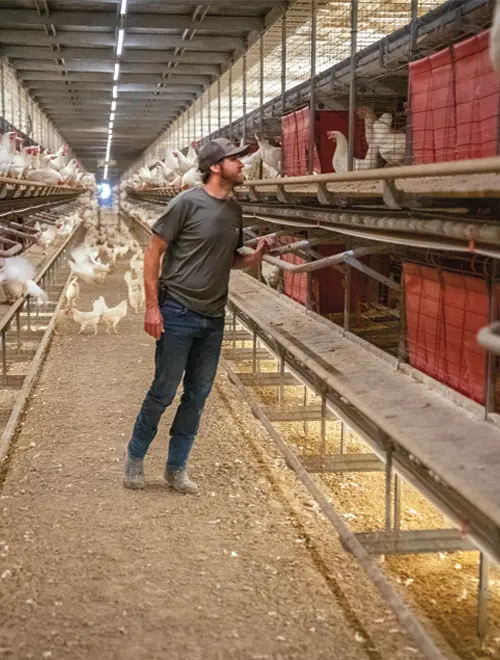
On the same trip to Kenya, the general manager of a large poultry farm said a very important and universal caveat about all the technology he employs. “Not one of my farms is the same, so I have to adapt to each different situation. If I use too much technology, it takes the farming and the fun out of it. You must be hands-on,” says Nicolas Grobler while showing me around his laying hen barns. “God’s given us all the five best computer systems that we can have. I don’t need a fancy computer in the chicken house to tell me there’s something wrong. If you just observe, smell, taste, feel, the chickens will tell you what’s wrong.” Fifty years from now, our smart phones will likely seem as quaint as portable calculators do now, but knowing where to draw the line with technology use will be just as important.
The 1976 article from The Furrow
In the American magazine The Furrow, regional editor Kim Allen wrote an article in March 1976 about the advent of electronics in agriculture. In it, he listed industry-wide advances such as video surveillance, handheld calculators, RFID tags and two-way radios.
