
 Loading...
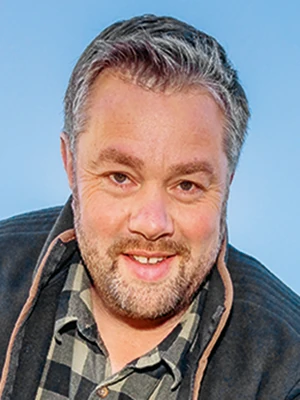
His T-shirt says ‘Curious about tomorrow’ – and it was curiosity that made Christian Højgaard Weigelt step forward in 2021, when Arla invited farmers to participate in a pilot project adopting regenerative farming.
Since 2005, Christian had run Snåstrupgård, in East Jutland, Denmark according to conventional principles. The cows were loose housed, cropping was forage-based cropping, and field operations included ploughing, spraying and manure spreading supplemented with NPK fertiliser. He describes himself as the prototype of an ordinary farmer.
“It worked well,” says Christian. “But although I developed the business over time, I still needed a fresh pair of eyes on the farm. The land I took over was good and reliable for cultivation, and I wanted it to remain that way.”
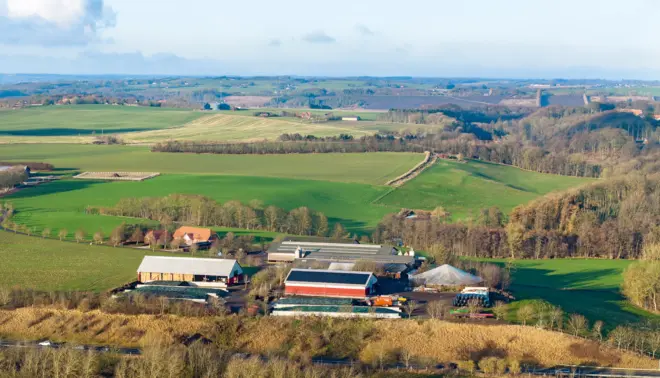
The fresh were exactly what Arla’s pilot project aimed to be. The initiative brought together 24 farmers – both conventional and organic – from five European countries, including six producers from Denmark. By the end of 2025, the goal was to assess how regenerative practices on a dairy farm could improve soil quality, specifically targeting two measures: Soil health and biodiversity.
The project brought together practical experiences into a guide designed to help other farmers move towards regenerative agriculture. External experts were involved throughout, and on the Danish farms, individuals from the independent centre for agriculture and food production, Seges Innovation P/S, were also involved.
A new approach
The main principles behind regenerative agriculture are: Minimal tillage, continuous soil cover with living roots all year, with as much biodiversity as possible and the integration of livestock. So, what has happened over the past three or four years?
After a brief pause, Christian Højgaard Weigelt begins to reflect. Reduced tillage and increased plant cover had already been on his wish list, so with expert guidance through the pilot project, he decided to commit to both. It required determination and effort, he admits. Long established routines and methods had to be reconsidered, and some familiar practices had to go.

“We previously only cultivated the land for one year at a time, plus a few catch crops, even though we are not obliged to do so,” explained Christian. “Now we prepare two-year field plans and use all aspects of crop rotation to ensure ground cover throughout the year. It’s a bigger and more time-consuming puzzle to solve. “In terms of yield, things are going well,” he emphasises. He grows 63% of the maize, grass and whole grains used to feed the 180 dairy cows. Introducing more diverse crops could increase feed self-sufficiency, he estimates, but he hesitates to act on this. For two factors come into play: Time and economics.
“It’s a choice I will have to make,” he says honestly. “It would require more work, and would a higher self-sufficiency rate economically support the extra hours?” Even in regenerative agriculture, it comes down to balancing inputs and outputs. The second item on his wish list – reduced soil treatment – is already under way. Today, 80% of Snåstrupgård’s land is managed without ploughing.
We used to think the soil was an inexhaustible resource, as long as we added NPK.
Christian Højgaard
“This suits our land,” says Christian. The soil is of the type JB6, meaning it is a heavy clay loam that retains both water and nutrients well, making it fertile. However, it can become waterlogged during wet periods and very hard when dry. Traditionally, the plough helped redistribute the phosphorus and other nutrients, making them more accessible to the roots.
It may seem paradoxical that similar results can be achieved with no-till farming, he admits. But by preserving soil structure, it creates better conditions for the micro-organisms that release the nutrients. The plough is now in storage though it has not been sold. “It’s still a good agricultural tool to have,” he says. “And it’s also indispensable if the soil collapses due to too much rain.”
A better food package
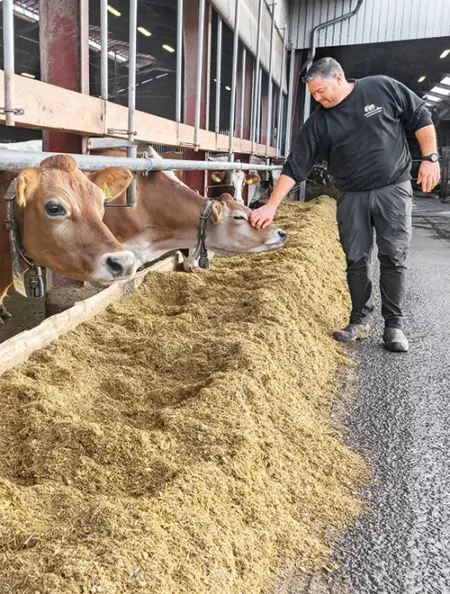
While the issue of greater feed self-sufficiency remains unsolved, Christian is increasingly considering closer integration between livestock and the field. The regenerative focus on soil quality has given him much food for thought. “We previously thought the soil was an inexhaustible resource as long as some NPK was added to it,” he says. “But in doing so, we probably overlooked the value of the entire world of micro-organisms that the soil contains. That’s where it all begins. Micro-organisms are the foundation of all growth.”
Today, the farm’s fields receive digestate from a nearby biogas plant. The added biogas step is primarily driven by climate considerations. However, Christian believes old-fashioned fertiliser from the cow shed – a mix of manure and straw – provides a better ‘food package’ than slurry.
“If I really wanted to make a difference, I would put the cows out to pasture,” he says. In the field, cows could then deliver the nutrients – and carbon – directly to the field. Altogether, grazing would create a heaven for bacteria, fungal spores and other micro-organisms that together promote soil health. The farm layout, with a suitable number of contiguous hectares around the barns, make grazing entirely possible. Eventually, Christian would like to create an entirely circular system: Soil-feed-table-waste-soil.
Increased root depth
In 2022, three field plots were selected for annual soil sampling as part of the project. Christian willingly pushes his spade into the ground to demonstrate the soil structure.
Today, a British consultant describes the soil as “fairly easy” to work with. Previously it required “some to moderate wiggling” for the spade to penetrate the ground. The root network is now denser and is better integrated with the soil. On two of the three plots the root depth has increased by six centimetres. The third plot was planted four days before the 2025 measurement and was not measured.
Micro-organisms are the foundation of all growth.
Christian Højgaard
The figures may not seem impressive, but this should be seen in light of the fact that the plots have been converted to no-till along the way. At first glance, biodiversity has not yet improved. However, the project is only three years old and needs time to show measurable change. To help things along, Christian has laid out approximately one kilometre of flower strips and installed beehives on the farm.
Patience. Patience. Patience.
Although the plough has not been sold and more crops are being considered, Christian has no regrets about enrolling in Arla’s pilot project. “It has been exciting, educational, and has given me new ideas about agriculture,” he says. Yes, some routines had to change. And it required patience; a lot of patience, as results will not be seen immediately. He sometimes had to change direction, including shifting his own mindset.
About Snåstrupgård
- 325ha, clay loam topsoil (JB6)
- 180 Red Danish dairy cows
- Home-produced forage crops
- 80% of the land is cultivated without ploughing
- Soil cover all year
“But the major advantage has been that external non-farmers were associated with the project. This provided a different environment for discussing matters,” he stresses. Is there anything he would have done differently with the experience he has gained? “No,” he immediately replies. “But it took me four years to get where I am today; I would have liked to have been able to do it in less time. It’s the old agricultural craftsmanship, just applied much more wisely.” There is no intention of going back. He remains, as his T-shirt says, curious about tomorrow.