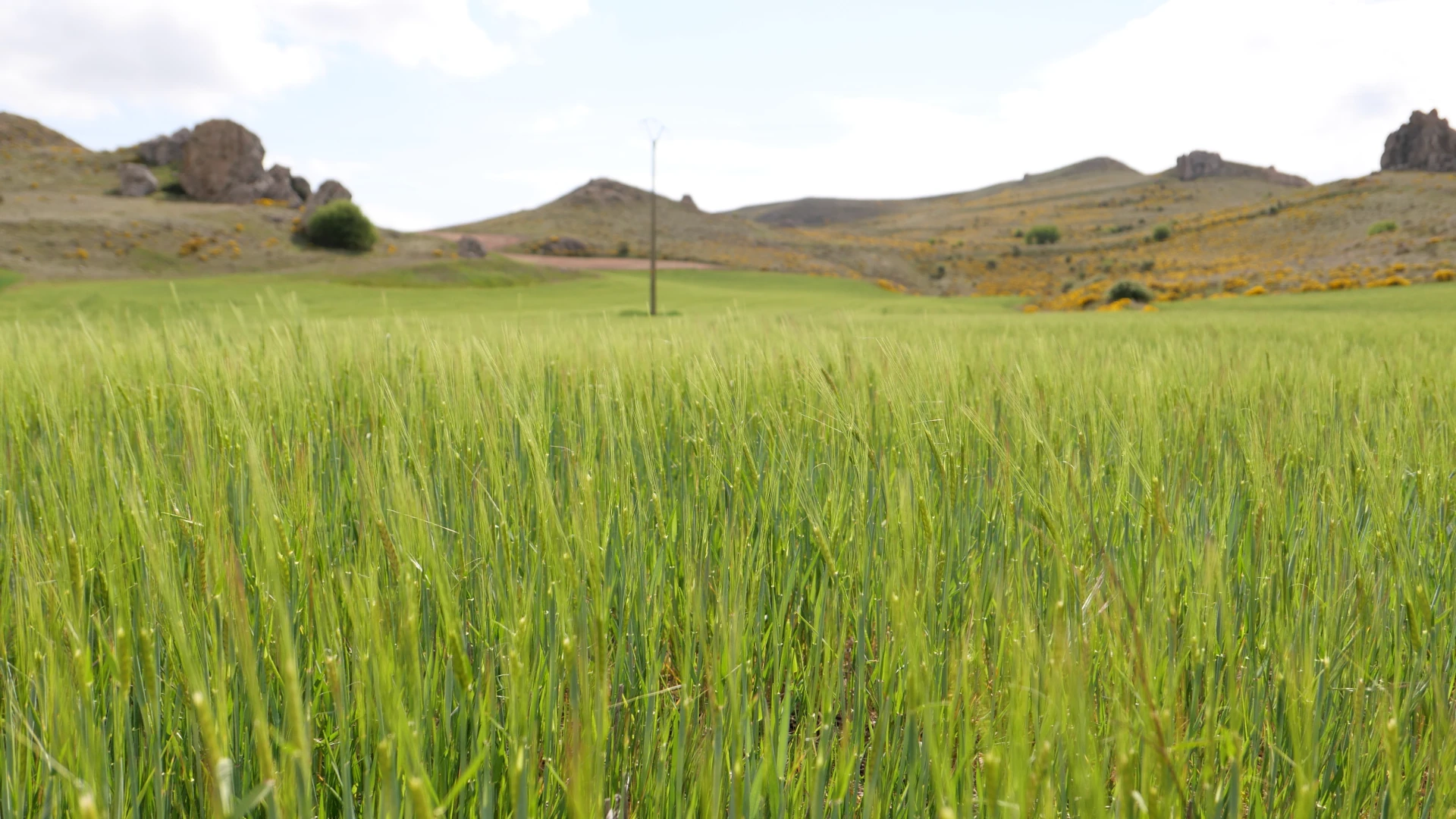
Javier Gonzalo Regaño from Beltejar, Spain farms the estates and woodlands of the traditionally Ducal Tierra de Medinaceli region (Soria). The harshness of life and the climate in the area have forged the hardy character of its inhabitants. The region has low rainfall, averaging 500mm/year, cold winters with temperatures as low as -15 °C, and hot summers commonly reaching 35 °C. The region is a clear example of ‘España vaciada’ (empty Spain); with a population density of 2.3 inhabitants/km2, it is one of the least populated territories in Western Europe.
Javier farms 150ha, mostly in Beltejar, a low-productivity area with heavy clay soils that compact quickly, and a low organic matter content of around 1.5%. According to Javier, the characteristics of the region are one of the reasons why farmer numbers are declining. “This is the village where I grew up and I have always wanted to carry on working the land like my father, but you have to juggle a lot to make a reasonable profit. An increasing amount of people are abandoning the land and their fields are being leased out,” he says.

From sheep farming to no-till
Javier grew up in a farming family of several generations with four siblings, one girl and three boys. After completing a vocational electrician qualification, he balanced his main job as a wind turbine maintenance technician with working the land. Until 2000, the family kept a flock of 800 Ojalada sheep, a small, hardy meat breed adapted to the area. The presence of sheep, once significant in the region, has gradually disappeared due to low profitability and the difficulty of finding shepherds, this was the case with Javier’s flock.
A lack of time motivated Javier to start no-till seeding, which allowed him to combine his work as a technician with the family farm. In 2012, with his brothers away in Bilbao and Zaragoza, Javier made the decision to dedicate himself to managing the farm full-time. Since then, he has managed 150ha, of which approximately 30% belongs to his family, 20% is his own property, and the rest is leased.

This is the village where I grew up and I have always wanted to carry on working the land like my father, but you have to juggle a lot to make a reasonable profit.
Javier Gonzalo Regaño
Pursuing sustainability
The term sustainability, widely used in agriculture, refers to the ability to meet current needs without compromising future ones, and is based on three main dimensions: environmental, social, and economic. In many cases, the emphasis is placed on the importance of the first two, however, ensuring the economic sustainability of farms is just as crucial. The ‘Empty Spain’ phenomenon is due, among other reasons, to the appeal of urban life for young people and the difficulties faced by farmers in some areas to make a living from their work in the countryside. Javie one of many examples where farmers work and strive to innovate so that their dedication to producing food guarantees them a sufficient income. His story is a constant struggle to make his farm profitable.
Javier’s decision to try no-till seeding was motivated by time and cost savings. Since his first trials in 1998 without his own seed drill, he acquired a disc seed drill in 2004, switching to a coulter seed drill in 2021 finding it has reduced maintenance costs. His experience with no-till seeding, which he employs for all crops except sunflowers, he says is satisfactory. “Yields are similar to those obtained with conventional tillage, but it saves time and money. Furthermore, in the wettest years I have more problems controlling weeds, but if there is little water, it holds up better.”

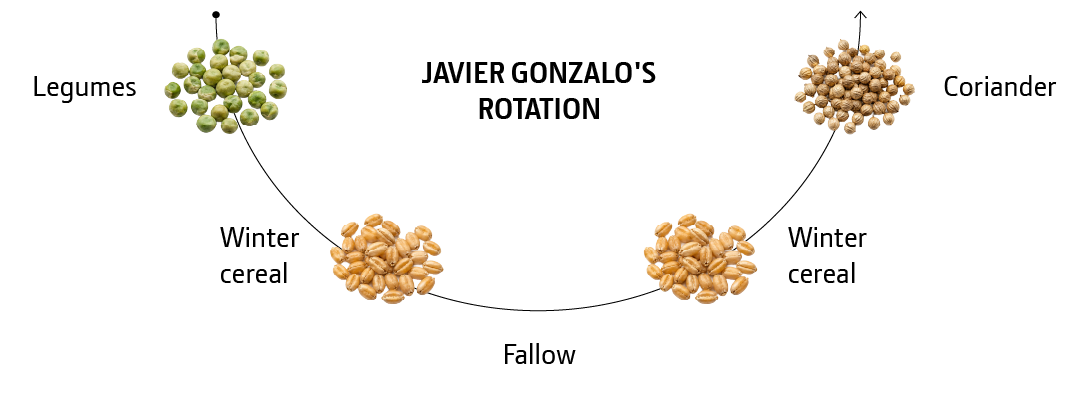
His usual crop rotation had included a leguminous crop (bitter vetch or vetch), followed by a winter cereal (wheat or barley), a fallow year, and finally sunflowers. With the farmland sited on a hunting reserve, Javier frequently experienced damage to his sunflower crop by roe deer. Despite the option of subsidised insurance covering 80% of production at a cost of around €30/ha against this, the increase in damage, especially in certain areas, combined with frequent complications during crop emergence, led him to seek alternative crops like coriander.
Fallow land, a vital water reserve
Javier recalls a particularly critical year: ”In the early 2000s, there was a year when I accompanied the surveyor to the sunflower plot, where it looked as if nothing had even been sown. When we dug into the ground you could see the stems of the plants. Those of us with farmland that is part of the hunting reserve receive compensation from them, but it is a very small amount and does not make up for the loss when crop damage occurs”.
Fallowing, to let the land rest and allow it to accumulate water and nutrients for the next crop, is a practice traditionally used in the area. Furthermore, it allows weed cycles to be broken. According to Javier, in a fallow year the soil can retain about 200mm of water, which makes all the difference for the next crop. In the case of very difficult land, two-year rotations have traditionally been applied. Historically sheep would graze on fallow plots, enriching the soil with organic matter, however, this no longer occurs today due to the reduction of flocks in the area.

The fallow traditionally practised in the area is bare fallow, with the primary objective of accumulating water in the ground. Weed control was usually carried out through tillage, using a mouldboard plough or chisel plough in spring, followed by hoeing around midsummer. In Javier’s case, he usually carries out chemical fallow, applying 1litre of glyphosate in spring and then again prior to seeding.
Modifying crop rotations
Given this situation, Javier has been forced to innovate. In his region, the way to balance the books often involves reducing costs, as production profits are tight. A few years ago, he was presented with the possibility of including a coriander crop in his rotations. This opportunity came from a spice trading company to which he sells the coriander seed he produces.
Coriander is sown in rows in February and March, although Javier mentions that other farmers in the area are carrying out seeding in November and it seems that the crop withstands frost well. Seeding is carried out with the same no-till seed drill that he uses for winter cereal. The plant is very hardy, tolerating poor and stony soils. It sprouts a few weeks after seeding and grows to a height of 40–50 cm. Small white flowers appear at the beginning of summer and the grain crop is harvested after the cereal, at the end of July and during August. “The coriander seed is harvested using a grain combine with a conventional header, simply by adjusting the air flow downwards,” explains Javier.
Adapting rotations to local conditions
The hardiness of this new crop, and the fact it is not favoured by the roe deer, have led Javier to incorporate it into his rotations, especially in areas with the highest deer population. In these cases, his rotations have changed to a leguminous crop, followed by winter cereal, fallow, followed by winter cereal and coriander.
The small grains he normally grows are soft wheat and two-row barley, for both fodder and malting. Cereal seeding usually takes place between November and December. Harvesting traditionally began around St James’ Day (25 July), although the crop is being harvested increasingly early, currently starting mid-July.
Vetch is sown in February, with the crop being harvested in mid-July. The seeding of bitter vetch takes place in November. It is also harvested throughout the month of July. In the plots where Javier continues to grow sunflowers, he carries out seeding in mid-May and harvests the seeds in early November. This is the only crop for which he does not use a no-till seeding system, instead using mouldboard or chisel ploughing followed by refining with a harrow and roller before seeding.

Coriander is a new addition to Javier Gonzalo’s crop rotation, providing an alternative to sunflowers in fields prone to roe deer damage.

Young coriander plants emerging in stony soil. The hardy crop is well suited to challenging growing conditions.
Rotation crops, requirements and yields
The crops used and the yields obtained by Javier are, as already noted, characteristic of farming with very tight margins, where profit is often achieved by controlling crop costs. For this reason, fertilisation is kept to a minimum for most crops and is non-existent for some.
As this is no-till seeding, one of the keys to the good progress of the crops is the proper control of weeds, with the cost that this entails. This investment in herbicide treatments varies significantly depending on the year. The weeds that Javier usually has to control in his winter cereal crops are brome, fescue, ryegrass and wild oats. Javier comments: “In the past, brome was not a problem in the area, as it was controlled by sheep flocks; as they have disappeared, brome infestation of the crop lands is increasing.”
As for coriander, the main weed competing with the crop is wild mustard a crucifer that is easily controlled in cereal crops but more difficult in coriander. Apart from the use of herbicides, Javier says he is learning day by day from the progress of his coriander crops and that it may be possible to minimise the impact of this weed through proper management. This year dry seeding of the coriander, resulted in delayed emergence, this could prove beneficial in the long run as the wild mustard in the plot is well ahead and may complete its cycle early enough not to affect the development of coriander.
Conclusions and future prospects
Javier’s case is not an isolated one; it is the reality for many farmers in Spain. The low profitability of agriculture in some regions, such as Tierra de Medinaceli, is undoubtedly discouraging farmers from continuing in farming and deterring young people from taking up one of the most noble and dignified professions there is.
However, Javier’s case also illustrates, through his desire to move forward in the face of current challenges, the adaptability of farmers. This adaptation involves innovation and experimentation which, just as they did for our grandparents, remain the only way to move forward and guarantee the future of the countryside.