The last harvest of the year. A combine is unloading rapeseed into a large trailer towed by a John Deere 3130 LS. The camera is shaky, and there is a pale colour filter over the footage. With these and similar recordings from 1950 to 1992, Thomas Möller now reaches a wide audience on Instagram, YouTube and Facebook. Millions of views show just how much interest there is – and more than half his audience are under 35 years old. In the social posts’ comments, tractor enthusiasts from different generations and countries share their memories, while others marvel at a farming world, they have never experienced themselves.

However, the 51-year-old engineer does not post elaborately staged videos on his channels, but rather historical photographs and Super 8 films of the Stadtgut Roggenhorst estate near Lübeck, Germany. They were taken by his father, Hans-Hermann, who documented his farm and farm life at the time for the sheer joy of it.
A farmer behind the camera
Thomas grew up in the 1980s with his four older sisters. His great-grandfather had been farming the estate; later, his grandfather and, finally, his father ran the leased farm. Hans-Hermann was not only a farmer, but also a man with a passion for technology. Whilst at work, he often carried his camera with him to capture scenes of fieldwork, machines, or moments with his family.
He passed on his enthusiasm for technology to his son, who loved nothing more than sitting on a tractor or watching repairs being carried out in the workshop. In winter, he and his father enjoyed watching the summer footage of the farm.
Stadtgut Roggenhorst Online:
Born to be green and yellow
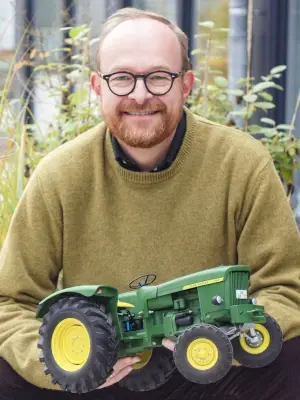
John Deere played an important role on the estate from an early stage. The connection dates back to Thomas’ grandfather, who bought a Lanz Bulldog in 1940. Hans-Hermann, remained loyal to the dealer and later opted for a John Deere Lanz 710. For him, this was the logical continuation of his previous experiences with Lanz. And the decision was to prove its worth; Thomas recalls that his father was ‘super satisfied’ with the 710. The tractor remained in the family’s possession until 2015. Today, he has even built a functional 1:8 scale model of the machine – using a 3D printer and a great deal of technical expertise.

The purchase of the 710 marked the beginning of a long-standing relationship with John Deere for the family. Next came a 3130, which Hans-Hermann saw in a demonstration on his own farm. There is even a film showing how the tractor ploughs the field. The farmer later opted for the model with a cab. Thomas found the 3130 much more comfortable; compared to riding on the mudguard next to his father on the 710, there was a proper passenger seat.
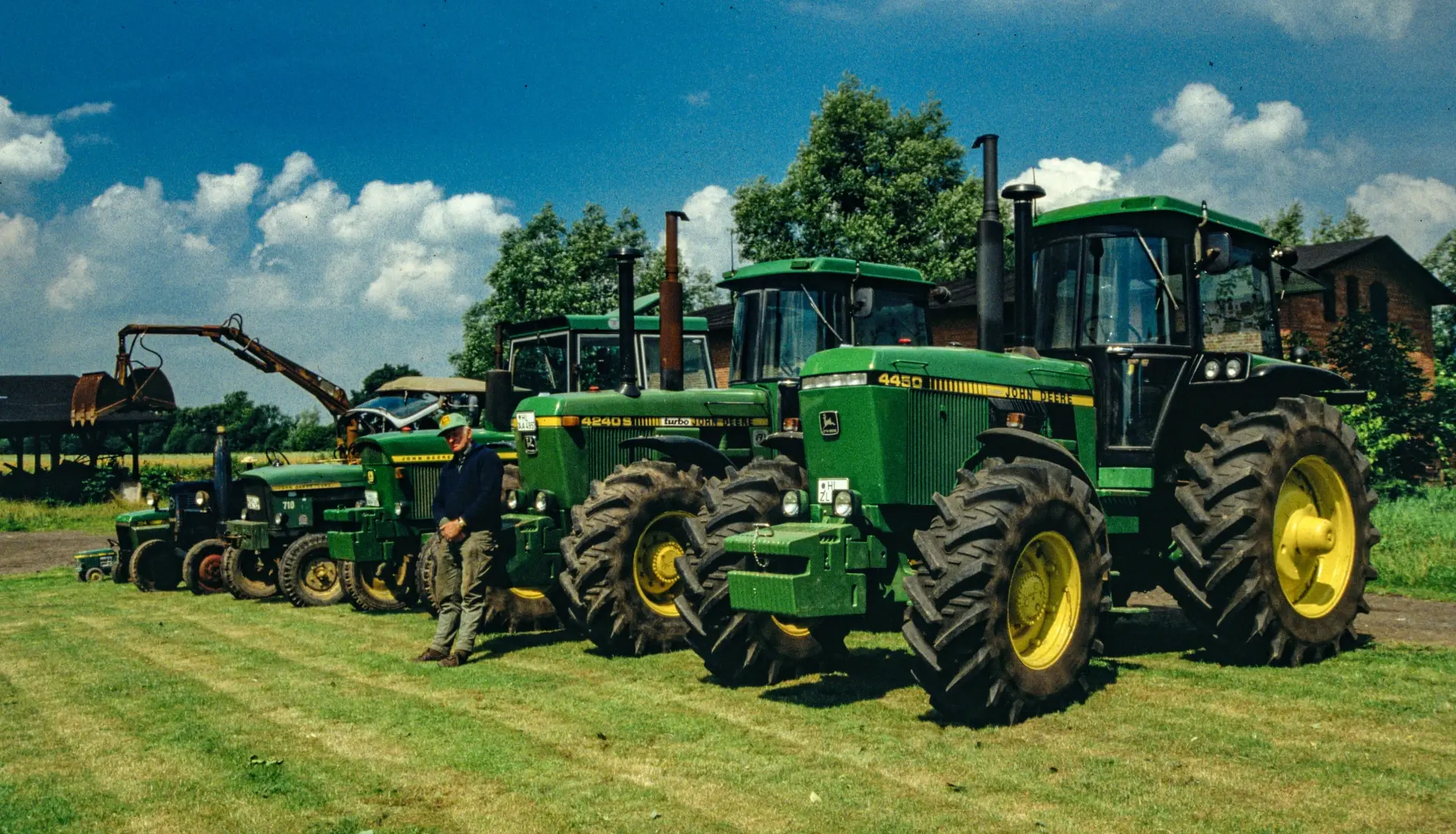
Over the years, more John Deere tractors – like the 4240 S and a 4450 – found their way onto the farm, and they even made it into Thomas’ bedroom. “I had a large poster of our 4240 S driving through the mud hanging above my bed,” he recalls. On his windowsill, he used to recreate whatever was happening outside in the yard using his models. Added to this were posters and brochures from the John Deere dealer; as Thomas himself puts it, enthusiasm for the brand had become “very, very deeply ingrained in my DNA”.

Thomas Möller in 1988—along with the John Deere 710, on which he could only ride on the fender, and the John Deere 3130, where he found a spot in the passenger seat.

Sorted by size: The entire John Deere fleet of the Stadtgut Roggenhorst estate near Lübeck in 1988.
But it was not just the modern machines that fascinated him. He was also captivated by the old Lanz Bulldogs. One of them; a Lanz D 1706 from 1954, was still occasionally in use on the farm. His father knew about his enthusiasm and gave him the vehicle for his 16th birthday.
I had a big poster of our 4240 S driving through the mud hanging above my bed.
Thomas Möller
Not everything was better in the past
The historical footage now shared brings back memories but also shows just how much agriculture has changed. Thomas is particularly impressed by the work achieved back then using low-performance machines. While the family initially farmed around 160ha, including 100ha of arable land, using draft horses, tractors and other machinery later took over more of the labour-intensive work.
From the Field to the Feed
In 1982, the John Deere 4240S rolls across the fields. Even on heavy soil, it effortlessly pulls the plow and double packer behind it. At the steering wheel is the neighbour’s boy, whom Hans-Hermann Möller trusted implicitly. The photo was originally taken as a personal memento and now captivates thousands of people online.
Comfort also improved. While older tractors offered little protection from wind and weather, later models featured enclosed, quieter cabs and air conditioning. Above all, however, the work became safer. “I see many situations that I consider to be very dangerous on the footage,” remarks Thomas who now heads up a machine safety department at his company.
A memory of his father illustrates just how hard the work used to be. He describes combine harvesting back then in just three words: “Noise, heat, dust”. Thomas thinks it is brilliant that working conditions have improved so much over time. The recordings thus document not only the history of a family and their machines, but also the changes in agriculture.
Back in action on a 1:8 scale
The Möller family’s enthusiasm for technology and tractors remains as strong as ever. Today, Thomas not only works as an engineer and shares his father’s historical recordings on social media, but has also discovered an unusual hobby for himself, model-making. Using 3D printing and a wealth of technical expertise, he brings the tractors from his childhood back to life on a 1:8 scale. He doesn’t just focus on the visual aspect: – his remote-controlled models can also drive, lift loads, and even tow a fertiliser spreader. Thomas also demonstrates online just how well this works.
The vehicles are selected in a very targeted manner: “I’m planning to recreate my father’s entire fleet,” explains Thomas. He has already taken an important step with the John Deere-Lanz 710; the John Deere 3130 is set to follow. Many more hours will be spent at the computer, the 3D printer and the workbench before the fleet is complete again. But in this way, bit by bit, the machines that his father once captured on camera are returning – this time in miniature.

Almost like the real thing: The remote-controlled 1:8 scale model of the John Deere Lanz 710

Lanz-Bulldog D1706 and Lanz 710 – Scales of 1:32, 1:16, and 1:8