The sun starts blazing in the Cederberg Mountains as early as 9am. For this reason, the harvesting of rooibos bushes in South Africa’s semi-arid Western Cape province begins in the early hours of the morning, shortly before sunrise. Around 150 workers then fan out across the Slabbert family’s Khoisan Tea Farm to cut the rooibos. It is hard manual labour.
Using sickles, the seasonal workers – many of whom come from the neighbouring country of Soweto – tackle the thin branches and small needle-like leaves of the diamond-shaped bush. They then pile the severed ends, which are around half a metre long, into 25-kg bundles that are wrapped in fabric for transport.

Harvesting, cutting, fermenting
A few hours later, the freshly harvested crop arrives at the farm. Everything is humming; The beginning of March is peak season. The green branches of “Aspalathus linearis” are fed into machines that chop the tea into short pieces using rotating blades. The workers transport the short-cut tea to the large yard, where it is laid out in small fermentation heaps.
A little later, the raw material for the globally popular tea is gently moistened with water. To further stimulate fermentation under the open sun, tractors drive over the fresh shrubs and leaves several times. The green material is then carefully spread across the open area. After just one night and a few hours the following day, the developing tea takes on its typical rust-red colour – nomen est omen (the name is a sign). Immediately afterwards, it goes for further processing on site.
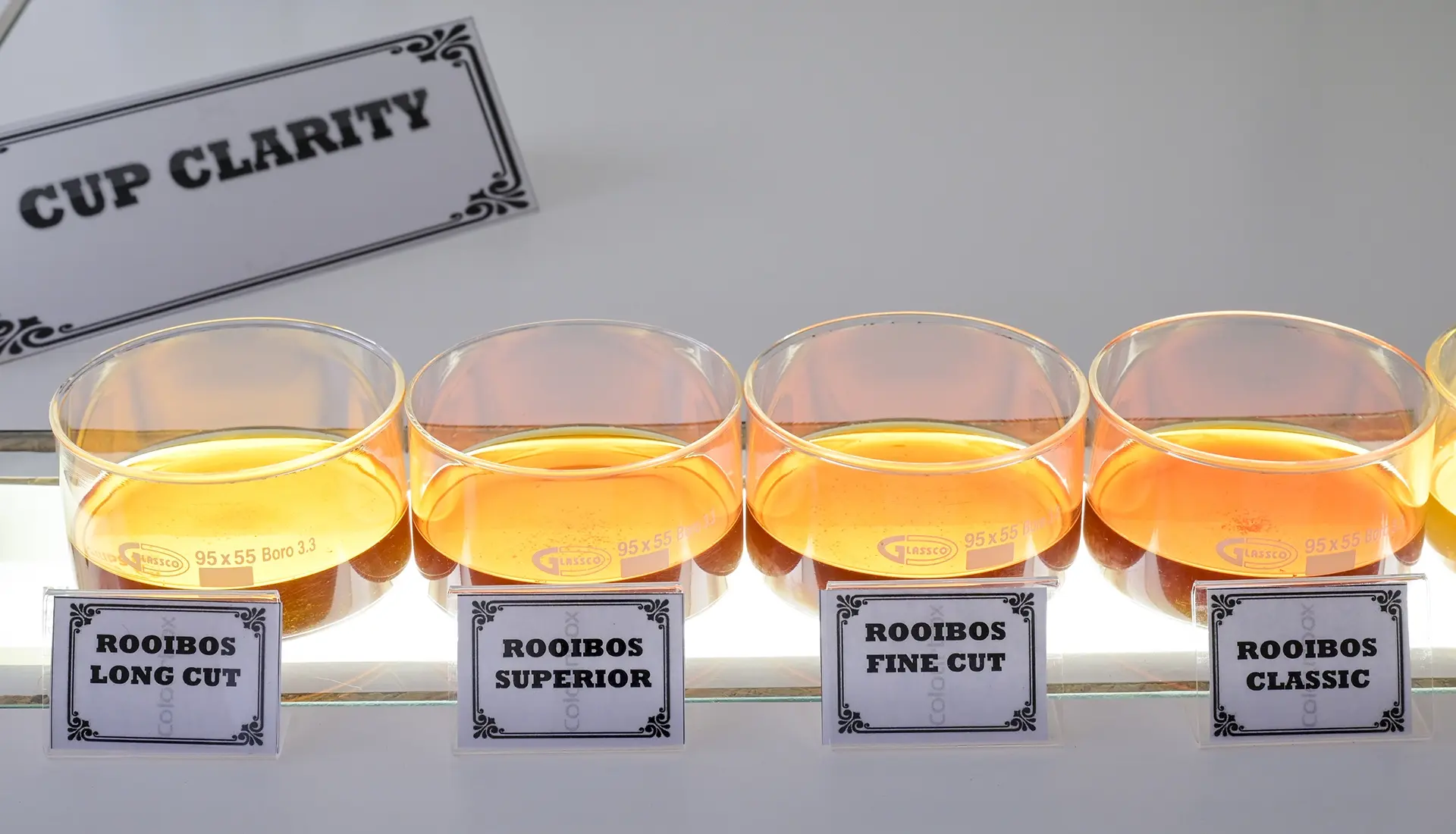
To achieve the quality that consumers recognise on European, Japanese, or North American shop shelves, the tea must be extensively screened and cleaned in the processing halls. In addition, experienced experts finely classify the individual batches according to flavour and meticulously sort them into sizes (Long Cut, Superior, Fine Cut or Classic).

“We are really under pressure!” Marten Slabbert speaks bluntly in his air-conditioned office during this year’s rooibos harvest. Together with his sister Maristha Schloms, he runs the Khoisan Tea Farm, which has an area of around 4,000ha. In addition to 80 full-time employees, a further 40 to 60 seasonal workers work on the farm as required. Around 2,000ha are potentially available for rooibos, but only 1,000ha are currently being cultivated.
In addition to tea production, oranges play a major role on an intensively irrigated area of 70ha, and there are plans to expand the plantation to 150ha. An investment of €12,000/ha (£10,373) is required for this. However, labour is scarce, wages are rising, energy costs are skyrocketing, and, furthermore, climate change is now taking quite a toll on rooibos.
We are really under pressure.
Marten Slabbert

“I was initially very sceptical about the warnings on climate change, but my experiences over the past five years have made me change my mind,” admits Marten. “We have so many more days here with temperatures above 45˚C compared to before. In addition, only half the usual amount of rainfall has fallen in recent years – we only get about 250mm/year now. Apart from a single small rainfall, we haven’t had a single drop since August 2025.” the 41-year-old farmer states dejectedly.
Consequences of climate change
The lack of rain is visibly damaging the rooibos. Anyone driving through the valleys around the pretty little town of Clanwilliam, framed by bizarre, archaic mountain formations, will repeatedly see withered bushes on the sandy rooibos plantations. In fact, many specimens are currently stunted, failing to reach their usual height of around 1.5m. In good years, tea farmers harvest around half a tonne per hectare; this year, it’s often as low as 350kg.
Marten also fears that some plants will not survive the harvest cut made half a metre above the rootstock and will die after harvest. While the lifespan of rooibos plantations used to span 11 or 12 harvests, today it is only three or four.
Nevertheless, despite the adversity, the rooibos industry and growers in the region are not panicking. Although this year’s harvest volume is unlikely to exceed 13,000t; around 10,000t below the record set in 2021, South African rooibos continues to enjoy great popularity and demand – both in South Africa and around the world. This is no wonder, as rooibos; which belongs to the legume family, is a truly unique specimen in the diverse world of tea. It is only at home here, in the sandy, stony, and dry valleys with their unique flora. It is part of the endemic plant community of this region.
Even the Khoi and San; the region’s indigenous peoples in this still sparsely populated mountainous area, were aware of the benefits of these yellow-flowering, rather inconspicuous bushes. After all, rooibos contains no caffeine, is low in tannins, but rich in valuable flavonoids, polyphenols, and minerals like sodium and potassium. The tea is generally said to have healing properties.
The green variety
During the dark days of the apartheid era, the tea produced from the twigs and tender leaves was not nearly as significant as it is today. A major boost only occurred when the Western world rediscovered the health benefits of this tea, with its uniquely gentle, slightly fruity-sweet note. Suddenly, the South African tea was said to have healing and even anti-ageing powers. This led to a real boom in demand, particularly in Japan.
However, it was not the usual red, fermented variety that was sought after, but the green, barely fermented version, which fits perfectly into the Japanese green tea tradition. South African growers adapted to this consumer demand; as a result, around 15% of the total crop is now no longer fermented under the scorching sun. Instead, the freshly harvested rooibos is heated at 145°C for four and a half seconds, reducing the moisture content to 6% and thus ending the fermentation process.
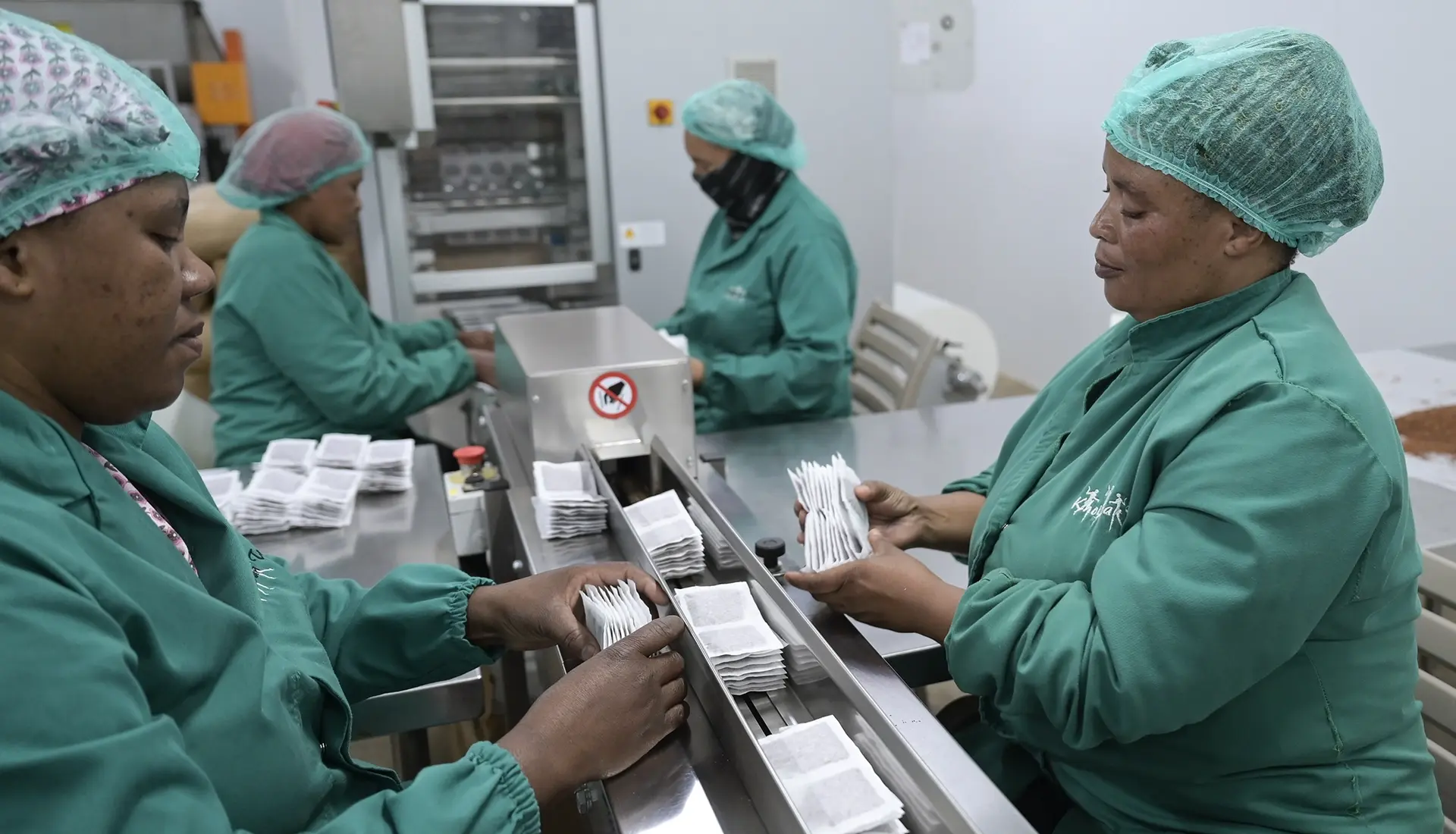
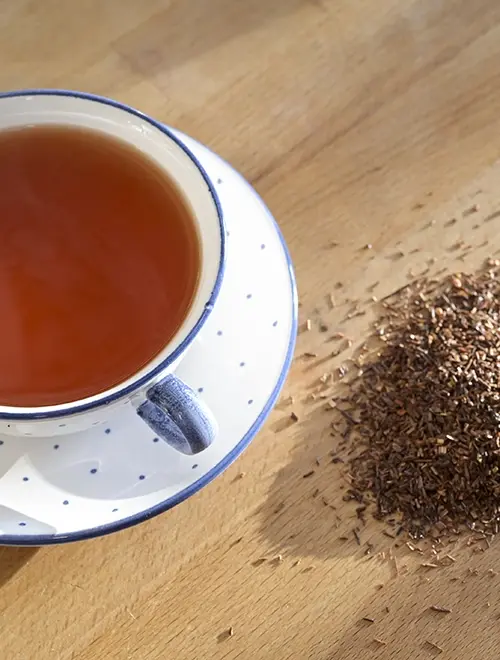
In line with the increased demand in South Africa and 50 other countries, the area under cultivation has grown considerably over the past three decades, reaching a current total of around 60,000ha. Meanwhile, some local rooibos experts, like Johan Brand from Rooibos Ltd, estimate a theoretical expansion potential of 120,000ha. In his opinion, this is sustainable and possible without major interventions in the Cape Floral Region, which was declared a UNESCO World Heritage Site in 2004 and to which the Cederberg region belongs.
Be that as it may, around 300 commercial farms, including major players like Khoisan Tea Farm and Rooibos Ltd; with areas of over 1,000ha, are currently involved in rooibos cultivation. Only 11 companies undertake further processing and have large storage capacities, and most tea growers have cultivation and purchase contracts with them.
In addition to these agreements, there are around 300 other smaller farms in the communities of Wupperthal, Moedverloor, and Heiveld. These often cultivate smaller and more remote fields. The cultivation co-operative in Wupperthal; a settlement that was founded by German missionaries in the 19th century, has its own processing facility and follows its own approach to marketing.
These are admirable individuals who cultivate their plots of rooibos on a natural plateau that can only be reached via a rocky, extremely bumpy, and breathtaking road that winds its way along the mountain slopes. What’s more, their production is certified by the anthroposophical Demeter farming association – it doesn’t get more unique than that.
Tiny seeds in sandy soil
However, all South African tea growers have one thing in common: They integrate their tea plants into a multi-year crop rotation. A one-year establishment period is usually followed by four harvest seasons, resulting in an average crop yield of two tonnes over five years. After clearing the bushes, a mix of alfalfa and rye is typically grown for the first year, followed by a fallow year and another year of rye, before returning to rooibos.
Tea farmers obtain the tiny seeds, the shells of which would only break in the wild through fire or wind abrasion, by laboriously gathering them from the plants. The seedlings are grown in nurseries and planted in the field with a row spacing of 45cm and up to 1.5m between rows. They are planted quite deep, between 15 and 20cm.
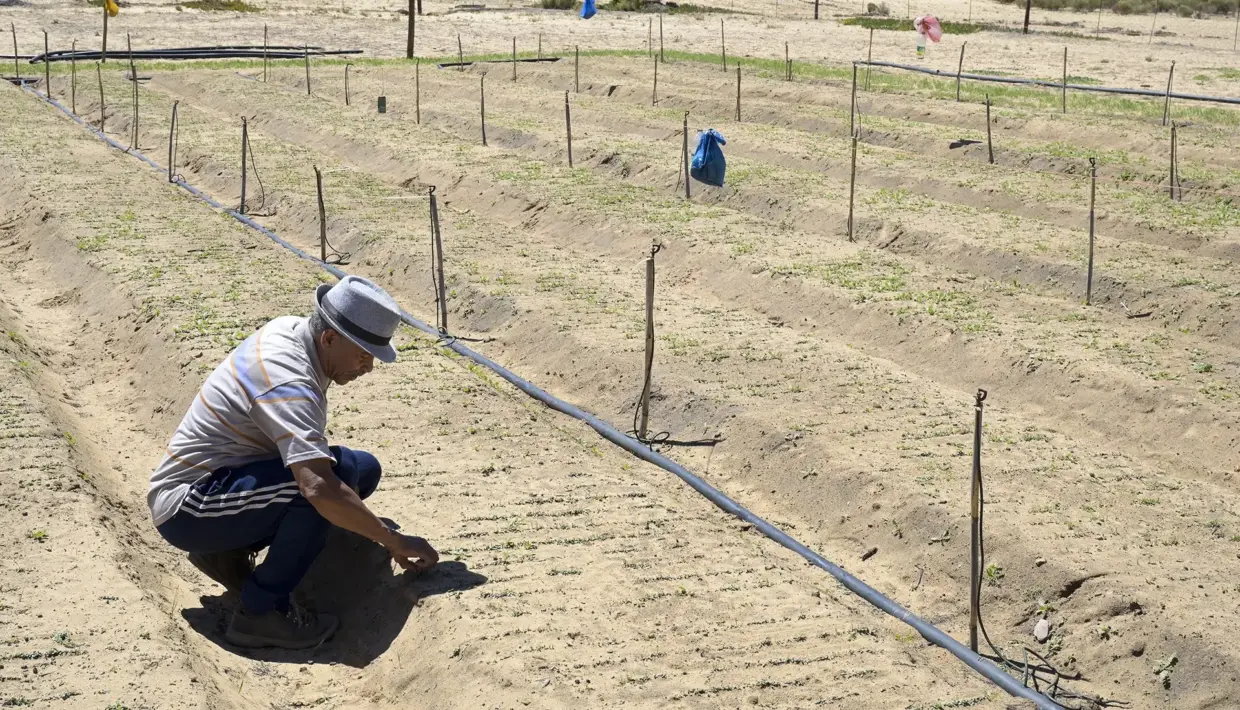
In addition to rye, there are other crop rotations in which sweet lupins, oats, barley, vetches, and vegetables like radishes or leguminous crops are grown. With the trend towards increasingly low rainfall, the quality of the soil is becoming a primary focus for rooibos producers.
Increasing the organic matter in sandy soils – whether through composting or catch cropping – is one option for improving soil quality, acknowledges cultivation expert Johan Brand. Healthy soil is often the guarantee for healthy tea plants, which can then vigorously defend themselves against insects like parasitic wasps, moths, bollworms, cicadas, or wireworms. Chemicals can be used in an emergency, but are certainly not the most sustainable long-term solution in this ecologically sensitive environment.
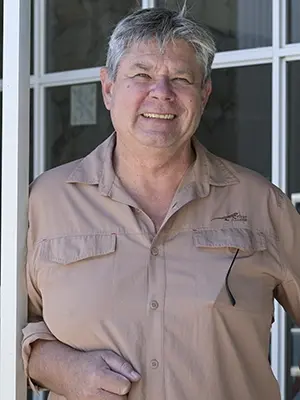
Healthy soil is important for healthy tea plants.
Johan Brand
A lot can go wrong before the high-quality, controlled red tea reaches the bag, admits Donovan Small, operations manager at the Khoisan Tea Farm. This is especially true if the cultivation is certified organic, as is the case for part of the land belonging to the grower from Citrusdal. Specialist knowledge is required to manage the risks associated with cultivation.
Diversify against risks
Farm manager Jan Hendrik at the neighbouring Skimmelberg Farm already works consistently in harmony with nature and with the help of natural resources in the immediate vicinity of a nature reserve of the same name. Compost tea is used as a liquid fertiliser, and all the land is certified organic. The farm grows about 90ha of rooibos 15ha of oranges, and buchu. Buchu? Yes, a still largely unknown newcomer among caffeine-free, medicinal teas. Its oil fetches impressive prices of almost €700/litre (£605).
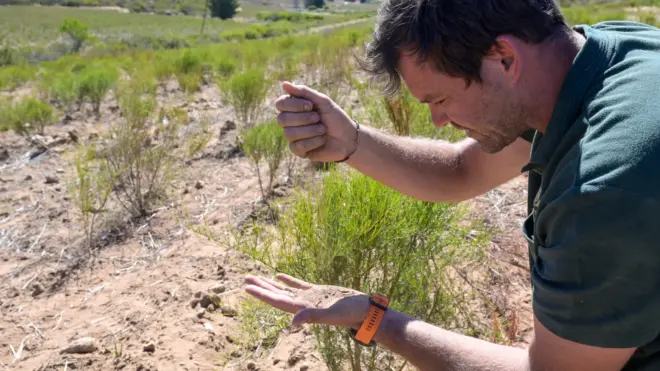
The flavour of its tea is unmistakable; not as smooth as rooibos, but with a dominant aroma. “The cultivation of buchu is still in its infancy, with only around 30 farmers working with this tea plant and a total harvest of no more than 2,500t,” explains the 35-year-old descendant of Dutch settlers who arrived here in 1654.
Jan considers growing diverse crops to be very important to manage future risks. It is therefore ideal that rooibos and buchu can be blended together in tea bags. The roles are still clearly defined: 97% rooibos, 3% buchu.
What both have in common, however, is the endemic magic of cultivated plants in an ecologically and geologically unique region. The Khoi and San peoples have long been aware of this distinctive uniqueness; their imitators who migrated here have now also recognised this and know how to use it to their advantage.