
 Loading...
It is an overcast autumn day in western Kyrgyzstan. While it snowed overnight in the breathtakingly high mountains, a gentle wind blows through the expansive walnut forests below the tree line in the valley of Arslanbob. Wilting leaves gently float to the ground while in the remarkable silence of the forest, you can constantly hear the walnuts drop into the leaves. Throughout the forest, children, adults, and entire families are gathering the valuable nuts.
The Dosibaev family sleep in tents in the forest high above the farm during the harvest period, so they do not have to walk the steep path into the forest every day. “I expect around three kilograms per tree this year,” reports farmer Bakirjon Dosibaev, who is sitting on a carpet laid out on the forest floor. Around him, his family; his wife Oyazimhon, daughter-in-law, son Bekbolot, two workers, and grandchildren are gathered together for lunch. Cheese, bread, squash and honey have been laid out, and hot tea is being served. The Muslim family speaks Uzbek, like many in the Arslanbob valley, named after a Persian from the 12th century who introduced Islam to the Central Asian high mountain region, which was later settled by numerous Uzbeks.


“Last year, the yield was considerably higher, more than 10kg per tree,” Bakirjon remarks, “but that’s the nature of things; it follows its own cycles.” He prefers to think and act in the long term, especially as he has already established a long-term lease agreement with the appropriate forestry authority for a total of 600 trees. Harvesting is not easy: Not all trees, some of which are already several hundred years old and rise over 20m into the sky, naturally shed their nuts. Bekbolot’s son must bravely climb up the trunk to the broad treetop and shake the mighty branches at height so that the valuable fruits fall and can then be harvested. This job is not without risk, as it has resulted in casualties in some areas in the past.
Nature is subject to its own cycles.
Bakirjon Dosibaev
WALNUT, HAY AND COWS
The Dosibaev family pay an annual rent of 3,700 Kyrgyz som (£31.33) to the forestry authority for approximately three hectares of forest. They use their leased area, which is fenced, as pasture for their cows and to take one cut of hay per year. “Apart from the walnuts, our 10 cows are crucial for our family income,” emphasises Bakirjon. The cows produce an average of about five litres of milk per day, which is mostly processed into sour-tasting milk balls and sold at local markets. The hay is transported to the farm in the lower-lying village by the legendary Soviet SIL lorry.
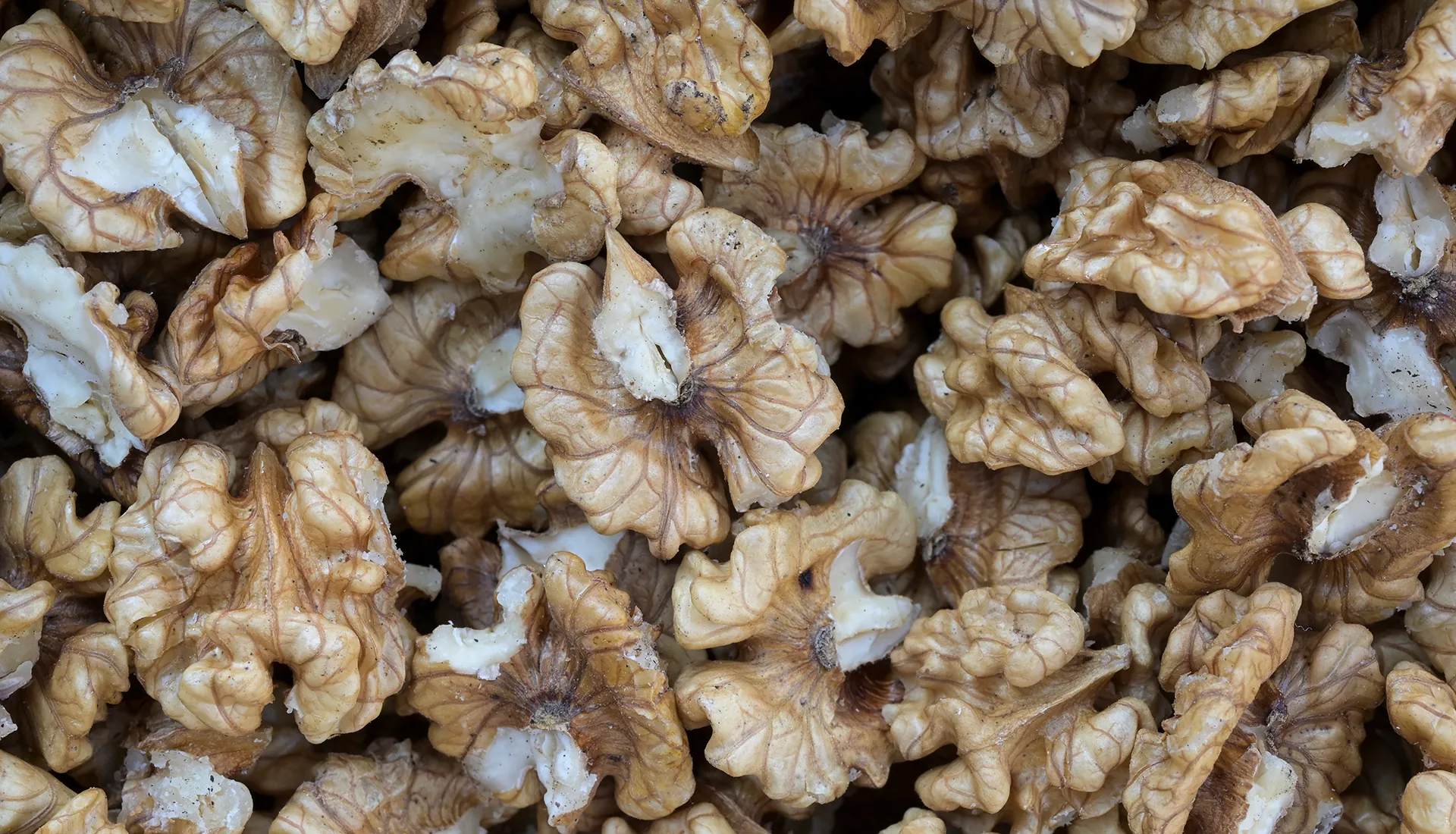
But are there too many animals grazing in the walnut forest? “Well, in our case I think we maintain a good balance between grazing and regeneration of the forest floor. However, the population in Arslanbob has grown in recent years, which does exert some pressure on usage,” admits Bakirjon. The forest spans an area of 20,000ha, with 3,600ha being pure wild walnut forest – a unique scale worldwide. The forest is owned by the Kyrgyz state and is managed by its state forestry authorities (Leschoz). “We have the task of preserving and further developing our forest,” explains forest director Keneshbek Pinazarov in his office, which exudes a socialist aura. The Kyrgyz flag in the background, the director’s desk, heavy wooden cabinet walls, and a soundproof double door evoke the Soviet era.

We have the task of preserving and further developing our forest.
Keneshbek Pinazarov
THE ROLE OF FORESTRY AUTHORITIES
Currently, there are approximately 1,000 lease agreements with farmers, as reported by Keneshbek, who has been using a wheelchair since he bravely confronted timber robbers in a brutal attack a few years ago. There are lease contracts over three terms: Five, 25 or 49 years. “If everything goes well after a five-year contract, families can choose whether they want to continue with a 25-year or 49-year lease,” explains Keneshbek. As head of the local forestry authority, he is responsible for a wide range of other utilisation options alongside the walnut contracts. These include the harvesting of wild apple, pear, plum and cherry trees, sustainable logging, firewood utilisation, beekeeping, and grazing.

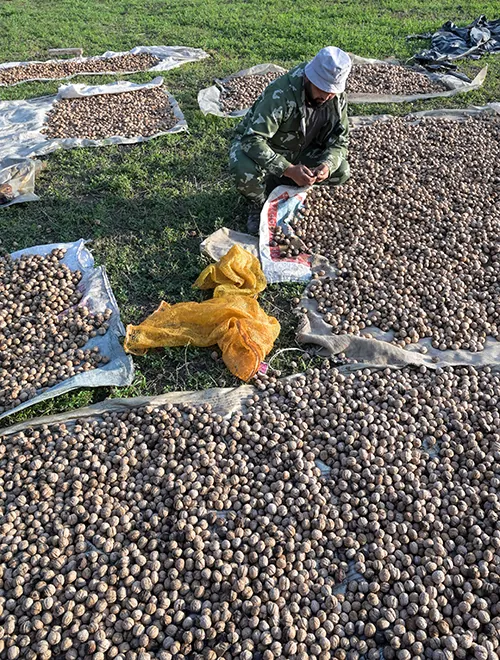
Although most farmers comply with the requirements of the lease contracts, Keneshbek observes soberly that some lack awareness regarding sustainable farming practices. Sometimes it’s also pure necessity. “We are therefore endeavouring to demonstrate that the forest floor must not be excessively depleted, ensuring enough nutrients remain for the trees, and particularly the walnuts, to be adequately nourished.” Forestry office employees are fencing off small areas in several locations within the forest to show everyone how quickly young trees can establish themselves without grazing.
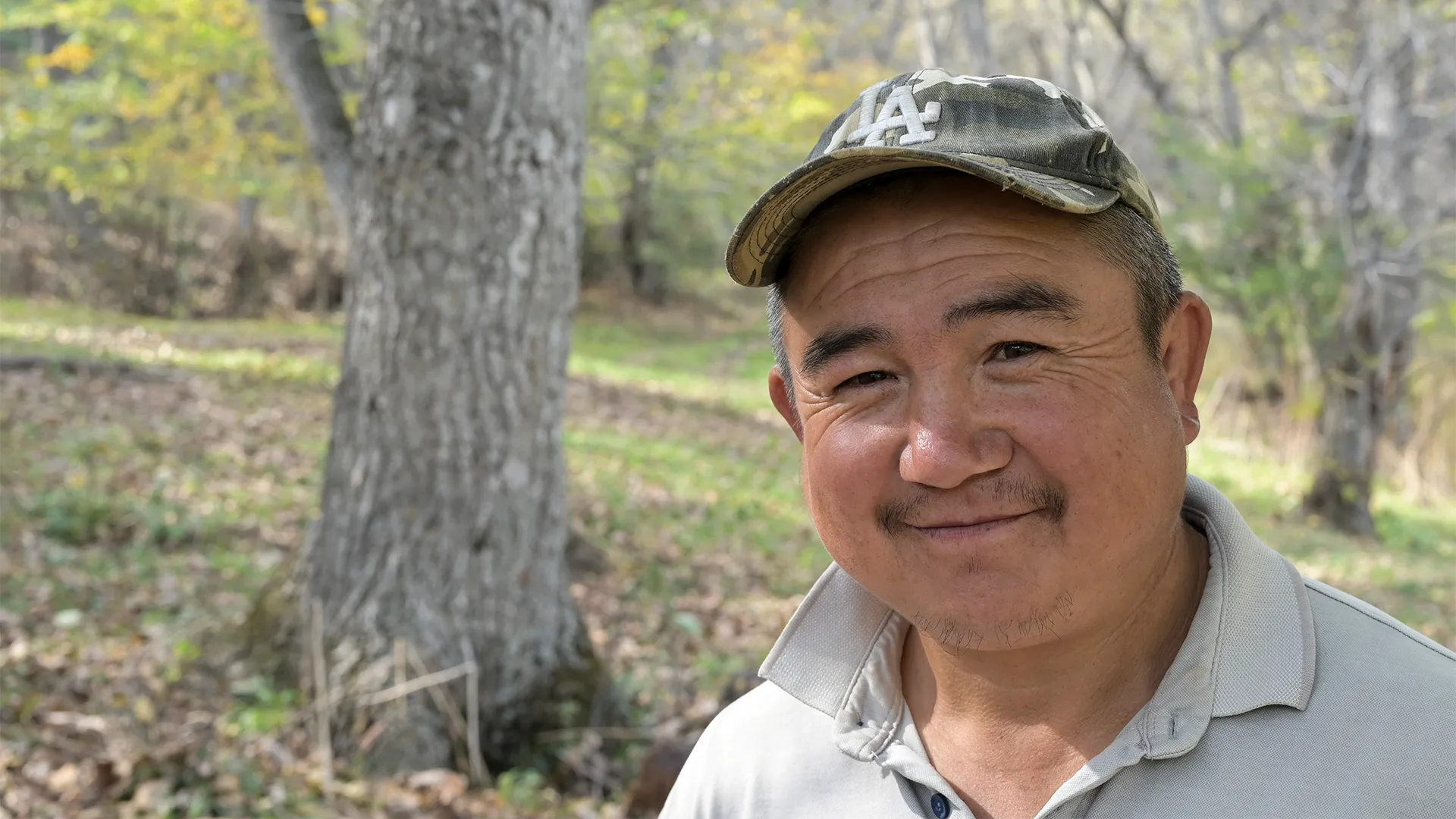
The forestry authority in Arslanbob earns 6m som (£50,810) annually from leases. And in good years, walnut farmers harvest thousands of tonnes of walnuts. According to forester Nias Kurmanbajev, in some years the harvest and subsequent processing (drying, cracking, sorting, and oil pressing) account for up to half of their total annual revenue. “Without the walnut, nothing works here,” emphasises Nias, standing in front of a tree nursery in the village of Gumhana, where pines, poplars, wild apples, wild cherries, and walnuts are cultivated. He leaves no doubt that the walnut will continue to play a major socio-economic role in the mountain region where, surprisingly, so far there has been little tourism.
SOCIAL ECONOMIC IMPACT
While walnuts are diligently collected in the forests above the settlements in autumn, the nuts in their shells are then delivered to families who specialise in cracking walnuts. In many courtyards, shielded from the street by iron gates and unrendered walls, and in small workshops, it is predominantly women who remove the nuts from their shells or crack them. This is not automated, but by hand, one nut at a time. Many people use a small hammer, with which they gently crack the shell. This is carefully done, because intact nuts, colloquially known as “beetles”, achieve the best price upon resale. As wild walnuts, which are also organically certified, they are in high demand, especially in Europe. If the beetle is split into two halves, it is called a “butterfly”, simply because the outline resembles a moth. These butterflies also achieve more than broken nuts; all broken nut pieces are classified into a lower-priced category.
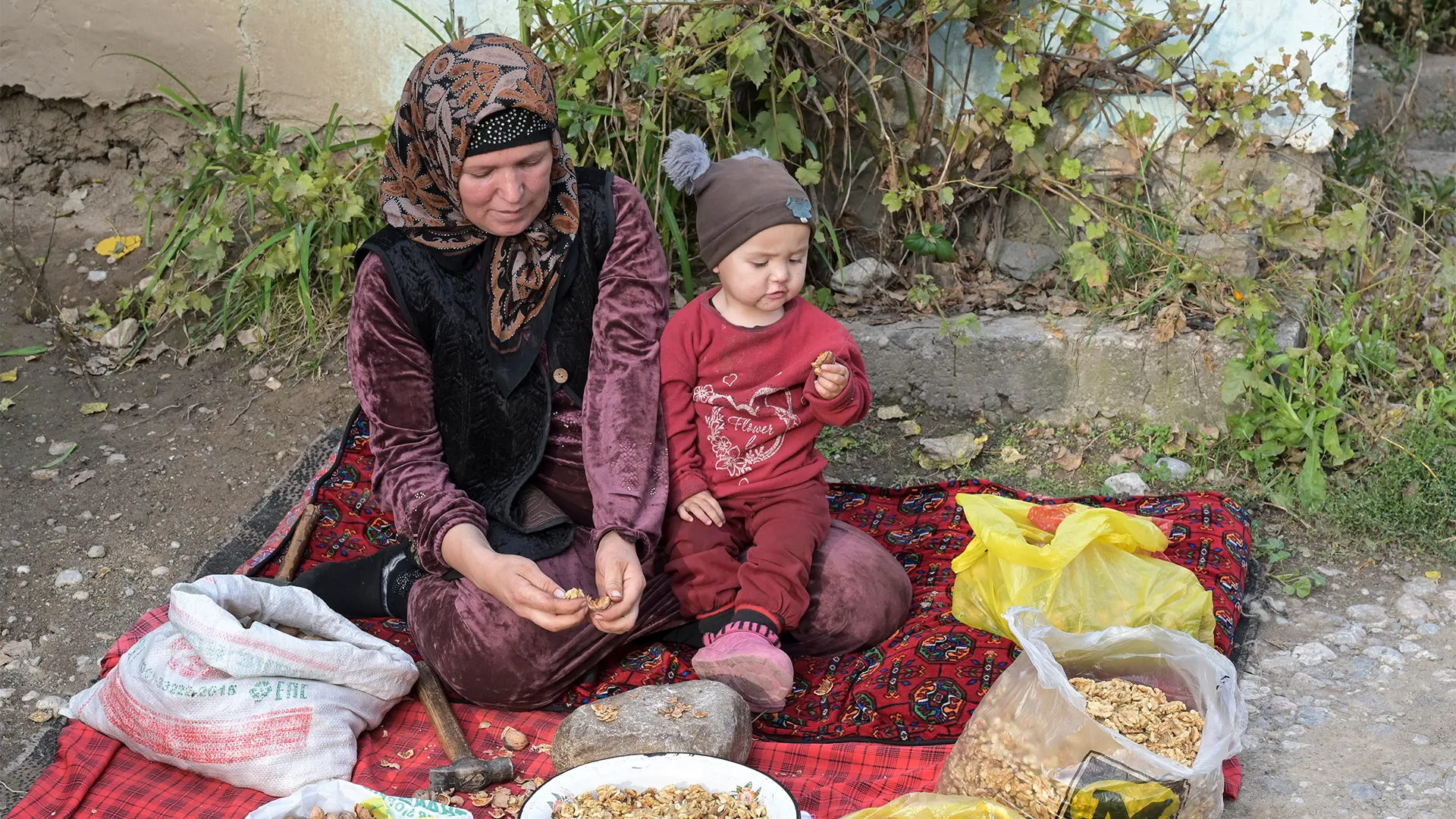
The nuts are mostly cracked by hand by women …
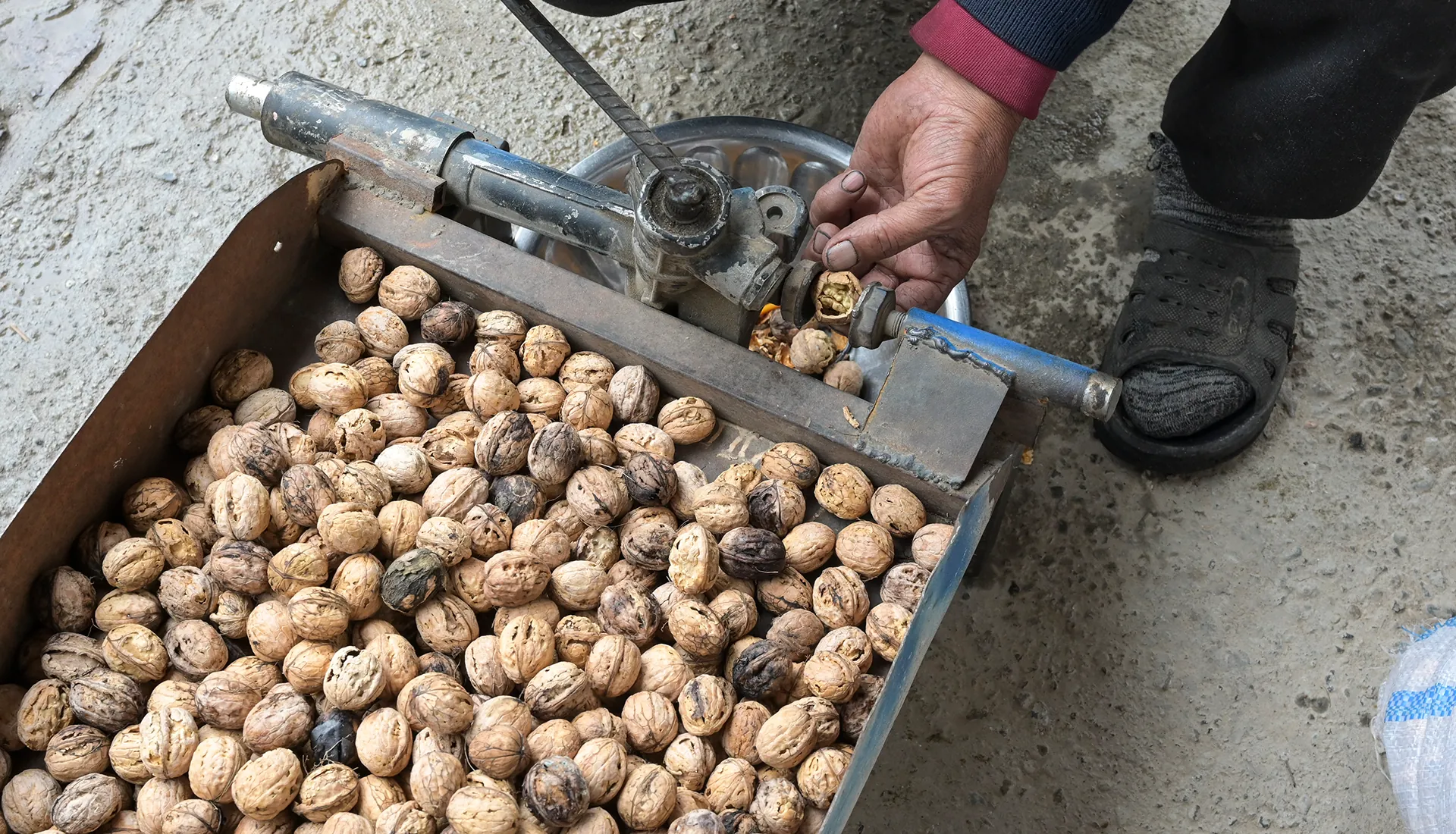
… but also in small manufactories.
A portion of this category is cold pressed into oil on-site, for example in the small mill belonging to the Kadirov family. In their grandfather’s time, a large millstone, which still stands in the same place, was moved by horse power, grinding mustard, apricot kernels, and flaxseed. For several years now, the Kadirovs have been practising cold pressing with dried, predominantly broken walnuts using a small electric mill, financed by the German Society for International Co-operation (GIZ). The family bottles around 2,000 litres of walnut oil, valued by gourmets worldwide, in 150-250ml bottles to sell at high prices in Kyrgyzstan, as well as to Japan and the US.
POST-SOCIALIST VACUUM
Ultimately, the production of walnut oil is an effort to generate new value in the region to maintain the balance – in short – between humans and the environment. Kadyrsultan Dooronbaev in the neighbouring valley of Kyzyl-Unkur demonstrates how well this can succeed. He and his family not only lease seven hectares of walnut forest, but they also operate their own wild plum drying business. More than 40 farmers harvest wild plums from the surrounding forests and deliver them to Kadyrsultan. Freshly picked, this amounts to approximately 40t annually, which reduces to 12t after drying. The devout Muslim exports his dried plums to neighbouring Uzbekistan, where his product is incredibly popular.
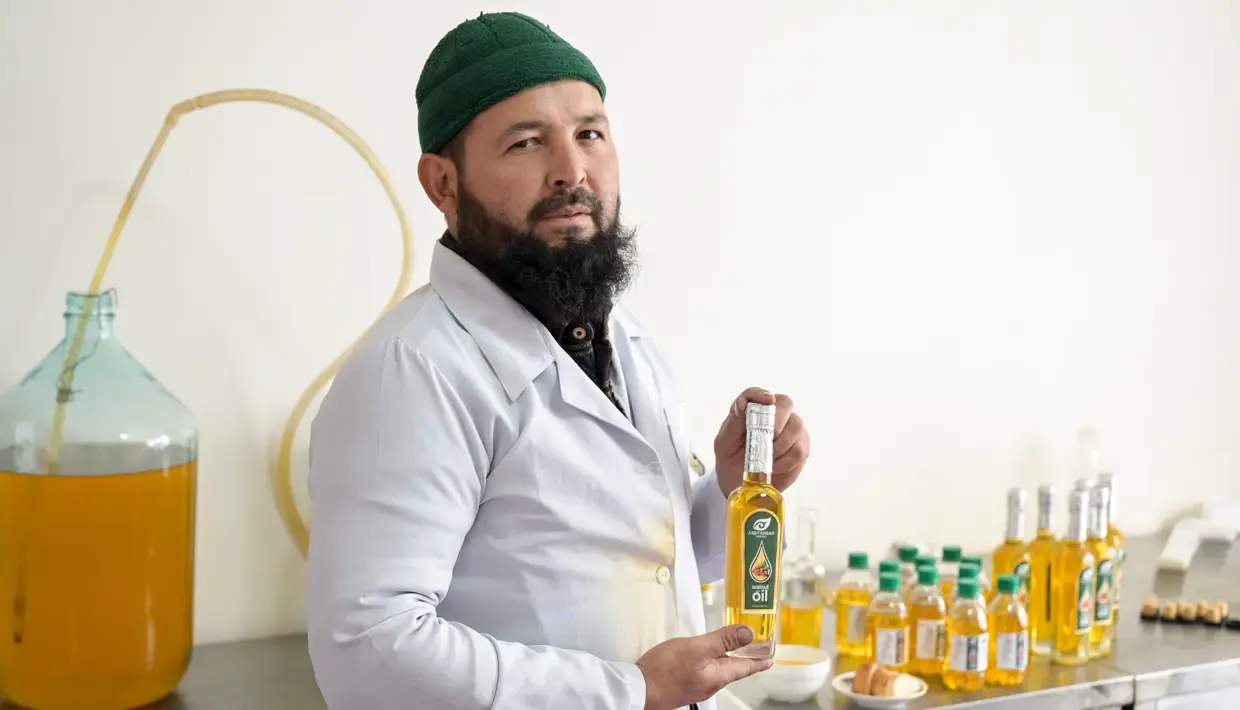
Although the complex post-socialist transformation is still incomplete, the Kyrgyz state has now managed to somewhat sustainably regulate management of the walnut forests. The era has passed when, after the collapse of the Soviet Union, a political vacuum emerged in which existing authorities lost their power, and ruthless opportunists like timber raiders took advantage of the situation by illegally cutting walnut wood, highly sought after worldwide, from the forests. While overgrazing in the unique walnut forest ecosystem continues in many areas, the problem has long been recognised: The forestry authorities are attempting to address this by terminating the leases in such cases once they have reached their expiry date. Additionally, cattle breeding focuses on ensuring that the cows of the future are better at converting feed than they are today, thereby indirectly drawing fewer nutrients from the forest soils.
The most famous Kyrgyz, the world-renowned writer Chingiz Aitmatov, who studied veterinary medicine and led the experimental farm of the Kyrgyz Research Institute for Livestock Breeding in the 1950s, also wrote on this topic. In his early poem “Am Gebirgspass,” he wrote: “Spirits of the mountains, be with us on our journey! We sit under the stars, horses flick their ears, sheep breathe against the cold stone …” Anyone wandering through the walnut forests of Arslanbob experiences precisely what Aitmatov once wrote, although even the majestic mountains of Central Asia are not immune to climate change. This is shown by the melting glaciers, which lead to water shortages in the valleys during the summer months. “Spring arrives earlier here as well; summer is increasingly hotter, autumn arrives sooner, and winter, though cold, has less snow,” summarises forestry director Keneshbek. Nevertheless, he hopes that future generations in Arslanbob will also be able to live off and with the walnuts.
KYRGYZSTAN AND WALNUTS

Kyrgyzstan has a population of 6.5m people and is approximately five times larger than Switzerland in terms of area. It is a multi-ethnic state in which the Kyrgyz constitute the largest portion at 68%. This is followed by Uzbeks at 14%, Russians at 12.5%, and Dungans, Uyghurs, Ukrainians, Tajiks, and Tatars, each making up around one percent of the total population. There is also a small German minority, currently estimated at about 12,000 individuals; two-thirds of these follow the Muslim faith.
Kyrgyzstan was a Soviet republic for decades. Following the collapse of the Soviet Union in 1991, it became an independent republic with borders adjoining China, Kazakhstan, Uzbekistan, and Tajikistan. The country is characterised by powerful mountain ranges (Tian-Shan). The tallest mountain rises over 7,000m. The vast majority of the state’s territory is over 1,500m above sea level. Agriculture is possible on only one fifth of the country’s area, primarily in the steppe-like valleys. Kyrgyz forests predominantly grow at altitudes ranging from 1,500 to 4,000m. These include the largest wild walnut forests in the world, which are primarily located in the Jalal-Abad region. Several thousand families rely on the harvesting and sale of wild walnuts.