When Friedrich Baumgärtel and his wife Kathrin settled in Wegeleben, east of Germany’s Harz Mountains, in the early 1990s to establish a farm, they were almost starting from scratch. The only existing structure was an abandoned silage pit that was previously used by the former Agricultural Production Co-operative (LPG).
Today, the farm presents a very different picture. Alongside a modern grain drying, receiving and storage facility stands a spacious machinery barn and an attractive farmhouse. At the beginning of December, the last of the grain maize has been harvested and winter cereals are sown. With fieldwork largely complete, Friedrich and his adviser Michael Eckhardt from John Deere dealer LVA Landtechnik GmbH now have time to review the season and discuss their shared passion for precision agriculture.
Friedrich manages the approximately 600ha arable farm together with his wife and two permanent employees. The farm lies in the Magdeburg Börde, one of Germany’s most fertile regions. Annual precipitation averages around 500mm in the rain shadow of the Harz Mountains. In years of sufficient rainfall, wheat yields of more than 10t/ha are achievable without excessive fertilisation. However, frequent drought and heat – especially in late spring and early summer when the grains are forming – have meant that recent yields have often fallen to around 6t/ha and sometimes lower following waterintensive crops.
To manage these specific climatic conditions, Friedrich cultivates the farm with a diverse crop rotation of winter wheat, spelt, winter and spring barley, rapeseed, sugar beet, peas, and grain maize. “Grain maize copes better with the heat than wheat,” he explains, adding that he is considering experimenting with soybean cultivation next year. To maximise returns, the farmer dries his crops himself and stores them in his own silos. Economic efficiency is also a key factor in machinery selection, with a strong focus on durability and long service life.
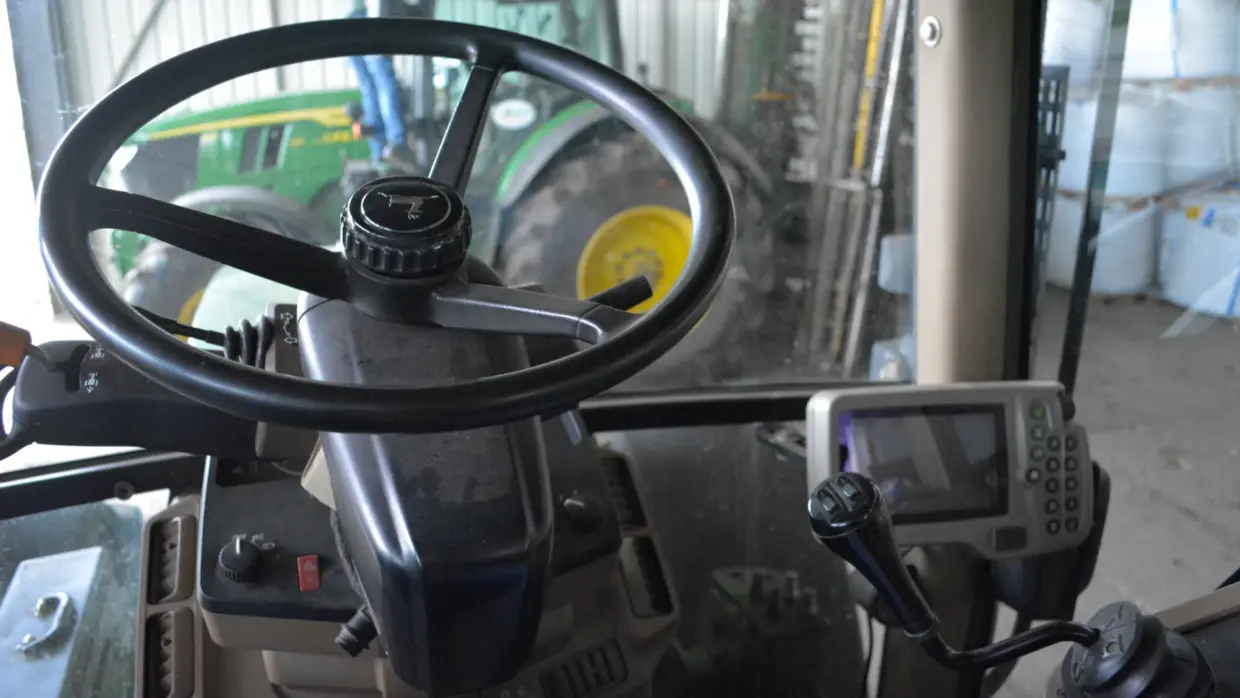
The John Deere 7810, built in 2000, is still equipped with a fully functioning AutoTrac Universal and GS1800 display.
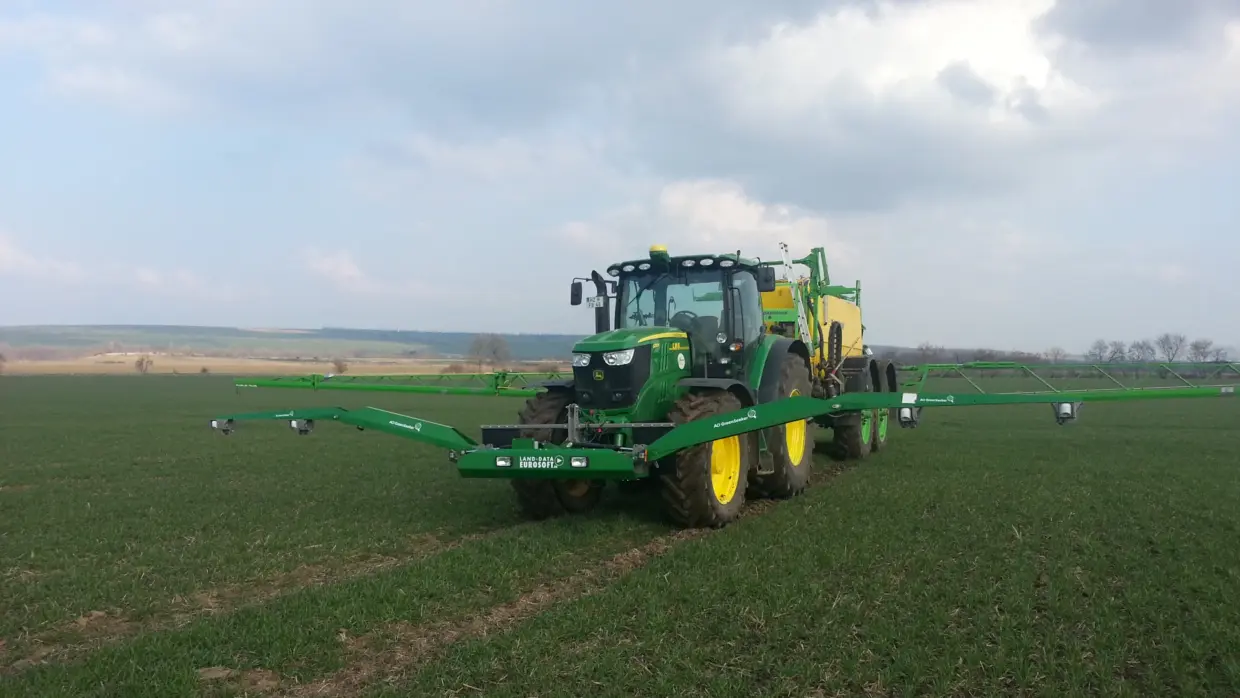
Nitrogen is applied in liquid form using a towed field sprayer and Greenseeker technology.
20 years of steering system in operation
The oldest tractor on the farm is a John Deere 7810, built in 2000, which has now accumulated more than 13,000 operating hours. Its standout feature is a John Deere Universal guidance system paired with a GS1800 display, still in use almost 20 years after installation.
A neighbour, who valued precise fieldwork and had a fitted a similar system to his Fendt tractor in the early 2000s, first inspired Friedrich’s decision. The neighbour told him how relaxed he felt even after a 12-hour working day, which ultimately convinced Friedrich to invest in guidance technology himself.
At the time, the system cost €19,000 (£16,475). “Today, the much more powerful components of the Essentials package cost less than €3,000 (£2,601) net,” says Precision Ag Manager Michael Eckhardt. This is clear evidence of how modern technology is becoming increasingly affordable and powerful.
Guidance systems are now indispensable in Friedrich operations. In addition to the 7810, two further tractors – a John Deere 8430 and a 6R 195 – are equipped with AutoTrac, as is a 6R 250 owned by a neighbouring farm with whom Friedrich shares certain operations. The same applies to the S combine harvester, which is currently being replaced.
I wanted to know how different my soils are.
Friedrich Baumgärtel
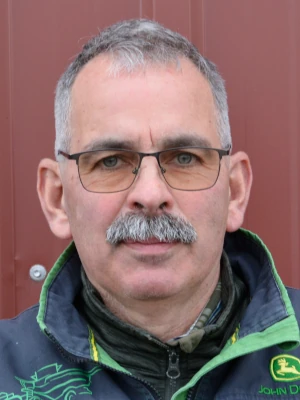
Friedrich began monitoring yields on the combine more than 20 years ago. “I wanted to know how different my soils are,” he explains. “However, it confirmed what I already knew. We have some gravel patches in our fields, and there just isn’t much growing there.” Nevertheless, this knowledge helps him. The soils on the farm are generally well supplied with phosphorus and potash, making nitrogen management particularly important. As the Fertiliser Ordinance limits the
total amount of nitrogen that can be applied per hectare, precise distribution is essential to achieve high yields and protein content on the more productive areas of the field. Nitrogen is applied in liquid form using a towed field sprayer, with application rates controlled by a GreenSeeker sensor. “When setting the upper and lower limits for the application rate, you can’t be too cautious, otherwise you won’t get any variability across the field,” says Friedrich.
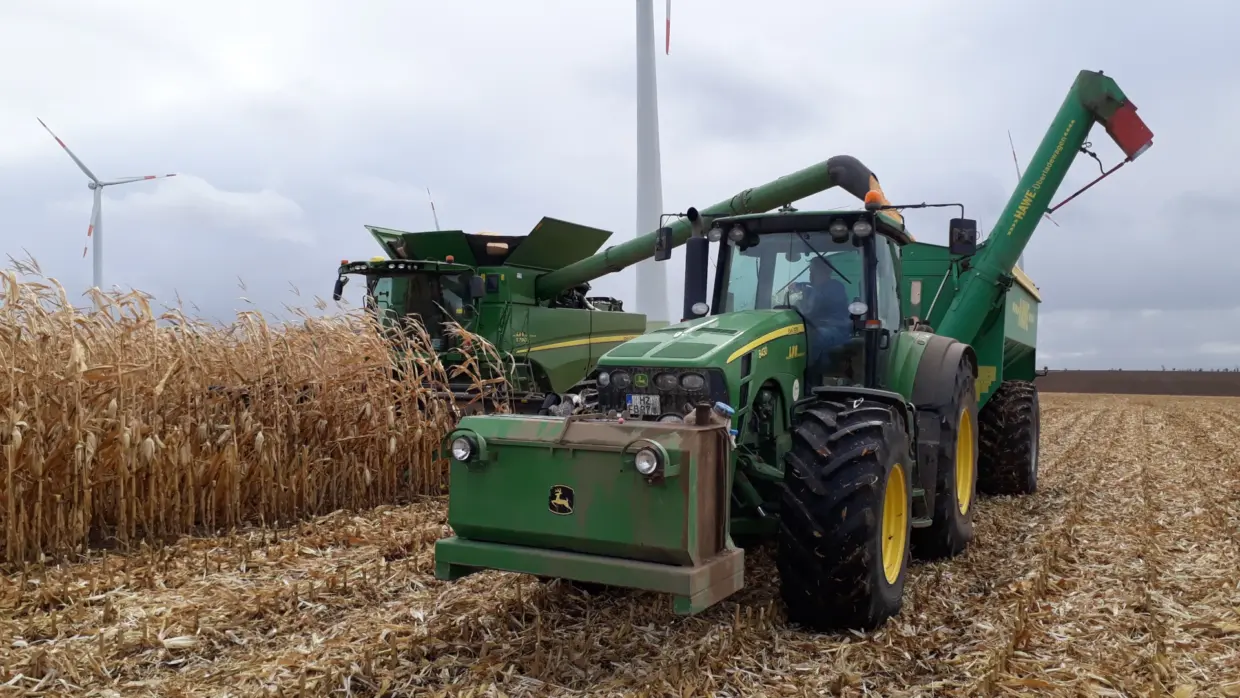
Data-driven fertilization
Friedrich has also had good experiences using drones to create weed control maps for sugar beet. Aerial surveys and mapping are carried out by a specialist service, and the resulting maps are imported into the John Deere Operations Centre.
“This means we know exactly how much spray mixture we need to mix beforehand and we also need much less herbicide, which ultimately saves money and the environment,” he says. For the past four years, a a HarvestLab 3000 sensor has also been used to analyse grain protein during harvest. While real-time data allows different batches to be separated by quality if necessary, a key benefit is the ability to analyse nitrogen use efficiency (NUE).
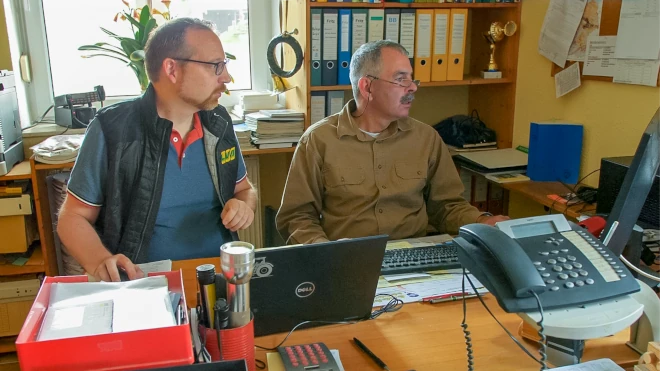
LVA Landtechnik GmbH plays an important role in this process by regularly evaluating the data after harvest and discussing potential adjustments to fertiliser strategies. Michael works closely with his partner GeoPard Agriculture, using its platform for his calculations. In recent years, an NUE of more than 90% has been achieved. “If it is lower, we examine the cause and seek possibilities for optimisation. It is also interesting to note that we sometimes exceed 100%, and we want to understand these patterns better. Even if we see that everything is in the optimal range, this is a valuable insight,” he says.
High precision despite limited resources
Although soils in the Magdeburg Börde are fertile, water remains a limiting factor. Together, Friedrich and Michael have identified the areas where precision technologies deliver the greatest benefit. For several years, Michael has been offering soil scans using gamma spectroscopy with RH3S Soil Sensor Systems through LVA Landtechnik GmbH. Friedrich receives detailed soil and nutrient maps, along with analyses of micro- and macronutrients and the pH value.
Although these scans represent a significant initial investment, Michael says they help to better understand the nutrient cycles in the soil and ultimately save money on fertiliser. In recent years, some parts of the farm have been digitised using this process.
Predicting the long-term economic impact is not always straightforward, as every farming year differs and direct comparisons are difficult. Nevertheless, both agree on one point. “Without collecting and analysing data, we wouldn’t have come up with certain questions and solutions,” says Michael. “Working with the data helps to better understand the entire operation and make better decisions.”