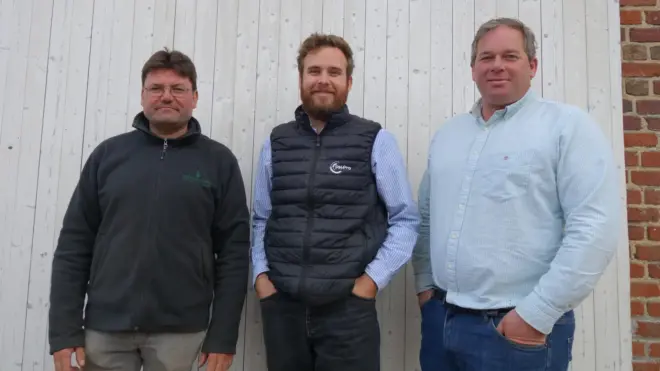
In 1993, Stéphane Lhotte and Matthieu Dupuys’ parents founded the machinery-sharing co-operative CUMA des Terroirs. The two men have known each other since childhood and naturally took over management of the CUMA when they became farmers themselves. The organisation provides machinery for its member farms and works a total of around 1,000ha. As is typical for the Hauts-de-France region, here in the Vermandois the rotation includes cereals, oilseed rape and other cash crops, like sugar beet. Stéphane and Matthieu employ just one full-time driver, which demonstrates CUMA’s high level of organisation.
2012: INTRODUCING GUIDANCE
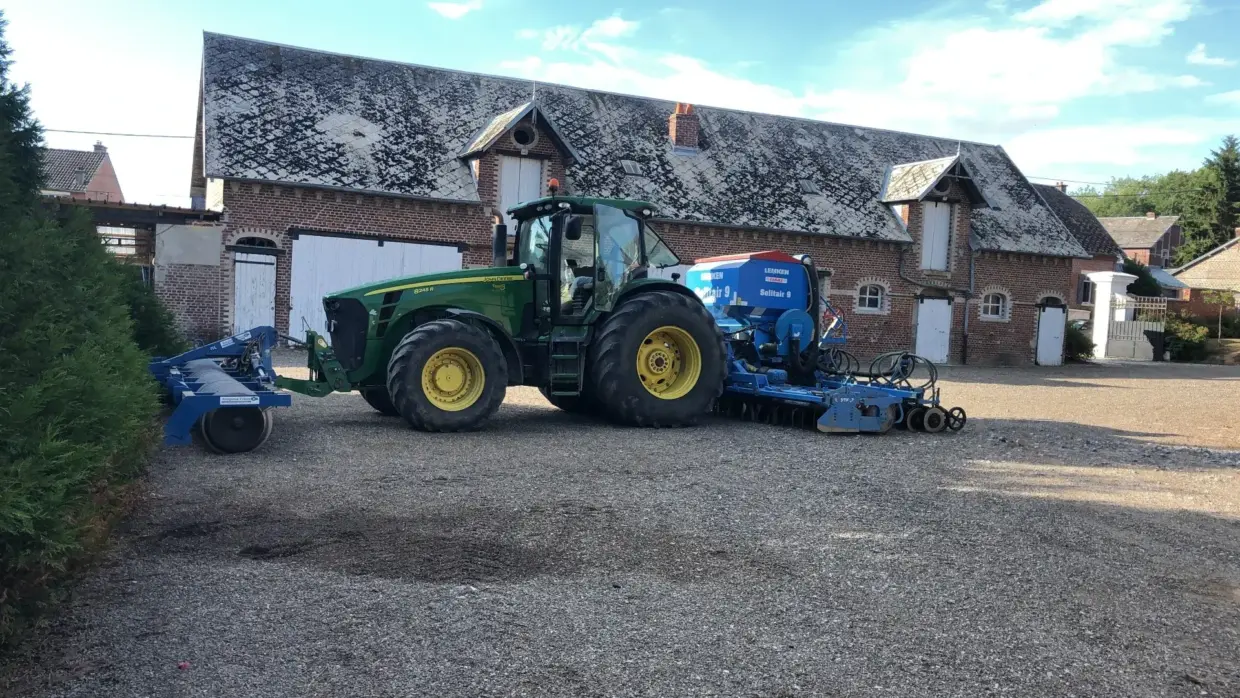
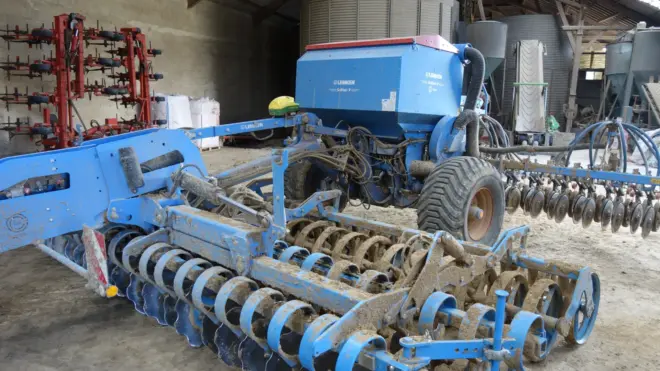
2012 was a turning point for the pair. “That year, we bought a seed drill combination with a rotary harrow,” recalls Stéphane. “It was a used machine without side markers, and the cost of fitting new markers made us consider other options. We asked our John Deere dealer, and he offered us a GreenStar 1800 display and an SF3000 receiver. That is how it all began for us.”
The famous ‘yellow dome’ (receiver) from all those years ago is still ready for work. On the day of our visit, it was mounted on a 6R 250 tractor. “At the time, we had an 8245R that was AutoTrac-ready,” Matthieu adds. “During stubble cultivation, the automatically guided tractor drove ahead, followed by a second tractor with an implement of the same working width – that was when we first saw the time savings per hectare.”
MIXED SOIL TYPES AND VARIABLE SEED RATES
In 2014, a second receiver was purchased for the self-propelled sprayer, and again, there were further time savings. But it was not until 2016, with the purchase of a new 18-row planter, that the two managers really grasped the potential of precision agriculture.
Stéphane and Matthieu had already tried varying the seed rate manually, with mixed results. Ultimately, it was not possible to maintain the prescribed rates consistently over several hours. Stéphane shows us a 1:25,000 soil map of northern Saint-Quentin, which he got from his father. Work on this map began more than 50 years ago by the Chamber of Agriculture in the Aisne département. “Today we have digitised maps of our soil types that we can upload to the John Deere Operations Centre,” says Stéphane.
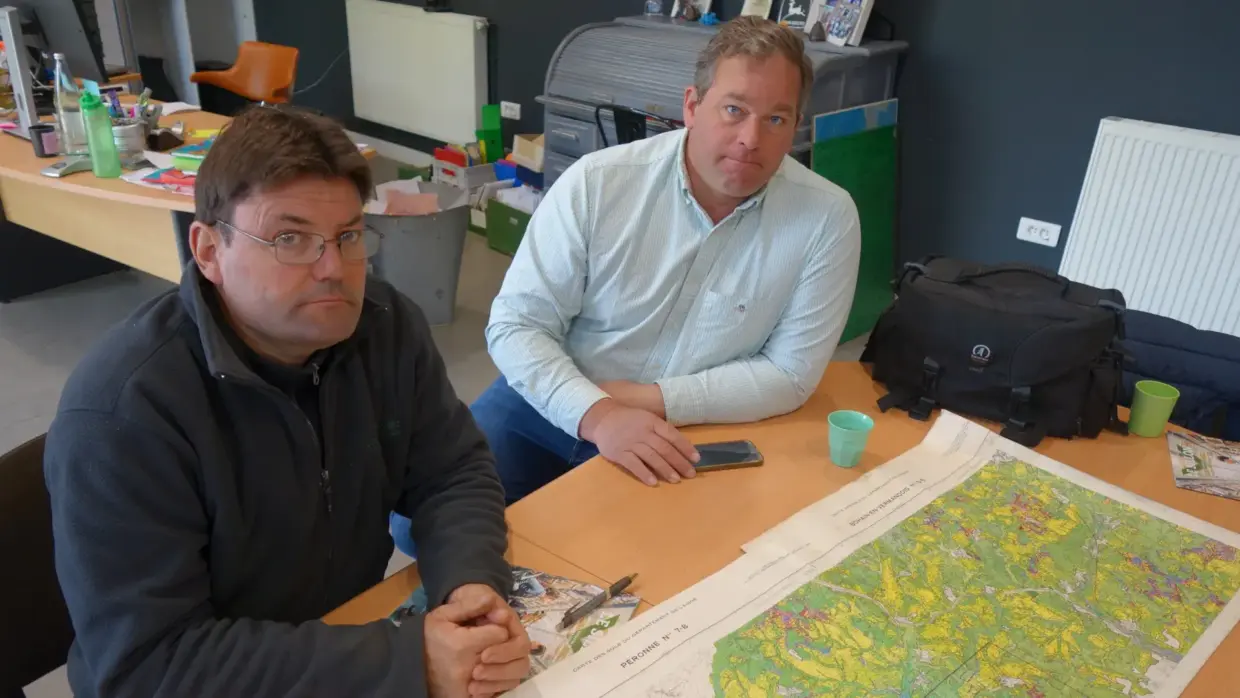
Stéphane Lhotte’s father handed down a soil map of the northern Saint-Quentin area – a remarkable piece of work carefully compiled over more than 50 years by the Chamber of Agriculture in the Aisne département.
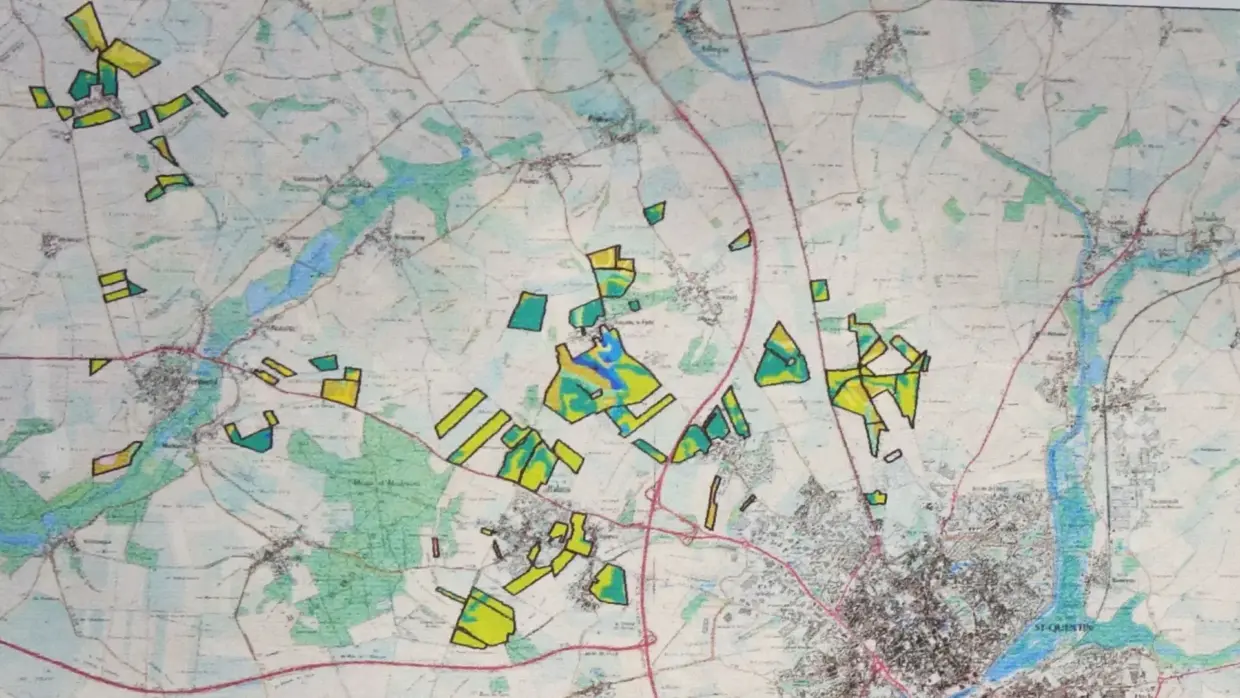
Today, CUMA des Terroirs relies on the digitised version of its soil type maps, which can be uploaded to the John Deere Operations Centre.
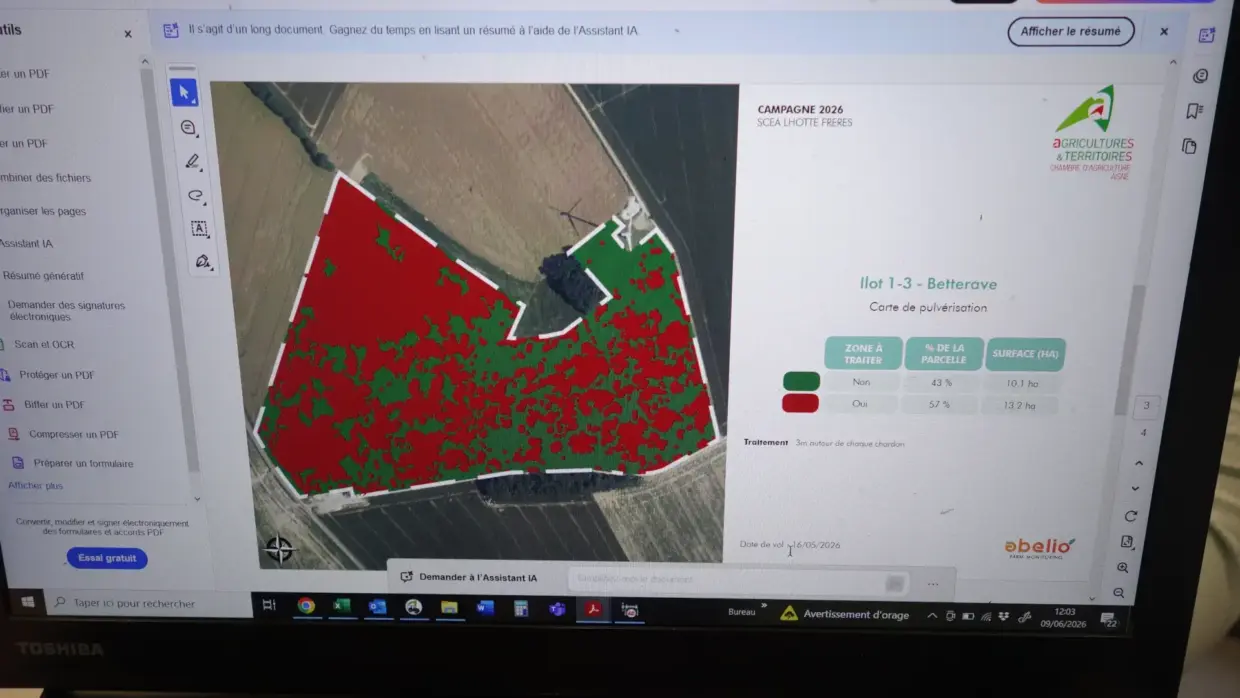
This map of a field belonging to a member of CUMA des Terroirs shows savings in herbicide use. It was created by drone, together with the Chamber of Agriculture in the Aisne département and its service provider, Abelio.
For each digitised field, the exact location of deep silty soils; which receive a normal seed rate, as well as calcareous zones; where the seed rate is automatically increased by 30%, is known. “Since 2019, sugar beet has been drilled with variable seed rates,” explains Matthieu. “Together with section control, which minimises losses from row overlaps, the crop develops more uniformly, and we have better control over seed use.”
Following the same principle of differentiated rates between silty, calcareous and sandy soils, variable-rate drilling is now used for cereals, oilseed rape and legumes too.
SOLUTIONS THAT ARE EASY TO IMPLEMENT

The step from a soil type map to an application map can be daunting for newcomers. “The specialist for new technologies at our John Deere dealer recognised the issue and trained us accordingly,” says Stéphane. “This allowed us to use variable seed rate, section control and tramline management on the drill simultaneously and directly via the tractor display, adapting drilling to suit subsequent operations with a 2.2m width.”
The Operations Centre makes it possible to integrate the soil type and adapt the seed rate accordingly. “It is easy to set up, especially on a tablet or PC because the screen is large enough,” says Stéphane. From the CUMA office in Gricourt, JDLink can easily transfer the application map to the tractor display, which is connected to the relevant implement. When drilling cereals, CETA du Saint-Quentinois provides recommendations for the number of seeds per square metre depending on the stage of the season. When drilling crops for energy production, especially sorghum, a second satellite receiver is used for auto-steer, as the length of the implement meant drift on slopes could sometimes reach up to 15cm.
TARGETED CROP PROTECTION TREATMENTS
The self-propelled sprayer has a 45m boom and is equipped with a G5+ display connected to the John Deere Operations Centre via JDLink. A successful trial for targeted thistle control was carried out on sugar beet this spring. A drone flight over the fields, conducted by the Chamber of Agriculture and its service provider Abelio, provided the basis for creating maps compatible with the sprayer’s section control. “The herbicide saving is very clear, and importing the Abelio map into the G5+ display is very easy,” says Stéphane. “Behind the steering wheel, it feels almost magical.”
FERTILISER: THE NEXT STEP?
The cost of nitrogen fertiliser and the potential savings from using precision technology are hard to leave out of the discussion. If it is not possible to apply less fertiliser, then nutrients could at least be supplied to the plants more precisely. For the two CUMA managers, the goal is clear: The right amount in the right place.
At a demonstration at their John Deere dealer PM-Pro, the two farmers were introduced to a new application developed with fertiliser manufacturer Yara. The Atfarm tool combines nitrogen rate control via a crop sensor with satellite-based monitoring of crop development. This produces an application map for variable nitrogen rates based on estimated biomass and nitrogen uptake. “The simplicity of the Atfarm system, which can be controlled via smartphone, is surprising,” says Stéphane, who would like to try it with his fertiliser spreader.
MOVING IN THE RIGHT DIRECTION
The two farmers agree: Precision agriculture is not a waste of time. “Honestly, the John Deere solutions work,” says Stéphane. “The specialists we deal with receive continuous training.” Matthieu relies on technology to address the shortage of labour, particularly when he is hoeing sugar beet, which is now significantly more precise thanks to the RTK signal, even with a somewhat older hoe.
CUMA des Terroirs entered the world of precision agriculture through guidance, and its managers are confidently continuing along that path. If there could be any improvements, Stéphane and Matthieu would like their records in the Operations Centre to be more compatible with the forms required by the authorities. Even so, they intend to continue investing in automated solutions. The applications should, however, remain simple and intuitive to use. “All time savings, both in setting up and in driving, improve the efficiency of our work,” says Matthieu. “These gains are more important than possible yield increases, because crop development depends, above all, on the weather.”
CROPPED AREA
- 500 ha Cereals
- 280 ha Sugar beet
- 80 ha Oilseed rape
- 80 ha Potatoes
- 40 ha Grain legumes
- 20 ha Maize
MACHINERY FLEET
- 5 John Deere tractors
- 1 John Deere S790 combine
- 2 self-propelled sprayers, 45m booms
- 1 precision drill with 18 rows (sugar beet)
- 1 six-metre seed drill combination with rotary harrow
- 4 ploughs
- 2 six-metre cultivators or disc harrows